

87 Views· 09/04/26· Black History
1773 Medical Stunt
The documented case comes from Grenada in 1773, where planter Alexander J. Alexander tested an enslaved African healer’s treatment for yaws against the treatment of a European-trained surgeon. Historian Londa Schiebinger discusses the case in Secret Cures of Slaves. The enslaved healer was not named in the record; Alexander called his treatment “Negro Materia Medica” and later elevated him to the plantation role of “Negro Doctor.” (Stanford University Press)
The disease was yaws, a painful tropical bacterial infection affecting the skin, bones, and joints. In the trial, two enslaved patients were treated by the African healer, while four enslaved patients were treated by the European surgeon. According to Schiebinger’s summary, the African healer’s patients were cured within about two weeks, while the surgeon’s patients were not; Alexander then gave the healer additional patients and eventually put him in charge of yaws cases in the plantation hospital. (Stanford News)
A careful correction: the record supports saying African and African-descended healers possessed valuable tropical medical knowledge that Europeans often lacked and tried to extract, test, control, and profit from. I would avoid saying “Africa didn’t need Europe to survive” as a medical claim, because the stronger point is more precise: European colonial survival in the tropics depended heavily on African, Indigenous, and Creole knowledge systems that colonizers publicly demeaned while privately exploiting. Schiebinger also notes that the cure’s exact origin is complex; it may have drawn from African knowledge, Indigenous Caribbean/Amerindian plant knowledge, or a new West Indian medical practice shaped inside the plantation world. (Stanford University Press)
The 1773 Medical Stunt — The African Doctor They Could Not Deny
In 1773, on the island of Grenada, a colonial plantation became the site of a medical test that exposed a truth Europe did not want to admit.
The disease was yaws — a painful tropical infection that produced sores, ulcers, and suffering. It was common in plantation societies where poverty, overcrowding, and brutal conditions weakened the body. European doctors had theories, chemicals, and university training. But in the tropical world of the Caribbean, their medicine often failed.
Then came an enslaved African healer whose name the records did not preserve.
A plantation owner, Alexander J. Alexander, placed this African healer’s treatment against that of a European-trained surgeon. The European surgeon treated four patients with harsh standard remedies. The African healer treated two patients using a different medical knowledge system — one rooted in plants, observation, heat, sweat, topical treatment, and practical healing.
The outcome was clear. Within about two weeks, the African healer’s patients were cured. The European surgeon’s patients were not.
This was more than a medical trial. It was a collision between two worlds of knowledge. One world claimed authority through Europe, universities, titles, and empire. The other carried memory through Africa, survival through enslavement, and healing through generations of lived experience.
The colonizer did not respect the healer as an equal. He did not preserve his name. He did not free him. But he could not deny the result. After more patients were cured, the enslaved healer was placed in charge of yaws treatment on the plantation and recorded as a “Negro Doctor.”
That title was not justice. It was proof. Proof that African medical knowledge was real. Proof that enslaved people were not empty laboring bodies, but carriers of science, botanical wisdom, clinical judgment, and healing systems.
The 1773 Grenada case shows what colonizers often did: they mocked African knowledge in public, extracted it in private, and used it when their own systems failed.
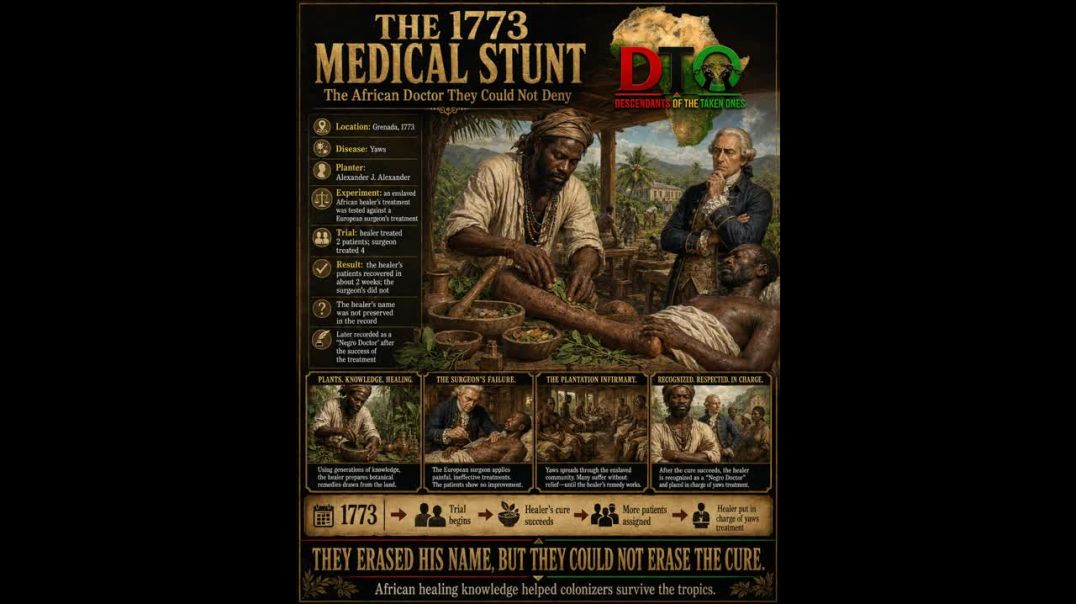
THE 1773 MEDICAL STUNT
How an Enslaved African Healer Outperformed a European Surgeon
In Grenada in 1773, planter Alexander J. Alexander tested an enslaved African healer’s treatment for yaws against a European-trained surgeon’s cure.
The African healer treated two patients.
The European surgeon treated four.
Within about two weeks, the African healer’s patients were cured. The surgeon’s patients were not.
In Closing
They erased his name, The healer’s name was erased from the record, but his skill could not be erased from history and could not erase the cure. Alexander later placed him in charge of treating yaws patients on the plantation and called him a “Negro Doctor.”
This was not superstition. This was clinical knowledge. This was African healing science under captivity.
Colonizers claimed African knowledge was primitive, but when European medicine failed in the tropics, they tested, copied, and depended on the healing wisdom of enslaved Black doctors.







2 Comments
cliprize
15 days agoJOSEPH ELISHA
2 months ago