
78 Views· 10/01/26· Black History
Daniel L. Haynes
Daniel L. Haynes
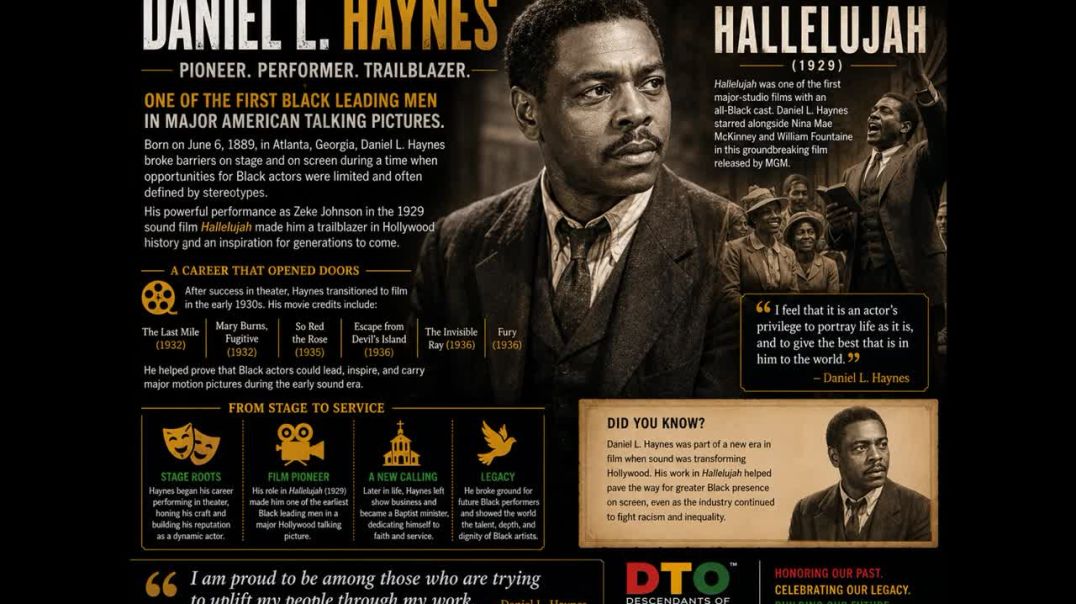
Daniel L. Haynes was a pioneering Black stage and film actor whose career reached one of the most important turning points in early American cinema: the arrival of sound film.
Born June 6, 1889, in Atlanta, Georgia, Haynes built his name as a performer during an era when Black actors faced narrow, unequal, and often stereotyped opportunities. He worked in the theater before becoming best known for his leading role as Zeke Johnson in King Vidor’s 1929 film Hallelujah.
Hallelujah was one of the first major-studio films with an all-Black cast. Released by Metro-Goldwyn-Mayer, it starred Haynes alongside Nina Mae McKinney and William Fountaine. The film was controversial for reflecting the racial limits and stereotypes of its time, but it was also historically significant for placing Black performers at the center of a major Hollywood production during the early sound era. (Encyclopedia Britannica)
As Zeke Haynes, portrayed a sharecropper whose life is marked by temptation, tragedy, faith, and redemption. His performance carried the film’s emotional weight, blending drama, music, and religious expression at a time when sound cinema was still new. The role made him one of the earliest Black leading men in a major American talking picture. (IMDb)
Haynes continued appearing in films during the 1930s, including The Last Mile, Mary Burns, Fugitive, So Red the Rose, Escape from Devil’s Island, The Invisible Ray, and Fury. Later in life, he left show business and became a Baptist minister, moving from performance to spiritual service. He died on July 28, 1954, in Kingston, New York.
His legacy is complicated but important. Daniel L. Haynes worked within a film industry that often-restricted Black representation, yet his presence in Hallelujah marked a breakthrough moment in Hollywood history. He helped prove that Black actors could carry major motion pictures, command the screen, and shape the future of American cinema.
Closing
Daniel L. Haynes stood at the doorway of sound film and helped show America that Black performers belonged at the center of the story.


![Daniel Lee Bellomy: Odyssey [Official Music Video]](https://theblacktube.com/upload/photos/2022/02/3a3a8ad56de8ebae4811f7909ff6ea2297fa5744RM4POxzrTVxgEOKA7WZZ.video_thumb_2051_11.jpeg)
![Daniel Lee Bellomy: Ain't No Hoe [Official Music Video]](https://theblacktube.com/upload/photos/2022/02/c5804b7fd399acdb5a646a4e3d2b406db5a540f8NSqCzHA4qGfgbA6L1KRj.video_thumb_6040_11.jpeg)
![Daniel Lee Bellomy: Fire [Official Music Video]](https://theblacktube.com/upload/photos/2022/02/996b93c05d40e953d0a65311c8f48b1d3ac9407bE5IRnMxHXfuWoWD7jtsc.video_thumb_1547_11.jpeg)

1 Comments
cliprize
2 days ago