
120 Views· 10/15/26· Black History
DESCENDANTS OF THE TAKEN ONES THE ATLANTA RACE MASSACRE OF 1906
DESCENDANTS OF THE TAKEN ONES THE ATLANTA RACE MASSACRE OF 1906
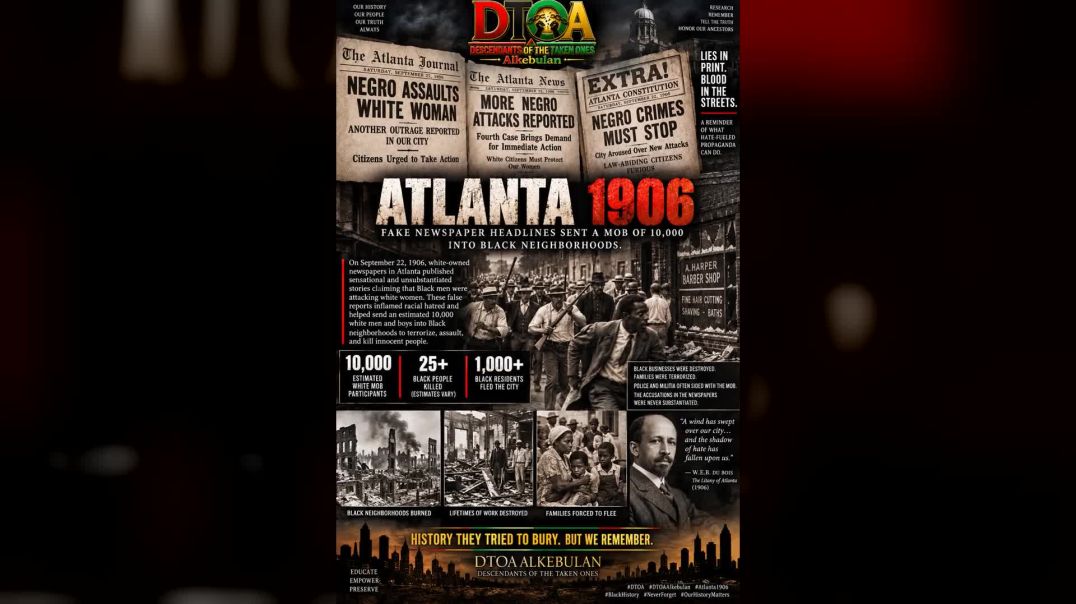
When False Newspaper Reports Helped Unleash a Mob of 10,000 Against Black America
September 22, 1906 — Atlanta, Georgia
Imagine opening a newspaper and reading an inflammatory accusation that would soon help turn thousands of people into a murderous mob.
That is what happened in Atlanta, Georgia, in September 1906.
White-owned newspapers published sensationalized, exaggerated, and unsubstantiated allegations that Black men were attacking white women.
The headlines spread fear and racial hatred.
By the evening of September 22, an estimated 10,000 white men and boys had gathered in downtown Atlanta, where mobs attacked Black residents, destroyed businesses, and terrorized neighborhoods.
Exhibitions - Library of Congress
1. The Real Threat to White Supremacy
Atlanta's Black community was growing economically and politically.
Black entrepreneurs operated barbershops, restaurants, saloons, and other businesses. Successful Black residents challenged the racist belief that African Americans should remain economically and socially subordinate.
Among Atlanta's prominent Black businessmen was Alonzo Herndon, a formerly enslaved man who became a successful entrepreneur and insurance founder.
At the same time, Georgia's 1906 gubernatorial campaign was exploiting racial hostility.
Candidates Hoke Smith and Clark Howell competed for white voters while debating policies aimed at restricting Black political power.
The newspapers helped inflame these tensions.
New Georgia Encyclopedia
2. The Newspapers That Helped Ignite the Violence
Atlanta's newspapers repeatedly published alarming stories about alleged assaults by Black men against white women.
On September 22, four new allegations appeared in extra newspaper editions.
None of those four accusations was substantiated.
But the stories circulated rapidly.
Crowds gathered.
The rhetoric escalated.
And thousands of white men began attacking Black people who had nothing to do with the allegations.
The National Center for Civil and Human Rights documents how competition among newspapers encouraged sensational reporting and helped create the conditions for violence.
NCCHR[42].docx
The newspapers did not merely describe racial hatred. Their reporting helped intensify it.
3. Ten Thousand People Turned Downtown Atlanta Into a Killing Ground
The violence began around Five Points and spread through downtown streets and Black business districts.
White mobs dragged Black passengers from streetcars.
They attacked pedestrians with clubs, knives, and firearms.
They smashed storefronts and destroyed Black-owned property.
Alonzo Herndon's elegant barbershop was damaged. Workers at another barbershop across the street were killed.
People were attacked simply because they were Black.
New Georgia Encyclopedia
The violence extended into Black neighborhoods, including Brownsville, where residents attempted to defend themselves.
The Library of Congress reports that police and militia members aided the mob and that more than 1,000 Black residents fled Atlanta.
Exhibitions - Library of Congress
4. The Death Toll and the Destruction
10,000
Estimated white mob participants
25+
Black people killed, according to historical accounts
1,000+
Black residents who fled the city
Historical estimates vary; the full death toll remains uncertain.
Exhibitions - Library of Congress
Some historical investigations suggest the number of people killed may have been substantially higher than the commonly documented totals.
The victims included ordinary workers, business owners, and residents caught in the path of racial violence.
Families lost loved ones.
Entrepreneurs lost their livelihoods.
And Black communities were left to rebuild after a wave of destruction.
5. The Survivors Who Refused to Forget
Among those who witnessed the violence was a young Walter White.
White would become an important civil rights investigator and later executive secretary of the NAACP.
The massacre also deeply affected W. E. B. Du Bois, who taught at Atlanta University.
Du Bois responded with his powerful poem, The Litany of Atlanta, condemning the violence and the racial hatred behind it.
The massacre became part of the broader history that shaped the struggle for organized civil rights activism in America.
ajc
6. The Truth About the Press and Racial Violence
One of the most disturbing facts about the Atlanta Race Massacre is that newspapers helped create the atmosphere in which innocent people were attacked.
The Fulton County grand jury later criticized the role of Atlanta newspapers, particularly the Atlanta News, in encouraging violence.
New Georgia Encyclopedia
The massacre demonstrates how unverified allegations, racial propaganda, political competition, and mob violence can reinforce one another.
It also exposes the vulnerability of Black economic progress in a society where white supremacist violence could destroy successful communities.
DTOA FINAL MESSAGE
They called it a race riot.
But the historical record reveals a massacre in which white mobs overwhelmingly targeted Black residents.
Black businesses were destroyed.
Black families were terrorized.
Black lives were taken.
And the inflammatory newspaper stories that helped trigger the violence were never substantiated.
On September 22, 1906, Atlanta demonstrated how words printed on paper could help unleash deadly racial terror.
DESCENDANTS OF THE TAKEN ONES We remember the victims.
We remember the survivors.
We remember the Black entrepreneurs who built businesses in the face of discrimination.
And we remember those who stood against the violence.
Because history does not disappear simply because it was left out of a classroom.
DESCENDANTS OF THE TAKEN ONES: Our history. Our ancestors. Our truth. Thank you for your time. To support the channel. Please like, share, and subscribe, and pass this along to your family and friends. Remember: information kept to yourself is lost over time, but shared information becomes enduring knowledge. People who lose control of their history can be led to believe they never contributed anything.
#dtoa #dtoaalkebulan #atlanta1906 #atlantaracemassacre #blackhistory #hiddenblackhistory #blackwallstreet #racialterror #africanamericanhistory #walterwhite #webdubois #alonzoherndon #blackhistorymatters #knowyourhistory #neverforget #HistoricalTruth









0 Comments