
193 Views· 10/01/26· Black History
Igbo Landing

Igbo Landing: The People Who Refused the Chain
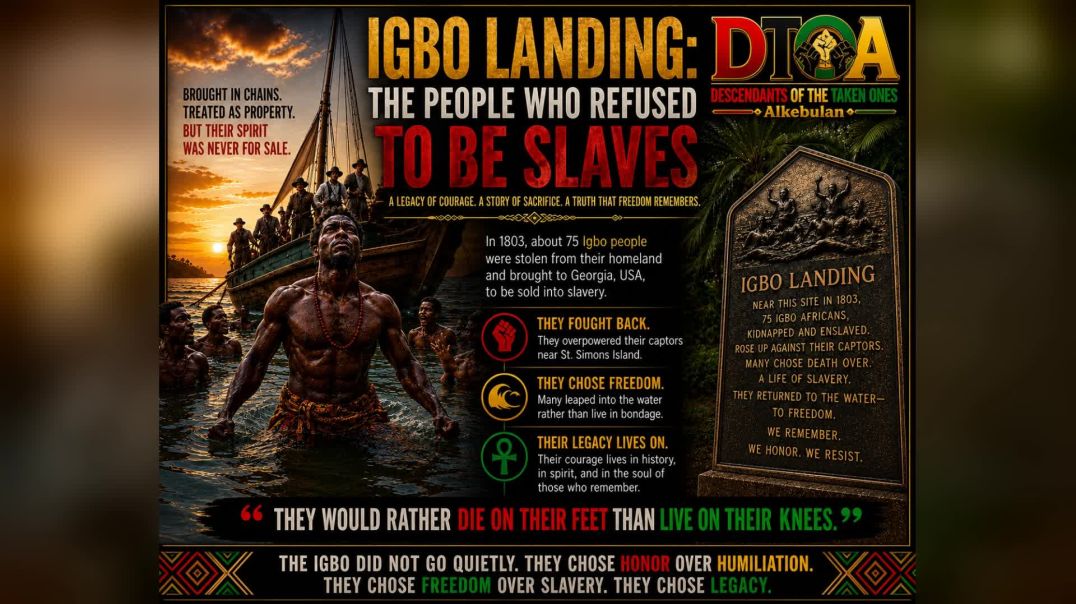
In 1803, a group of about 75 Igbo people from West Africa, in present-day Nigeria, was brought to Georgia after surviving the horrors of the Middle Passage. They had been stolen from their homeland, carried across the Atlantic, and sold in Savannah to plantation owners connected to St. Simons Island. From there, they were forced onto a smaller vessel and taken down the Georgia coast toward bondage. (National Park Service)
But before they reached the plantation, the captives rose.
Near Dunbar Creek on St. Simons Island, the Igbo people overpowered their captors. Historical accounts say they seized the vessel and drowned several of the men transporting them. What happened next became one of the most powerful acts of resistance in African American memory. Rather than submit to slavery, many of the Igbo captives walked into the water. Some accounts describe them as choosing death over enslavement; others preserve the story in spiritual language, saying they returned home by way of the water. (New Georgia Encyclopedia)
Igbo Landing is remembered not only as a tragedy. It is remembered as a declaration.
The enslavers saw property. The Igbo saw themselves as people. The system saw bodies to be bought. The Igbo answered with resistance. In that moment, they rejected the idea that anyone had the right to own them. They refused to let captivity define their souls.
Over time, the story became part of Black folklore, especially within the coastal Gullah Geechee tradition. It helped shape the legend of the Flying Africans—the belief that some Africans, when faced with bondage, rose beyond the reach of slavery and returned spiritually to Africa. History and legend are connected: one preserves the event, while the other preserves its meaning. (New Georgia Encyclopedia)
Closing
Igbo Landing is sacred ground because the Igbo captives refused to surrender their humanity. They chose resistance over submission, memory over erasure, and freedom over chains.









2 Comments
KINGRAY
18 days agocliprize
20 days ago