

38 Views· 10/23/26· Black History
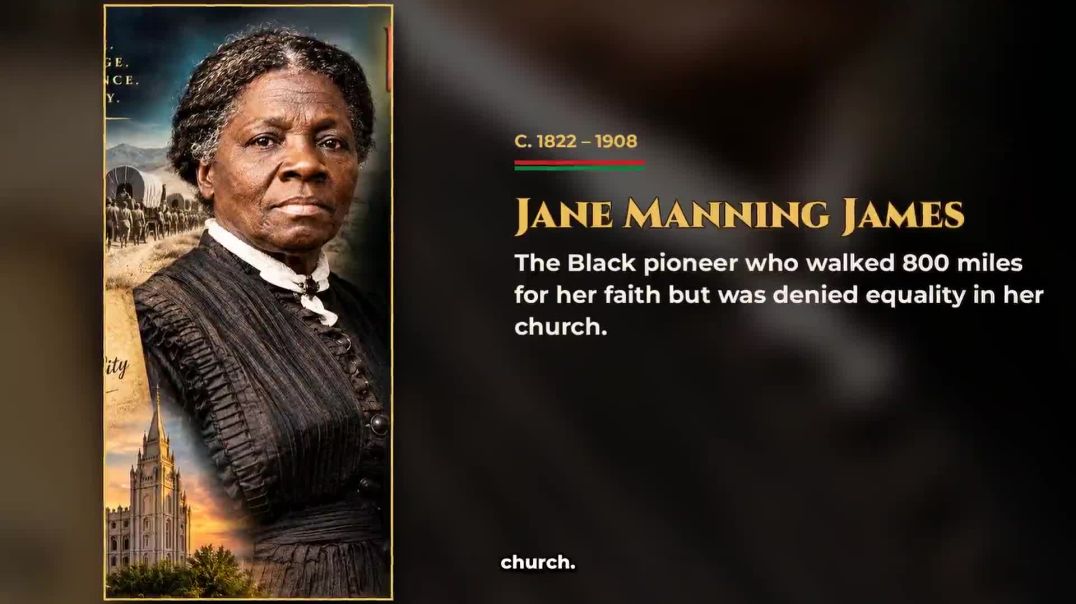
Jane Manning James (1822–1908): The Black Pioneer Who Walked 800 Miles for Her Faith but Was Denied

Jane Manning James (1822–1908): The Black Pioneer Who Walked 800 Miles for Her Faith but Was Denied Equality in Her Church
Her faith carried her across America. Her courage challenged the racial barriers of her own religion.
Jane Elizabeth Manning James was a free-born African American woman, religious pioneer, mother, and advocate for equal participation in The Church of Jesus Christ of Latter-day Saints. Her extraordinary life exposed a painful contradiction in nineteenth-century American religion: a Black woman could dedicate her life to a church yet be denied sacred privileges available to white members.
1. Born Free, but Not Free From Racism
Jane was born around 1822 in Connecticut to a free Black family. Her mother had previously been enslaved, and her father died while Jane was young.
At approximately six years old, Jane began living and working in the household of a wealthy white family named Fitch.
Although Connecticut was a Northern state, Black residents encountered severe discrimination in employment, education, transportation, and public life.
Jane grew up in a society where freedom from slavery did not guarantee equality.
2. A Religious Conversion That Changed Her Life
As a young woman, Jane searched for spiritual fulfillment.
After attending a Protestant church, she encountered missionaries from the emerging Latter-day Saint movement in the early 1840s.
She embraced the new religion, eventually joining alongside several family members.
But her conversion would soon expose her to another painful reality: even among people professing Christian brotherhood, racial discrimination remained deeply entrenched.
3. The 800-Mile Journey: When Racism Forced Her to Walk
In 1843, Jane and members of her family attempted to travel to Nauvoo, Illinois, where thousands of Latter-day Saints were gathering.
They expected to travel much of the distance by boat.
But when they attempted to board a vessel, they were refused passage because of their race.
Rather than abandon their journey, Jane and her family continued on foot.
They walked approximately 800 miles.
Their feet became sore and bloody. They endured exposure, hunger, exhaustion, and uncertainty.
In Peoria, Illinois, authorities even questioned whether they were fugitives from slavery and demanded proof of their freedom.
Imagine that: a free Black American family traveling through its own country, forced to defend its legal right to exist outside bondage.
Yet Jane kept moving.
4. Living With Joseph Smith
When Jane finally reached Nauvoo, Joseph Smith, founder of the Latter-day Saint movement, and his wife, Emma, welcomed her into their household.
Jane worked in their home, performing household duties, including laundry.
She developed close relationships with members of the Smith family and later spoke affectionately of Joseph Smith.
Emma reportedly invited Jane to become connected to the Smith family through a religious sealing ceremony, but Jane declined because she did not fully understand the unfamiliar practice at that time.
Years later, that decision would become especially significant.
5. Becoming One of Utah's First Black Women Pioneers
Following Joseph Smith's death in 1844 and the movement of church members westward, Jane married Isaac James, a free Black convert.
The couple joined the Mormon migration toward the Rocky Mountains.
In 1847, Jane arrived in the Salt Lake Valley, becoming one of the earliest documented Black women settlers in Utah.
She worked to support her growing family through washing, sewing, spinning cloth, and other labor.
Her life was marked by economic hardship, marital difficulties, and the deaths of several of her children.
Nevertheless, she remained active in her religious community and helped neighbors during difficult periods.
6. The Church That Accepted Her Faith but Restricted Her Rights
Here lies one of the most troubling aspects of Jane Manning James's story.
During her lifetime, the Latter-day Saint Church maintained racial restrictions that excluded Black members from important religious ordinances.
Black men were barred from priesthood ordination, and Black women and men were generally denied temple endowments and family sealings.
These ceremonies were central to the church's teachings concerning eternal family relationships and exaltation.
Jane believed deeply in these teachings.
She wanted the same religious opportunities available to white members.
Between 1884 and 1904, she repeatedly petitioned church leaders for permission to receive temple blessings.
Her requests were denied.
Jane could contribute her labor, money, religious testimony, and decades of faithful service.
But she could not participate equally in the ceremonies she believed were essential to her eternal future.
7. The 1894 Ceremony: Sealed as a Servant, Not a Daughter
In 1894, church leaders authorized an extraordinary arrangement.
Instead of allowing Jane to be sealed into Joseph Smith's family as an adopted daughter, they permitted a special ceremony connecting her to the Smith family as a servant.
Jane did not participate in the ceremony personally; another woman represented her by proxy.
The arrangement maintained a servant relationship rather than granting the familial standing she had requested.
Historians identify this unusual ceremony as a striking example of how racial hierarchy affected religious practice.
For a Black woman who had devoted her life to the church, the distinction was profound.
8. She Never Abandoned Her Faith
Despite repeatedly being refused full temple participation, Jane remained a committed member.
She contributed to temple construction, participated in women's church organizations, and continued advocating for access to sacred ordinances.
She also ensured that her life story would be preserved.
In her later years, she dictated an autobiography documenting her conversion, journey, family experiences, and religious convictions.
Jane died on April 16, 1908, at approximately 85 years old.
Her funeral drew considerable attention and reflected the respect she had earned within her community.
In 1978, seventy years after her death, the church ended its race-based priesthood and temple restrictions. The following year, temple ordinances that Jane had sought during her lifetime were performed on her behalf.
9. The Legacy of Jane Manning James
Jane Manning James deserves to be remembered as much more than a pioneer who endured hardship.
She was a Black woman who exercised extraordinary personal agency in a society determined to limit her choices.
She crossed hundreds of miles when discriminatory transportation practices attempted to stop her.
She helped establish a community in the American West.
She raised a family and supported her neighbors despite serious economic and personal difficulties.
And she challenged racial exclusion from within an institution to which she remained deeply committed.
Her life reminds us that African American history is not confined to the plantations of the South or the civil rights campaigns of the twentieth century.
Black Americans were also central participants in the westward migration, religious history, and settlement of the American frontier.
Jane Manning James helped build a religious community that would not grant her full equality during her lifetime. Her persistence made the contradiction impossible to ignore.
That is why her story matters.
That is why her name deserves to be remembered.
DESCENDANTS OF THE TAKEN ONES
Recovering the history. Honoring the ancestors. Restoring the memory.Thank you for your time. To support the channel. Please like, share, and subscribe, and pass this along to your family and friends. Remember: information kept to yourself is lost over time, but shared information becomes enduring knowledge. People who lose control of their history can be led to believe they never contributed anything.
Historical references
The narrative draws on Jane's autobiography, the Church History Library, the University of Utah's Century of Black Mormons project, and historian Quincy D. Newell's biography, Your Sister in the Gospel: The Life of Jane Manning James, a Nineteenth-Century Black Mormon.

















0 Comments