
177 Views· 09/17/26· Black History
The 42 Declarations of Ma’at and the Ten Commandments
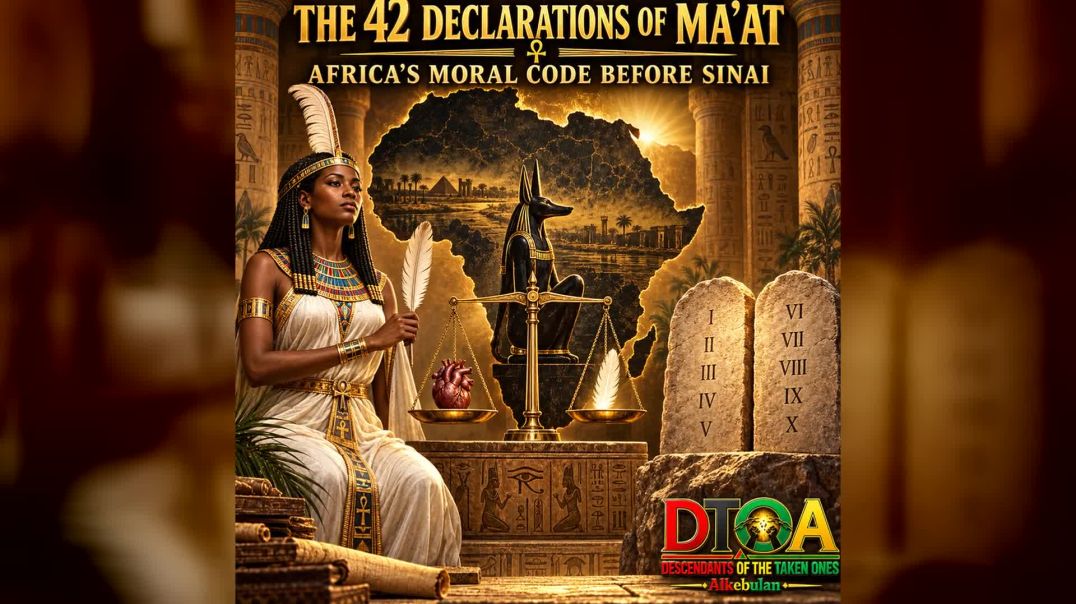
The 42 Declarations of Ma’at and the Ten Commandments
Long before the biblical commandments were written in their surviving form, ancient Africans in Egypt had developed an ethical tradition centered on Ma’at—truth, justice, balance, order, and right conduct.
One of its best-known expressions appears in Spell 125 of the Egyptian Book of the Dead, commonly called the 42 Negative Confessions or Declarations of Innocence. Before 42 divine assessors, the deceased declared that they had not committed offenses such as murder, theft, lying, adultery, cruelty, fraud, or mistreatment of the poor. The person’s heart was then weighed against the feather of Ma’at, symbolizing cosmic order and ethical behavior. University College London and The Metropolitan Museum of Art document this tradition.
MA’AT AND THE 42 DECLARATIONS
Before Ten, There Were Forty-Two
Long before the biblical Ten Commandments became central to Jewish and Christian tradition, ancient Kemet developed a moral system rooted in Ma’at — truth, justice, balance, order, harmony, and righteousness.
In the Egyptian Book of the Dead, the soul stood before the divine court and declared innocence before 42 judges:
I have not stolen.
I have not killed.
I have not lied.
I have not caused suffering.
I have not disturbed the balance.
The Ten Commandments later carried similar moral themes: do not kill, do not steal, do not lie, honor divine law, and live with moral discipline.
Moses did not bring morality into an empty world. Africa already had Ma’at — a sacred system of ethics, justice, truth, and accountability.
These declarations share broad moral themes with the later Ten Commandments, including prohibitions against murder, theft, adultery, falsehood, and coveting. However, they were not identical documents. The Egyptian declarations formed part of a funerary judgment ritual, while the Ten Commandments were presented as divine covenant laws governing Israel’s relationship with God and its community.
According to the biblical tradition, Moses was raised in Pharaoh’s household, and Acts 7:22 states that he was educated “in all the wisdom of the Egyptians.” It is therefore reasonable to consider the possibility that Egyptian ideas formed part of the cultural world from which the biblical tradition emerged.
But historical accuracy requires an important distinction: no surviving evidence proves that Moses directly copied the 42 Declarations or transformed them into the Ten Commandments. Moses’ historical life, the date of the Exodus, and the development of the biblical commandments remain subjects of scholarly debate.
What the evidence does establish is powerful enough:
Africa possessed sophisticated ideas about truth, justice, morality, and divine judgment long before the biblical texts reached their final written form.
The moral similarities deserve serious study, but similarity alone does not prove direct borrowing. Egyptian civilization was not waiting to receive morality from somewhere else. Through Ma’at and other ancient teachings, Africans had already articulated a demanding vision of ethical life—one in which a person’s words, actions, treatment of others, and responsibility to society followed them beyond the grave.
The honest conclusion is not that Egypt “invented” the Ten Commandments. It is that the commandments emerged within an ancient world where African moral philosophy was already old, respected, and deeply developed.
DTOA — Descendants of the Taken Ones
Before the tablets of Sinai, Africa had the scales of Ma’at. Separating documented history from mythology while restoring Africa’s place in the human story.



2 Comments
cliprize
7 days agoJOSEPH ELISHA
21 days ago