
269 Views· 10/07/26· Black History
Under a white flag, he was shot! He Came to Discuss Peace. The British Officer Killed Him.

Under a white flag, he was shot! He Came to Discuss Peace. The British Officer Killed Him.
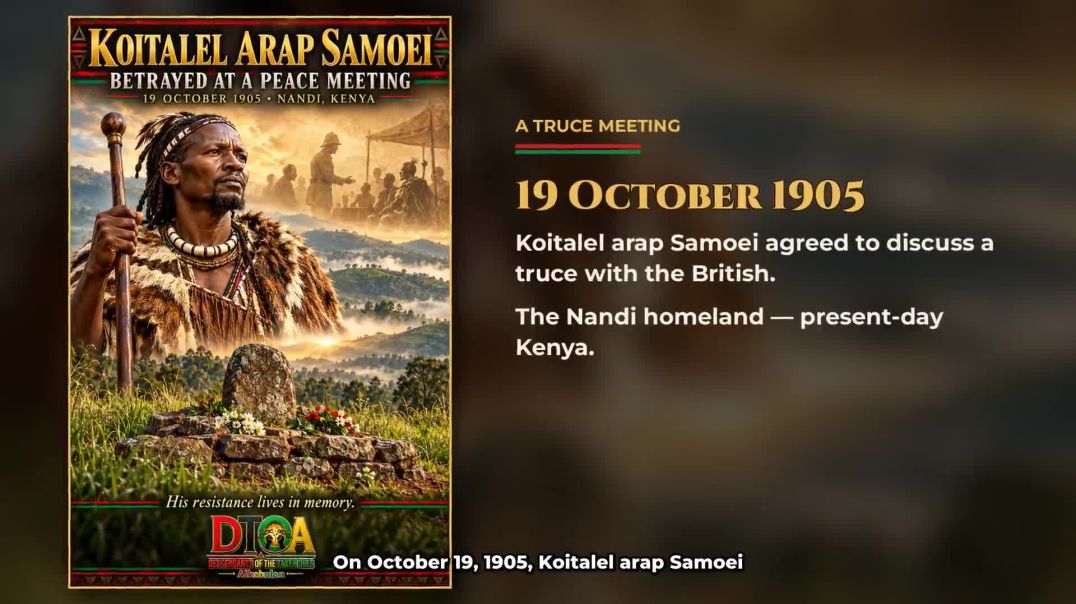
On October 19, 1905, Koitalel arap Samoei attended a meeting to discuss a truce with the British. For years, the Nandi leader had resisted colonial expansion into his people’s homeland in what is now Kenya. British officer Richard Meinertzhagen offered a meeting that held out the possibility of ending the fighting.
Koitalel would never return from it. Meinertzhagen killed him, and the British party killed members of his delegation. A meeting presented as an opportunity for peace became the scene of an assassination. Koitalel was the Nandi orkoiyot, a leader whose authority combined spiritual responsibility with military leadership. His people looked to him for guidance in defending their land and in deciding when to fight or negotiate.
As British power advanced into the interior of East Africa, the Uganda Railway became a focal point of conflict. Its construction extended colonial authority deeper into African territory. Nandi warriors attacked supply routes and challenged an empire armed with firearms, resisting British control for more than a decade. That long resistance gives the peace meeting its terrible significance. Negotiation requires some measure of trust. Even enemies must believe that approaching one another to discuss a truce will not be an invitation to be killed.
According to the widely remembered Nandi account, Koitalel extended his hand to greet Meinertzhagen and was shot at close range. The gesture that should have opened a conversation instead led to his death. Accounts differ on the precise sequence, but the killing at the arranged meeting remains central to the history of the Nandi resistance.
The betrayal reached beyond one man.
Koitalel’s death struck at a people whose leadership, independence, and homeland were already under attack. The resistance was subsequently broken, and colonial rule brought displacement and restrictions upon Nandi life. Historical research describes the removal of Nandi communities to a reserve as British control expanded.
Within Koitalel’s family, the story endured for generations. His granddaughter, Anne Machii Samoei, grew up hearing her father describe the leader he had lost. Those stories instilled in her pride in her grandfather’s courage. They also passed down the pain of his death and the belief that his remains had been taken away. In the account you shared, Anne was 87 when she was interviewed in 2024. Her grief showed how an act of colonial violence could remain present in a family long after the people responsible were gone.
Nandi oral history holds that Koitalel was decapitated and that his head was taken to Britain. That account must be distinguished from a confirmed identification of his skull: the belief is deeply important to his descendants, but the evidence provided does not establish its location. For his family, the search has a profoundly human purpose. They want to bring their ancestor home and give him the dignity of a complete burial.
We are the Descendants of the Taken Ones, and we remember: Koitalel’s story asks us to remember both his resistance and the circumstances of his death. He was a leader defending his people who agreed to meet an adversary under the promise of a truce. The peace meeting should have offered a way to end the killing. Instead, it became the betrayal his descendants would remember for generations.
Thank you for your time. To support the channel. Please like, share, and subscribe, and pass this along to your family and friends. Remember: information kept to yourself is lost over time, but shared information becomes enduring knowledge. People who lose control of their history can be led to believe they never contributed anything.





















0 Comments