
32 Views· 10/07/26· Black History
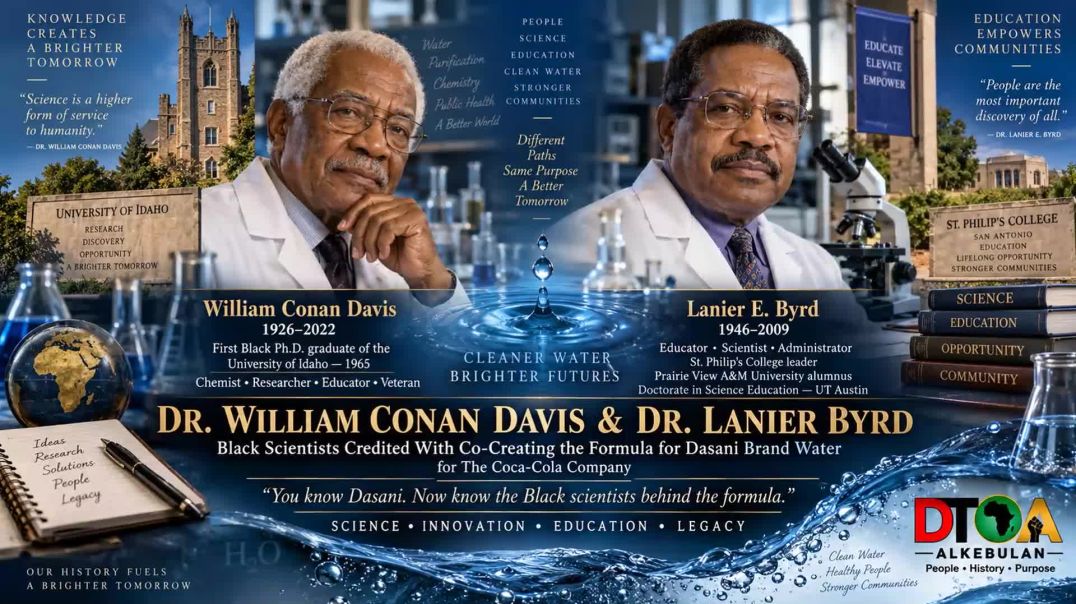
YOU KNOW DASANI. NOW KNOW THE BLACK SCIENTISTS BEHIND THE FORMULA.”
YOU KNOW DASANI. NOW KNOW THE BLACK SCIENTISTS BEHIND THE FORMULA.”
Dr. William Conan Davis & Dr. Lanier Byrd
Science • Innovation • Education • Legacy
Dr. William Conan Davis did not “create Coca-Cola,” but he and Dr. Lanier Byrd are credited with co-creating the formula used for Coca-Cola’s Dasani bottled water. St. Philip’s College and the University of Idaho both document that contribution. University of Idaho Library
Long before millions of people ever picked up a bottle of Dasani, two Black scientists and educators were doing the work that helped shape its story: Dr. William Conan Davis and Dr. Lanier E. Byrd. St. Philip’s College credits the two colleagues with studying the characteristics of drinking water and co-creating the formula for Dasani brand water. That one sentence alone should have made both of their names widely known. Instead, like so many Black innovators, their contributions were absorbed into a larger corporate story while their names remained in the background. Davis and Byrd were not simply someone who worked at a Coca-Cola bottling plant or appeared somewhere in the company's corporate history.
They were chemists whose scientific work contributed directly to the formulation of one of Coca-Cola's major bottled-water brands.
When The Coca-Cola Company introduced Dasani in 1999, the product became part of a growing global bottled-water market. Davis's contribution was in the science behind the water formulation—the characteristics that helped give the product its particular composition and taste.
Yet most people who have picked up a bottle of Dasani have probably never heard of the name Dr. William Conan Davis or Dr. Lanier Byrd
Dr. William Conan Davis was born on August 22, 1926, in Waycross, Georgia. His road into science was shaped early by exposure to Black excellence. St. Philip’s College recounts that when he was young, his father took him to Tuskegee Institute, where he saw African American professors and scientists at work. That experience helped inspire him to become a chemist. He later earned a bachelor’s degree in chemistry from Talladega College and a master’s degree in organic chemistry from Tuskegee Institute, where he was a George Washington Carver Research Fellow.
At a time when opportunities for Black research scholars were severely limited, Davis pushed forward anyway. St. Philip’s reports that the University of Idaho was the only institution willing to accept him as a research-track graduate student, and in 1965 he completed his thesis, A Study of Sloughing in the Potato Tuber. University of Idaho’s Black History project notes that this achievement made him the first Black man to earn a Ph.D. from the University of Idaho.
Davis’s scientific life did not stop with one milestone. St. Philip’s says he contributed to work related to instant mashed potatoes, soft-serve ice cream, industrial glue, and standardized medical tests for insulin and growth hormones. He also served as a research associate in Molecular Pharmacology at the University of Texas Health Science Center in San Antonio before joining St. Philip’s College in 1983 as a chemistry professor. There he continued a long career as an educator, later serving as department chair of Natural Sciences, and upon retirement he was named professor emeritus. In 2012, the college even named its science building in his honor.
Dr. Lanier E. Byrd built a legacy just as powerful. According to his funeral program, he was born on August 3, 1946, in San Antonio, Texas. He earned an associate degree from St. Philip’s College and then completed both a B.S. and M.S. in biology and chemistry from Prairie View A&M University. The Texas House of Representatives memorial resolution for Dr. Byrd adds that he later earned a doctorate in science education from The University of Texas at Austin in 1995.
Byrd began his career in education teaching at Sidney Lanier High School before joining St. Philip’s College in the early 1970s as a biology instructor. From there, he rose through the institution—earning tenure, becoming a professor, guiding the Department of Natural Sciences as chair, and later serving as Vice President of Academic Affairs from 1996 to 2007. The Texas House resolution credits him with helping St. Philip’s earn exceptionally strong program-review results and establishing the Lanier Byrd Endowed Scholarship to help lower-income students pursue their education.
What makes their story especially important is not just that they were accomplished individually, but that their work intersected in a way that reached millions of people. St. Philip’s College specifically states that Dr. Davis, working with his colleague Dr. Lanier Byrd, studied water characteristics and co-created the formula for Dasani brand water. In other words, a product eventually associated worldwide with The Coca-Cola Company also carries the intellectual fingerprints of two Black scholars working in a college environment far removed from the spotlight of corporate fame.
That is what makes this story a DTOA story.
It is a story about knowledge without celebrity.
A story about Black brilliance without proper recognition.
A story about scientists, teachers, and institution-builders whose work moved quietly from the laboratory into everyday life.
Dr. William Conan Davis represented the path of the pioneer—the chemist who broke barriers, entered spaces that had not welcomed men like him, and proved that Black scientific excellence belonged in every research institution in America. Dr. Lanier Byrd represented the power of educational leadership—the scholar who helped build opportunity for students while also contributing to real scientific work of lasting impact. Together, they symbolize something larger than one bottled-water formula: the power of Black intellect to shape the world, even when the world fails to remember the names.
DTOA CLOSE
You may know the company.
You may know the bottle.
You may know the brand.
Now know the men.
Dr. William Conan Davis
Dr. Lanier E. Byrd
Two Black scientists.
Two educators.
Two builders of legacy.
Descendants of the Taken Ones that story reminds us that history is not made only inside presidential palaces, universities, or military headquarters. Their story reminds us that history is not only made by those whose names appear on labels, buildings, and advertisements. Sometimes history is made by those who do the research, teach the next generation, and leave behind work that becomes part of everyday life for millions.
Thank you for your time. To support the channel. Please like, share, and subscribe, and pass this along to your family and friends. Remember: information kept to yourself is lost over time, but shared information becomes enduring knowledge. People who lose control of their history can be led to believe they never contributed anything.




















0 Comments