
151 Views· 08/31/26· Re-Education
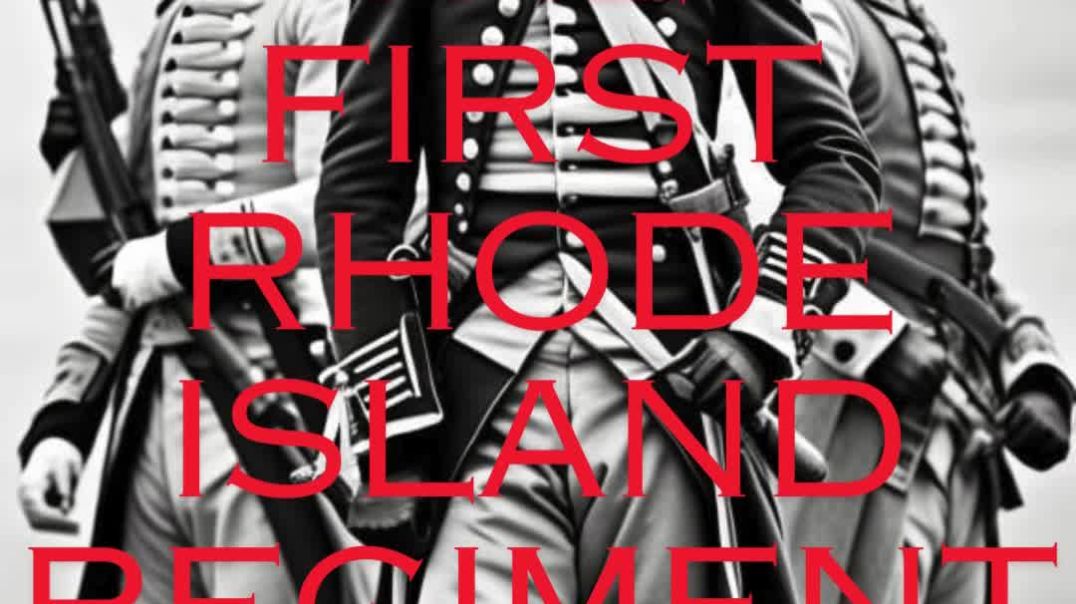
1st Rhode Island Regiment
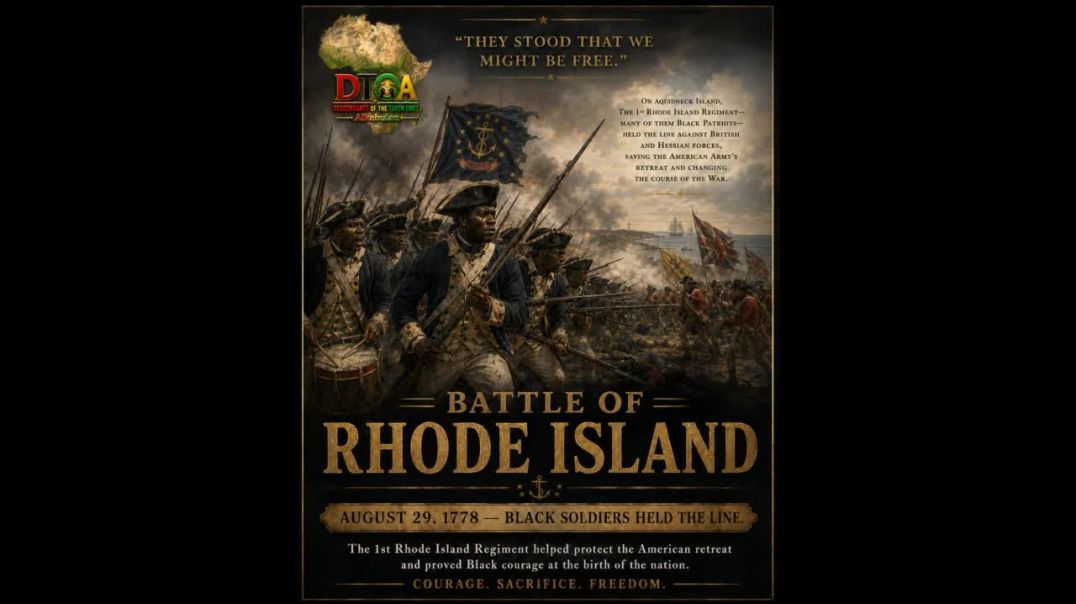
On August 29, 1778, during the American Revolution, Black soldiers helped hold the line at the Battle of Rhode Island, and their courage helped save the Patriot army from disaster.
On August 29, 1778, the 1st Rhode Island Regiment—widely known as America's first Black regiment distinguished itself with "desperate valor" at the Battle of Rhode Island. Stationed on the right flank, these predominantly Black and Native American soldiers repelled three fierce charges from seasoned Hessian troops.
These men served in the 1st Rhode Island Regiment, one of the most famous Revolutionary War units that included African American soldiers. Many were free Black men. Others had been enslaved and enlisted under Rhode Island’s 1778 law, which offered freedom to enslaved men who joined the army. By the fall of 1778, the National Park Service notes that more than 60 percent of the regiment consisted of free and formerly enslaved Black men. (National Park Service)
They were fighting for a nation that had not yet agreed they were fully human.
They were fighting for liberty while slavery still lived in the land.
The 1st Rhode Island Regiment was assigned a critical defensive position anchoring the American right wing at Turkey Hill. Heavily outnumbered, they held their line and repulsed three furious assaults by 1,500 Hessian troops
At the Battle of Rhode Island, American forces under General John Sullivan were retreating from Aquidneck Island after a failed attempt to recapture Newport from the British. British and Hessian troops pressed hard against the American rear guard. If the line broke, the retreat could have become a massacre.
That is where the 1st Rhode Island Regiment stood.
The regiment helped repel repeated enemy assaults, including those by elite Hessian troops. Their discipline under fire gave the American army time to withdraw in an orderly manner. Their stand became one of the clearest examples of Black military courage during the Revolution. Modern accounts of the regiment emphasize its key role in repelling enemy charges at the Battle of Rhode Island. (Journal of the American Revolution)
The regiment’s fierce resistance held the line, preventing the British from breaking through and enabling the Continental Army to withdraw from Aquidneck Island that night
But here is the betrayal.
These soldiers helped defend the Revolution, but the Revolution did not fully defend them.
They fought for independence, but many Black people remained enslaved after independence.
They fought under the language of liberty, but America wrote its founding story around white patriots while Black patriots were pushed into the margins.
Their blood helped hold the line, but their names were rarely held in the textbooks.
The Battle of Rhode Island exposes the contradiction at the heart of America’s birth: Black men helped save the cause of freedom while the nation they helped create denied freedom to Black people.
Yet their service cannot be erased.
They were soldiers.
They were patriots.
They were freedom seekers.
They were proof that Black courage stood at the dawn of America’s military history.
At the Battle of Rhode Island on August 29, 1778, Black soldiers of the 1st Rhode Island Regiment helped repel British and Hessian assaults, protecting the American retreat and demonstrating their courage under fire. They fought for American liberty even as America still denied liberty to many of its Black defenders.
Battle of Rhode Island — August 29, 1778
1st Rhode Island Regiment • Black Patriots • Freedom Fighters. They held the Line While America Broke Its Promise, but they continue to serve.
Going to Yorktown
When the regiment arrived at the Siege of Yorktown in the autumn of 1781, its high level of discipline immediately impressed the allied forces. While much of the Continental Army struggled with supply shortages and ragged clothing, the Rhode Island soldiers stood out for their exceptional military bearing. Baron Ludwig von Closen, an aide-de-camp to French General Rochambeau, noted in his journal that the most precisely trained and neatly dressed unit on the field was the Rhode Island Regiment, which he observed was three-quarters composed of Black and Indigenous soldiers.
The Assault on Redoubt 10 (October 14, 1781)
To force a British surrender, Washington needed to capture two heavily fortified outer redoubts: Redoubt 9 and Redoubt 10. The assault on Redoubt 10 was assigned to an elite American light infantry column under Lieutenant Colonel Alexander Hamilton.
• The Strategy: The attack was carried out under the cover of darkness. To ensure total surprise, Washington ordered the soldiers to unload their muskets. They were to rely exclusively on the bayonet to seize the fortification, preventing any accidental gunfire from alerting the British.
• The Breach: Elements of the Rhode Island Regiment were at the vanguard of the column. Armed with axes, sappers chopped through the abatis (a defensive obstacle of sharpened tree branches) as the infantry charged directly over the earthen walls.
• The Combat: Hand-to-hand combat inside the redoubt was fierce but brief. The American column, heavily relying on the disciplined coordination of the 1st Rhode Island soldiers, overwhelmed the British defenders in less than ten minutes, securing a vital position that allowed American artillery to fire directly into Lord Cornwallis’s main lines.
The victory at Yorktown effectively broke British military strategy in North America, but the war was not yet officially over.
Saratoga Garrison Duty: After the surrender ceremony, the 1st Rhode Island Regiment marched north to Newburgh, New York, and was eventually stationed at Fort Oswego and Saratoga. They spent the final two years of the war guarding the northern frontier against potential British incursions from Canada.
• The Final Parade: On December 25, 1783, after the signing of the Treaty of Paris, the regiment was officially disbanded at Saratoga. Having served in every major year of the conflict, it was among the very few Continental Army units to endure the entire Revolutionary War.
While white officers and soldiers received land bounties and back pay, Black veterans faced severe systemic neglect. The Continental Congress defaulted on many financial promises, leaving many former slaves unable to secure the back pay they had earned. To prevent these decorated veterans from falling into absolute poverty, the Rhode Island General Assembly was forced to pass a dedicated act in 1785 that required local townships to provide financial maintenance and care for any disabled or destitute Black and Native American veterans of the regiment.
If the Black soldiers of the 1st Rhode Island Regiment had not held their ground, the Continental Army might have suffered a crushing defeat in Rhode Island. That defeat could have weakened the Revolution at a critical moment, possibly altering the future of the United States.
The deeper truth is this:
Black men who were not fully free helped win freedom for a nation that still refused to fully recognize theirs. Then America betrayed them and tried to write them out of the victory.
That is the contradiction America has never fully faced.







![Charleston White Vs. Island Boys [2025] (Full Fight)](https://theblacktube.com/upload/photos/2025/06/f3399d1c7a6d0619018adec4f40ba4f8a380ad6ehVlXheV7IRWzsoefKwsi.video_thumb_4068_311.66666666667.jpeg)





3 Comments
cliprize
9 days agoJoeBurnaFromMemphis
13 days agoCopuffs843
1 month agoJoeBurnaFromMemphis
13 days ago