
135 Views· 08/31/26· Black History
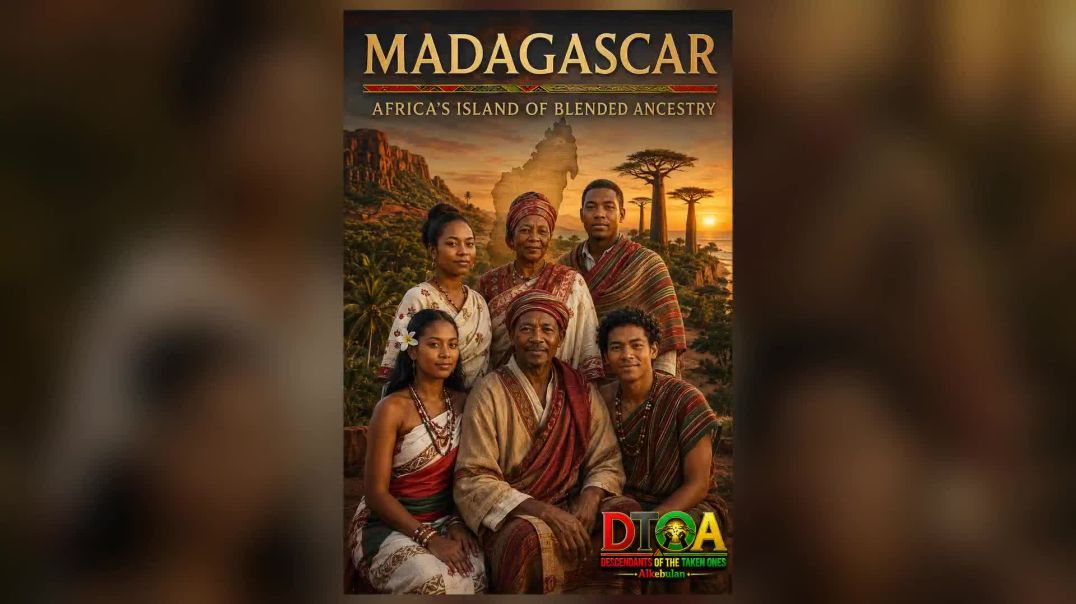
Madagascar Africa’s Black Island of Blended Ancestry
Madagascar — Africa’s Black Island of Blended Ancestry
Madagascar rises from the Indian Ocean off the southeastern coast of Africa. It is the world’s fourth-largest island and the homeland of the Malagasy people—an African people whose ancestry recounts one of history’s greatest stories of migration, cultural fusion, and survival. Madagascar is unquestionably part of Africa. It is an African nation and a member of the African Union. Yet the history of its people is especially distinctive.
An African and Austronesian Heritage
Madagascar’s early population developed from the convergence of two major migrations. Bantu-speaking Africans traveled to the island from the eastern African mainland. Austronesian voyagers also crossed the Indian Ocean from Maritime Southeast Asia, with strong ancestral ties to southern Borneo. Over generations, these communities intermarried, forming the Malagasy people. Genetic research confirms that Malagasy ancestry generally combines African and Southeast Asian lineages, though the proportions vary across communities and regions. Coastal populations often have stronger East African ancestry, while some highland populations retain more visible Austronesian influences.
The Malagasy language belongs primarily to the Austronesian language family, but Malagasy culture also bears unmistakable African influences in its music, spirituality, social traditions, foodways, and connections with the East African coast. This means Malagasy people cannot be reduced to only “Asian” or only “African.” They are an African people formed through a remarkable union of Africa and Asia.
Madagascar’s Black Kingdoms
Long before European colonization, Madagascar was home to organized societies governed by kings, queens, and ancestral traditions. The Sakalava established powerful kingdoms across western Madagascar. Their rulers controlled key trading networks linking the island to East Africa, the Swahili coast, Arabia, and India. The kingdoms of Menabe and Boina became influential political powers. In the central highlands, the Kingdom of Imerina grew into the dominant Malagasy state. King Andrianampoinimerina expanded and strengthened the kingdom near the end of the eighteenth century. His son, Radama I, continued its expansion and established diplomatic relations with foreign governments.
Madagascar also produced formidable queens. Queen Ranavalona I ruled from 1828 to 1861. She resisted growing European interference and sought to preserve Malagasy sovereignty. Her reign remains controversial for its severe punishments, forced labor, and violent political repression. Nevertheless, her resistance made her a lasting symbol of independence for many Malagasy people. Later queens—Rasoherina, Ranavalona II, and Ranavalona III—continued the royal line amid mounting European pressure.
Resistance to French Colonialism
France invaded Madagascar and formally annexed it in 1896. The monarchy was abolished, and Queen Ranavalona III was removed from power and eventually exiled. The Malagasy people did not surrender quietly. The Menalamba resistance arose against French occupation, foreign control, and the destruction of traditional Malagasy authority. Resistance continued throughout the colonial period. During the Malagasy Uprising of 1947, thousands fought to end French rule. France responded to the revolt with brutal repression, killing many Malagasy people.
Their struggle could not be erased. Madagascar finally regained its independence on June 26, 1960. Are the Malagasy People Black? Under broad modern racial categories, many Malagasy people—particularly those with stronger African ancestry—would be recognized as Black. Others may have features reflecting the island’s mixed African and Southeast Asian heritage. However, “Malagasy” is the people’s national and cultural identity. American racial labels cannot fully describe the island’s many communities.
What must never be denied is this: Madagascar is African. Its people carry African blood, history, and civilization. Their Austronesian heritage does not remove them from Africa—it reveals how widely African peoples were connected to the ancient Indian Ocean world. Madagascar is not outside Black history. It is an essential chapter in the larger history of Alkebulan—a place where African and Austronesian ancestors met, built kingdoms, resisted colonial conquest, and created a civilization found nowhere else on Earth.
Madagascar is Africa’s island of blended ancestry, royal power and unbroken memory. Descendants of the Taken Ones






1 Comments
cliprize
7 days ago