
245 Views· 09/04/26· Black History
Africa’s Genocides: They Tried to Hide
Africa’s Genocides: They Tried to Hide
Africa’s genocides were not accidents.
They were not natural disasters.
They were not just “conflicts” that somehow happened on their own.
They were systems.
Systems built on land theft, forced labor, racial hatred, colonial greed, starvation, political terror, and the belief that African lives could be erased without consequence.
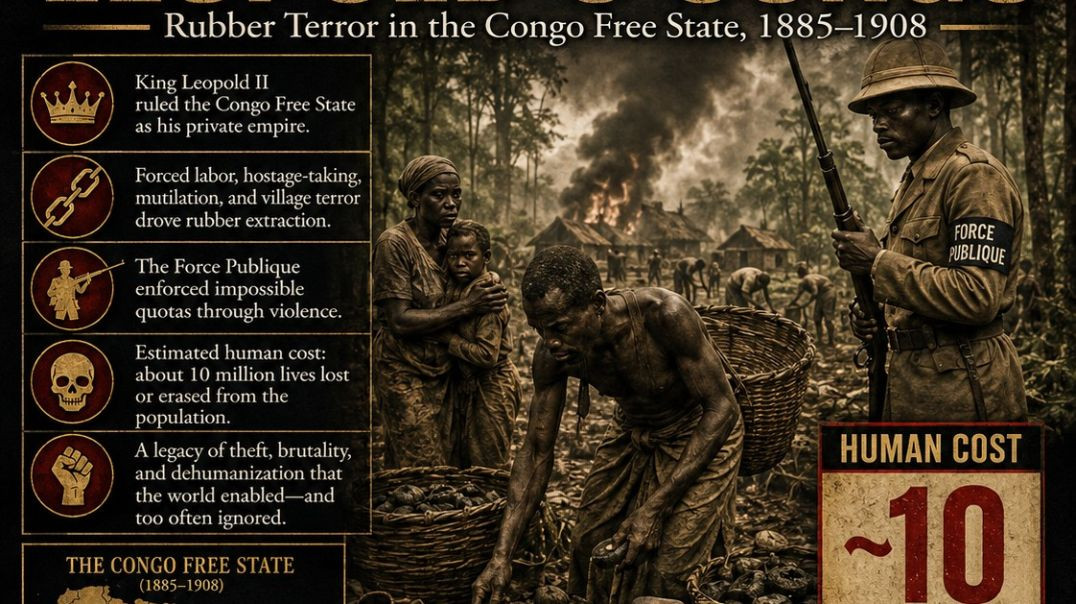
King Leopold II of Belgium ran the Congo Free State as his own private property from 1885 to 1908. He used a brutal forced labor system to extract rubber and ivory, resulting in mass murder, starvation, and mutilation that killed an estimated 10 million In the Congo, King Leopold II turned a vast African nation into his private empire. Under the false language of civilization, Congolese people were forced to collect rubber and ivory through terror. Families were held hostage. Villages were burned. Bodies were mutilated. Millions died or disappeared from the population while Europe grew rich from African suffering.
In Namibia, German colonial forces targeted the Herero and Nama peoples. Their land, cattle, and water were seized. Families were driven into the desert to die of thirst and starvation. Survivors were forced into concentration camps, where labor, disease, hunger, and abuse killed thousands more. Germany called it the colonial order. History remembers it as genocide.
• Herero: Estimates range from 40,000 to 80,000 deaths, wiping out up to 80% of the population. • Nama: Approximately 10,000 deaths, destroying about 50% of the population. • Total Impact: Widely recognized by historians as the first genocide of the 20th century
In Rwanda, in 1994, hate became organized machinery. Radio broadcasts, militias, political extremists, and state structures turned identity into a death sentence. In about one hundred days, more than 800,000 people — mostly Tutsi, along with moderate Hutu — were murdered while the world delayed, debated, and failed to act.
In Darfur, villages burned, and families fled as communities were targeted by militia terror, scorched-earth campaigns, mass killing, rape, and forced displacement. The Fur, Masalit, Zaghawa, and other peoples became victims of a campaign that turned homes into ash and survival into exile.
In Biafra, starvation became a weapon of war. During the Nigerian Civil War, blockade, bombardment, famine, and displacement devastated civilians. Children carried the highest cost. The images shocked the world, but the suffering remains one of Africa’s most painful and contested memories.
These histories are hard to face because they expose the truth: genocide is not only mass killing. It is the destruction of a people’s future. It is taking land and removing those who belong to it. It is using hunger as a policy. It is turning neighbors into targets. It is calling brutality “security,” calling conquest “civilization,” and calling silence “peace.”
But the people survived.
The Congo survived.
The Herero and Nama survived.
Rwanda remembers.
Darfur still demands justice.
Biafra remains in memory.
They tried to hide these genocides because truth threatens power. But memory is resistance. Teaching is resistance. Naming the victims is resistance.
Africa’s dead are not forgotten.
Africa’s wounds are not erased.
Africa’s history will be told.
Africa’s genocides were systems of conquest, forced labor, land theft, starvation, racial hatred, and political destruction. From Leopold’s Congo to the Herero and Nama, Rwanda, Darfur, and Biafra, these stories remember the people they tried to erase.
Africa’s Genocides They Tried to Hide
Congo • Herero and Nama • Rwanda • Darfur • Biafra
Memory • Justice • Survival • Truth
In Closing
They tried to bury the evidence. We carry the memory, and memory becomes justice.














2 Comments
cliprize
10 days agoJOSEPH ELISHA
1 month ago