
246 Views· 09/02/26· Black History
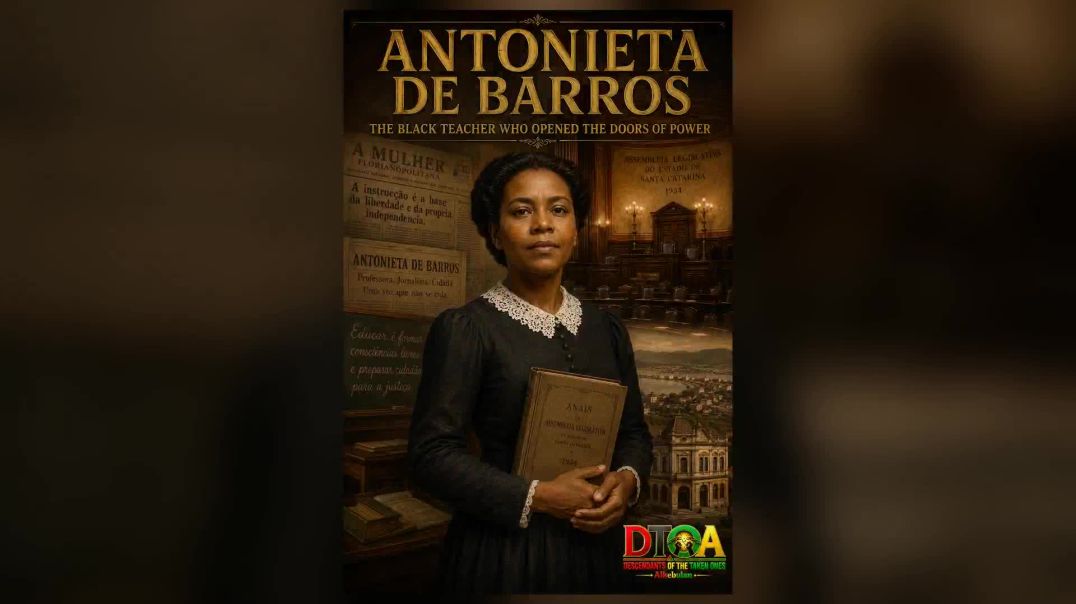
Antonieta de Barros The Black Teacher Who Opened the Doors of Power

Antonieta de Barros
The Black Teacher Who Opened the Doors of Power
Only thirteen years after Brazil formally abolished slavery, a Black girl was born in Florianópolis, Santa Catarina, into a country that had ended human bondage without ending the racism, poverty and exclusion it created.
Her name was Antonieta de Barros.
Born in 1901, Antonieta was the daughter of Catarina de Barros, a formerly enslaved woman who worked as a laundress and domestic worker. Her father died while Antonieta was still young, leaving Catarina to support and educate her daughters, Antonieta and Leonor.
The family possessed little wealth or political influence. What they did possess was a belief in education.
At a time when opportunities for Black children were severely limited—and when women were expected to remain outside public life—Antonieta pursued an education and trained to become a teacher. She understood that literacy was more than the ability to read words. Education gave people the power to interpret the world, defend their rights and challenge those who expected them to remain silent.
In 1922, Antonieta and her sister opened the Curso Particular Antonieta de Barros, a school that helped provide educational opportunities to people who might otherwise have been excluded. She later taught in public institutions and became a respected school administrator. But the classroom was only one part of her mission. Antonieta also entered journalism, using the written word to confront inequality. She founded and directed the newspaper A Semana and contributed articles to several publications. Writing under her own name and the pseudonym Maria da Ilha “Maria of the Island”—she addressed education, politics, racial discrimination, and the position of women in Brazilian society.
Her writing carried a radical message for its time: Black people, poor people, and women possessed intelligence, dignity, and the right to participate fully in their nation's life. Antonieta did not merely write about political change. She stepped directly into politics.
Brazilian women gained national voting rights in the early 1930s. In the 1934 election, Antonieta ran for the Legislative Assembly of Santa Catarina as a member of the Liberal Party of Santa Catarina. She took office in 1935.
With that victory, Antonieta de Barros became the first Black woman to serve in a Brazilian legislature and the first woman to hold a seat in Santa Catarina’s state parliament. Researchers have also identified her as a pioneering Black female legislator in Latin America—and possibly the first in the Americas.
Imagine the room she entered. The legislature was an institution built and controlled almost entirely by white men. Antonieta walked into that chamber as a Black woman, the daughter of a formerly enslaved laundress, an educator who had built her public life on discipline, intelligence, and service.
She did not enter merely to occupy a chair. She entered to legislate. Antonieta advocated expanded access to education, professional recognition for teachers, scholarships for students with limited financial resources, and fairer standards within the public-school system. In 1935, she helped shape Santa Catarina’s state constitution, particularly contributing to provisions on education, culture, and public service.
Her first legislative term ended in 1937, when President Getúlio Vargas imposed the Estado Novo dictatorship and closed legislative bodies throughout Brazil. But Antonieta’s political life was not over. When democratic government returned, she again served in the Santa Catarina legislature, taking a seat during the 1947–1951 legislative period. Once again, she was the only woman in the chamber.
In 1948, Antonieta authored legislation that established October 15 as Teachers’ Day and a school holiday in Santa Catarina. The date was later recognized throughout Brazil, cementing her influence on the nation’s educational calendar. Throughout her public life, Antonieta confronted both racism and sexism. Critics sought to diminish her accomplishments and questioned whether a Black woman belonged in intellectual or political leadership. She answered them through her teaching, journalism, and legislative record. Her life demonstrated that representation is not symbolic when it creates opportunity for others.
Antonieta de Barros died on March 28, 1952, at only fifty years old. For decades, much of her story remained outside Brazil’s best-known historical narratives. Even a woman who had broken multiple political barriers could be pushed to the margins of national memory. Yet erasure did not defeat her legacy. Schools, public buildings, awards, and social programs now bear Antonieta’s name. The Legislative Assembly of Santa Catarina operates the Antonieta de Barros Program, which offers professional opportunities to young people facing social and economic disadvantage. In 2021, the Federal University of Santa Catarina unanimously awarded her a posthumous honorary doctorate. Antonieta’s journey was not simply a story of becoming “the first.”
She used education to reach people whom society had neglected. She used journalism to challenge beliefs that perpetuated inequality. She used political office to translate her principles into public policy.
The daughter of a formerly enslaved Black woman entered a legislature that was never designed to include her—and left the door open behind her.
Antonieta de Barros did not wait for history to make room for her. She entered the room, took her seat, and began rewriting history herself.
We speak your name, Antonieta de Barros.
DTOA Reflection
Antonieta understood that liberation requires more than removing chains. It requires access to schools, knowledge, political representation, and the power to shape the laws that govern our lives. Her legacy reminds us that a teacher can become a legislator, a newspaper can become an instrument of resistance, and the daughter of an oppressed woman can become the author of a new future. Descendants of the Taken Ones honors Antonieta de Barros the Black teacher who carried the classroom into the halls of power. Historical references: Legislative Assembly of Santa Catarina, FAPESP Research Magazine.
To support the channel, please click the like button and subscribe to receive new videos


















2 Comments
cliprize
9 days agoJOSEPH ELISHA
1 month ago