
286 Views· 09/04/26· Black History
CHUCK BERRY — THE BLACK ARCHITECT WHO GAVE ROCK-AND-ROLL ITS LANGUAGE

CHUCK BERRY — THE BLACK ARCHITECT WHO GAVE ROCK-AND-ROLL ITS LANGUAGE
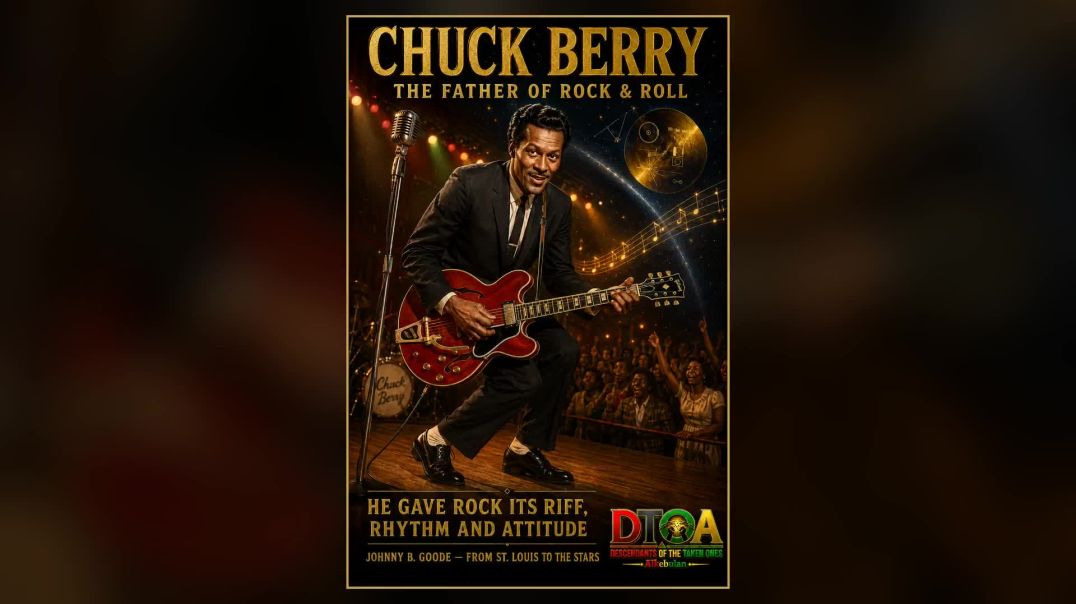
Before stadium guitars, British rock bands and generations of performers copied his style. Chuck Berry had already written the blueprint. Charles Edward Anderson Berry was born on October 18, 1926, in St. Louis, Missouri. He grew up in the Ville, a thriving Black community, and attended Sumner High School—the first high school established for Black students west of the Mississippi River.
Berry’s musical foundation drew on Black American blues, rhythm and blues, gospel, swing, and boogie-woogie. He studied the performance style of blues guitarist T-Bone Walker and blended those influences with country music, creating a sound that could cross the rigid racial boundaries of 1950s America. After joining pianist Johnnie Johnson’s trio, Berry began developing the driving guitar riffs, clever storytelling, and energetic stage presence that would transform popular music.
In 1955, blues legend Muddy Waters encouraged him to approach Chess Records in Chicago. There, Berry recorded “Maybellene,” an adaptation of the country song “Ida Red,” transformed by Black rhythm, electric guitar, and Berry’s imagination. “Maybellene” reached No. 1 on Billboard’s rhythm-and-blues chart and crossed over into the predominantly white pop market. America was being introduced to a new sound—but that sound had deep Black roots. Berry followed it with recordings that became part of rock-and-roll’s foundation:
“Roll Over Beethoven.”
“School Day.”
“Rock and Roll Music.”
“Sweet Little Sixteen.”
“Johnny B. Goode.”
Berry understood young people's aspirations. His songs told stories about school, dancing, romance, automobiles, rebellion, and the dream of becoming somebody. His lyrics turned teenage life into musical cinema. His guitar became another voice. Berry made the electric-guitar riff central to rock-and-roll. His sharp introductions, bent notes, rhythmic drive, and famous “duck walk” created a musical and visual language that generations of performers would imitate.
The Beatles recorded his songs. The Rolling Stones built their early identity around his music. The Beach Boys’ “Surfin’ U.S.A.” used the musical structure and melody of Berry’s “Sweet Little Sixteen,” which eventually led to Berry receiving songwriting credit. Yet in racially segregated America, white performers and institutions often received greater promotion, protection, and profit from music created by Black pioneers. Berry’s influence traveled farther than the recognition he initially received.
His life also included serious legal troubles and personal controversies. His complicated history should not be erased, but neither should it be used to erase his revolutionary contribution to American music. Chuck Berry did not create rock-and-roll alone. Black artists, including Sister Rosetta Tharpe, Louis Jordan, Big Joe Turner, Bo Diddley, Little Richard, Fats Domino, and many others, helped lay its foundation. But Berry gave the genre some of its most recognizable guitar language, storytelling, and attitude. The Rock & Roll Hall of Fame recognized him as a member of its first induction class in 1986. The Hall describes Berry as an artist who combined country, blues, and rhythm and blues into a singular guitar style that helped shape the development of rock-and-roll.
His red Cadillac and his Gibson guitar, known as “Maybellene,” became part of the Smithsonian’s National Museum of African American History and Culture, preserving his place in the history of Black music and American culture. Smithsonian Institution
Perhaps the greatest symbol of his reach left Earth itself. When NASA launched the Voyager spacecraft in 1977, “Johnny B. Goode” was placed aboard the Golden Record—a collection designed to represent the sounds and cultures of humanity. Berry’s recording was the collection’s only rock-and-roll song.
A musical language created by a Black man from St. Louis is now traveling through interstellar space. Chuck Berry died on March 18, 2017, at the age of 90. But every time a guitarist opens a song with a powerful riff, every time a performer crosses the stage with swagger, and every time rock-and-roll tells a story about youthful dreams, his influence can still be heard.
In closing, Descendants of the Taken Ones Recovering the stories history tried to bury. Rock-and-roll did not appear from nowhere. It grew from Black music and carried Black rhythm. One of its greatest architects was Chuck Berry.
.To support the channel, please click the like button and subscribe to receive new videos






1 Comments
cliprize
11 days ago