
113 Views· 09/20/26· Black History
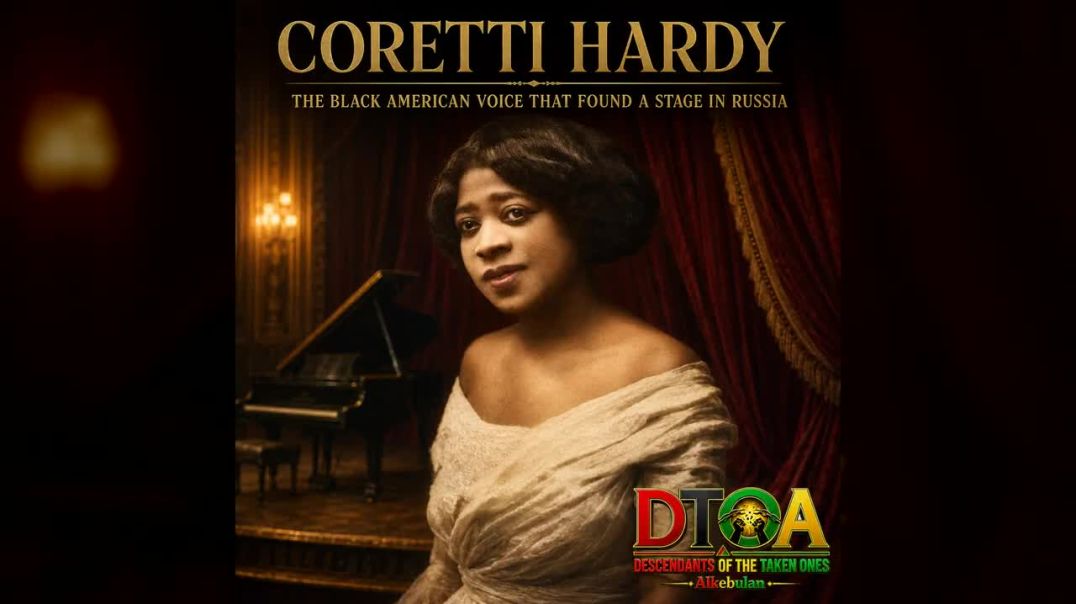
CORETTI HARDY THE BLACK AMERICAN VOICE THAT FOUND A STAGE IN RUSSIA

CORETTI HARDY THE BLACK AMERICAN VOICE THAT FOUND A STAGE IN RUSSIA
Before Paul Robeson became internationally associated with Black American music in the Soviet Union, another African American performer had already built an extraordinary life and career there. Born Corette Elizabeth Hardy on December 5, 1881, in Churchville, New York, she later became known professionally as Coretti Arle-Titz. She was a singer, actress, dancer, and recording artist, and one of the earliest Black American performers to establish a lasting career in Russia.
Coretti was born to Carrie Carter and Thomas Hardy. Her family eventually settled in New York City, where opportunities for Black women were severely restricted by racism and segregation. As a young woman, she worked as a copyist and sang in a church choir. Her life changed when she joined African American entertainers traveling to Europe. By the early 1900s, Coretti had traveled through Europe and into the Russian Empire. What began as a theatrical journey became an entirely new life.
While other performers returned home or moved elsewhere, Coretti remained in Russia. She learned the language, adapted to Russian musical traditions, and built a repertoire that encompassed Russian romances, classical works, popular songs, jazz, and African American spirituals.
Her dramatic soprano voice earned recognition. Russian audiences heard Black spirituals through Coretti decades before these songs were widely recognized as foundations of American music. Imagine the scene: an African American woman from New York walking onto a stage in Imperial Russia to sing Russian music for Russian audiences.
Coretti refused to remain a curiosity. She earned serious musical credentials and built a career that spanned the final years of Imperial Russia, World War I, the Russian Revolution, the Civil War, the creation of the Soviet Union, Stalin’s rule, and World War II. In 1924, Coretti appeared at Moscow’s legendary Bolshoi Theatre. Her program featured classical selections alongside Negro spirituals.
A Black woman born in nineteenth-century America had traveled thousands of miles beyond the racial barriers of the United States and was now performing African American sacred music in one of the world’s most prestigious cultural institutions.
The spirituals carried the suffering, faith, resistance, endurance, and hope of generations of Black people. Coretti helped carry those voices across another continent.
During the early 1930s, Coretti became the first known African American-born musician to record music in the Soviet Union. Among the spirituals she recorded were “Sometimes I Feel Like a Motherless Child” and “Little David Play on Your Harp.”
These recordings placed the African American spiritual within Soviet recorded culture. The voice of a woman born only sixteen years after the end of American slavery was being preserved thousands of miles away in Moscow.
Coretti belonged to a small but remarkable community of African Americans who lived, worked, performed, or traveled through the Soviet Union.
In 1932, she helped welcome a group of Black American artists and intellectuals who arrived in Moscow for a proposed film about American racism. The delegation included Langston Hughes. Paul Robeson later became one of the most famous Black Americans associated with the Soviet Union. But Coretti had already performed there for decades.
There were pioneers before the famous names. Coretti Hardy was one of them.
Coretti performed more than spirituals. She interpreted music associated with several peoples of the Soviet Union. In 1933, she performed in Yerevan, Armenia, where her treatment of Armenian folk music received favorable attention.
She carried Black American music into Russia while also absorbing the music of the cultures around her. She became something rare: a transnational Black artist.
Coretti remained in the Soviet Union during World War II and continued her artistic work despite the catastrophic destruction caused by Nazi Germany’s invasion. She later received the Soviet Medal “For Valiant Labour in the Great Patriotic War 1941–1945.”
A Black woman born in nineteenth-century New York survived two world wars, a revolution, and two Russian political systems. Coretti died in Moscow on December 14, 1951, after spending most of her adult life thousands of miles from the United States.
Coretti Hardy’s story is part of the larger history of the African diaspora. Some descendants of enslaved Africans crossed oceans to build lives in societies that barely understood their origins. Some carried African American culture to places where Black voices were rarely heard.
Coretti Hardy was one of those people. She performed on stages in Imperial Russia. She survived the revolution. She sang at the Bolshoi. She recorded Black spirituals in the Soviet Union. She endured political upheaval and world war. She built a career that lasted decades.
Coretti Hardy did not simply leave America. She carried the voice of Black America with her. Wherever that voice traveled, a piece of our history traveled with it.
DESCENDANTS OF THE TAKEN ONES — ALKEBULAN
Remember the names history allowed to disappear.
To support the channel, please click the like button and subscribe to receive new videos









2 Comments
cliprize
7 days agoJOSEPH ELISHA
20 days ago