
143 Views· 09/25/26· Black History
Dr. David Blackwell: The Mathematics Behind AI

Dr. David Blackwell: The Mathematics Behind AI
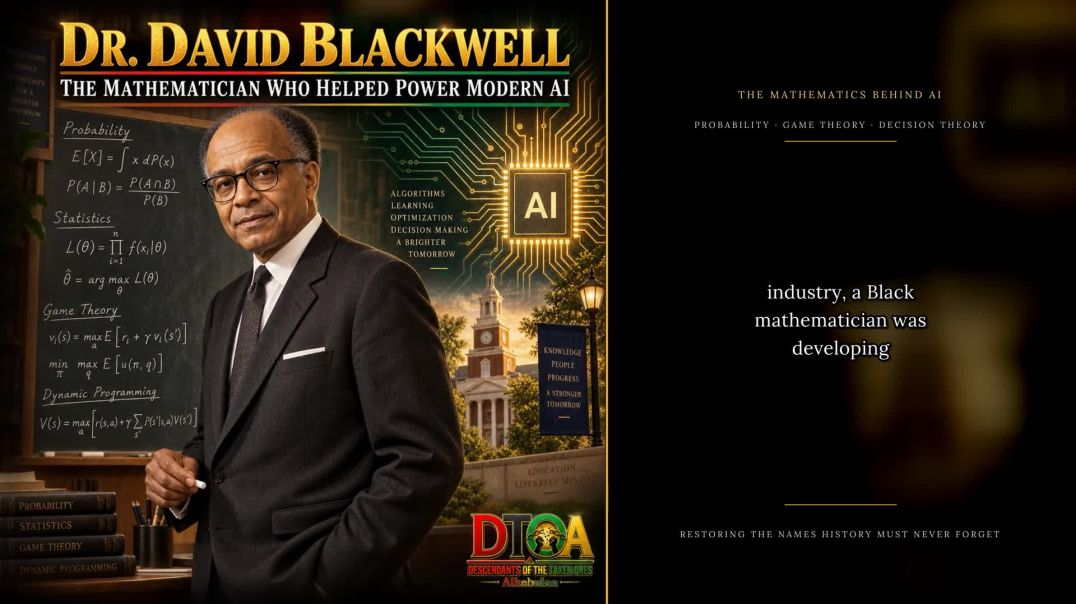
Long before artificial intelligence became a global industry, a Black mathematician was developing ideas that would enable machines to learn from information, improve predictions, and make decisions under uncertainty. His name was Dr. David Harold Blackwell.
Born in Centralia, Illinois, in 1919, Blackwell entered the University of Illinois at age 16. By 22, he had earned a doctorate in mathematics, becoming one of the earliest African Americans in the United States to do so. Blackwell later joined Howard University, where he became a professor and chaired the mathematics department. His brilliance was undeniable, yet racism still limited where he could teach and conduct research. Institutions that benefited from mathematical talent were not always prepared to recognize Black genius.
Blackwell continued working anyway. His research transformed several fields, including probability, statistics, game theory, information theory, decision theory, and dynamic programming. The Rao–Blackwell theorem, named in part for him, provides a method for improving statistical estimates. In plain language, it helps improve an existing prediction by using available information more effectively.
That principle is deeply connected to modern data science and machine learning: collect information, reduce uncertainty, improve the estimate, and make a better decision. Blackwell’s approachability theorem examines how a decision-maker can repeatedly adjust strategies to move toward a desired outcome—even when facing uncertainty or an opponent. Related ideas now appear in online learning, reinforcement learning, automated decision systems, economics, and game-playing artificial intelligence.
His work comparing information sources—sometimes called the Blackwell order or Blackwell’s comparison of experiments—helped mathematicians determine when one source of information is more useful than another. That question remains central to AI:
Which data should a system trust? Which information improves its decisions? How can uncertainty be measured? How can a machine learn from repeated outcomes? Blackwell did not invent artificial intelligence, write modern AI software, or design today’s computer chips. His contribution was more fundamental: he developed mathematical ideas that helped establish how intelligent systems can evaluate information, improve predictions, and make decisions.
In 1965, Dr. Blackwell became the first Black scholar elected to the National Academy of Sciences. He later received numerous honors for a career that transformed mathematics and statistics. Decades after his pioneering research, NVIDIA named its advanced Blackwell computing architecture in his honor. The technology trains and operates powerful artificial-intelligence systems. That naming carries historical weight. A Black mathematician who worked during segregation—when racial barriers sought to limit his opportunities—is now honored by technology that helps power the age of generative AI. We do not need to exaggerate Dr. Blackwell’s story by claiming he invented AI.
The truth is powerful enough. Dr. David Blackwell developed mathematical frameworks that helped the modern world understand information, uncertainty, learning, strategy, and intelligent decision-making.
His name belongs wherever the history of mathematics, computing, machine learning, and artificial intelligence is told. We are the Descendants of the Taken Ones, and we restore the names history too often leaves out of the equation.
Thank you for your time. To support the channel. Please like, share, and subscribe, and pass this along to your family and friends. Remember: information kept to yourself is lost over time, but shared information becomes enduring knowledge. People who lose control of their history can be led to believe they never contributed anything.

















2 Comments
cliprize
14 days agoJOSEPH ELISHA
21 days ago