
169 Views· 10/01/26· Black History
Canada's First Race Riot: David George and the Shelburne Race Riot — 1784

Canada's First Race Riot: David George and the Shelburne Race Riot — 1784
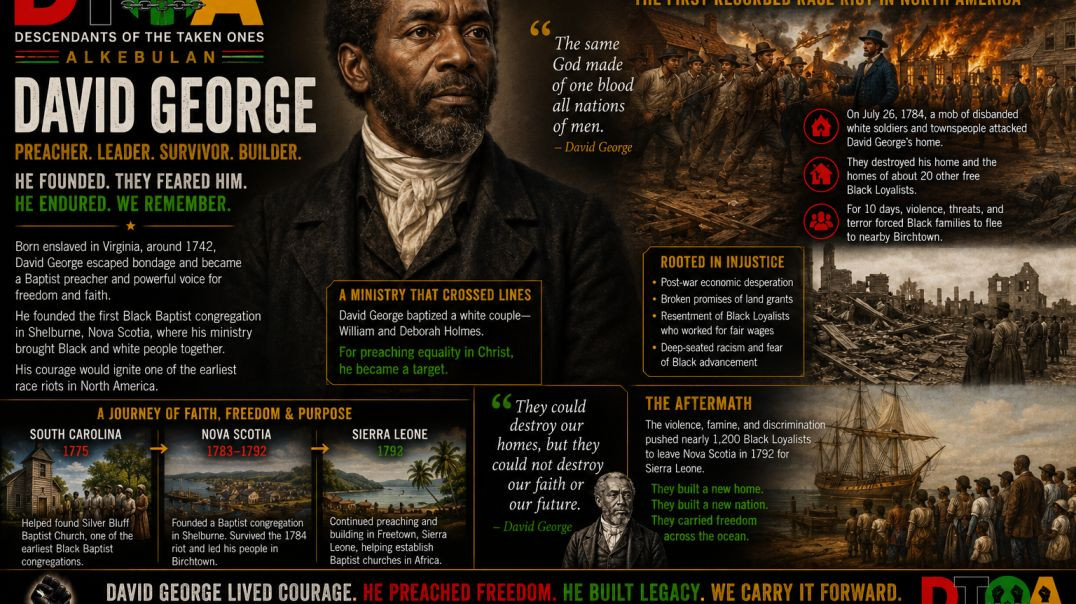
In 1784, the town of Shelburne, Nova Scotia, became the site of one of the earliest recorded race riots in North America. At the center of the storm was David George, a formerly enslaved Black Baptist preacher whose ministry crossed racial lines in a society that sought to keep Black people beneath white authority.
George had founded a Baptist congregation in Shelburne that drew both Black and white worshippers. When he prepared to baptize a white couple, William and Deborah Holmes, white anger erupted. To many in the town, the idea of a Black preacher exercising spiritual authority over white converts was intolerable.
On July 26, 1784, a mob of white Loyalists and disbanded soldiers attacked. They stormed David George’s property, destroyed his home, and tore down nearby homes of Black Loyalists. The violence continued for days, forcing many Black residents to flee toward Birchtown, a nearby Black Loyalist settlement. The Canadian Encyclopedia records the July 26 attack on the home of a Black preacher in Shelburne, and the Nova Scotia Museum notes that disbanded white soldiers destroyed about 20 houses belonging to free Black Loyalists, an event often described as Canada’s first race riot. (The Canadian Encyclopedia)
The riot was not only about religion. It was fueled by postwar desperation, delayed land grants, labor competition, racism, and resentment toward Black Loyalists who had also earned freedom through British promises during the American Revolution. The Nova Scotia Archives notes that Black Town was founded by Black settlers driven from Shelburne during the July 1784 riot, and the Black Loyalist Heritage material links the violence to white laborers and disbanded soldiers. (Nova Scotia Archives)
The aftermath helped shape a broader Black Atlantic story. Ongoing discrimination, hunger, broken promises, and violence pushed many Black Loyalists to leave Nova Scotia in 1792 for Sierra Leone, where David George continued his ministry. The Nova Scotia Archives’ Book of Negroes collection documents roughly 3,000 Black refugees who came to Nova Scotia after the American Revolution. (Nova Scotia Archives)
Strong DTOA line
1784 David George stood as a Black preacher whose faith transcended the color line. When white mobs tried to destroy his home and silence his ministry, they revealed the truth: Black freedom was feared not only in the body but also in the pulpit, the community, and the soul.



















1 Comments
cliprize
19 days ago