
42 Views· 10/14/26· Black History
Dr. Leslie Ray Matthews (1963–2025): The Black Surgeon Who Challenged Conventional Medicine and Brou

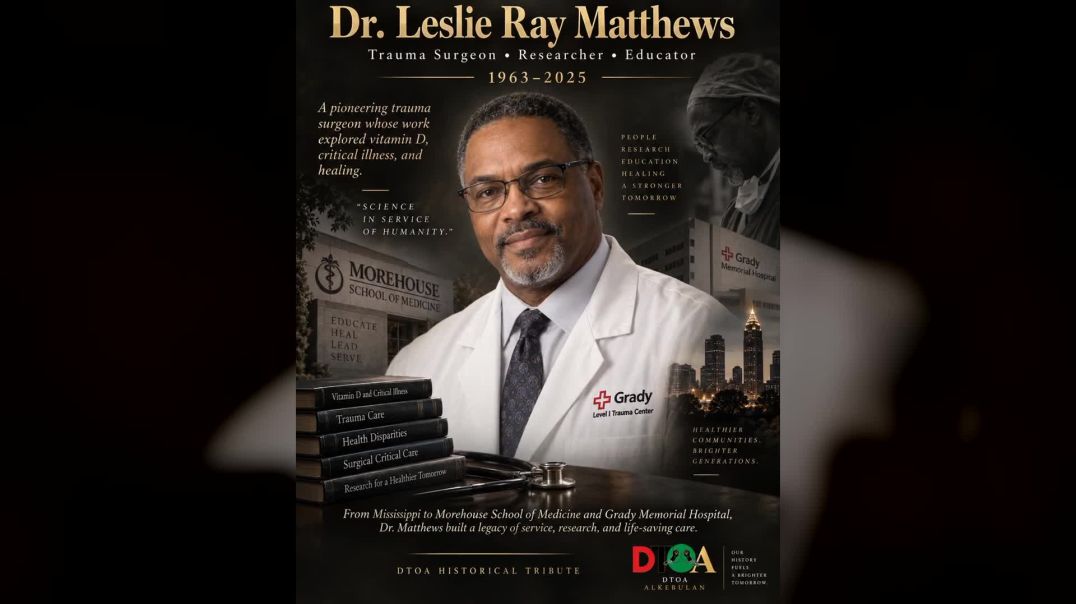
Dr. Leslie Ray Matthews (1963–2025): The Black Surgeon Who Challenged Conventional Medicine and Brought Vitamin D Into the Fight for Survival
A legacy of medical excellence, scientific investigation, Black achievement, and the determination to save lives.
medium.com
He was born in Mississippi during the final years of legal segregation. He became a highly trained trauma surgeon, a medical professor, an internationally recognized researcher, and a determined advocate for examining the role of vitamin D in critically ill patients.
His name was Dr. Leslie Ray Matthews.
And his story deserves to be remembered.
In an American medical system where African Americans have historically faced discrimination, unequal access to treatment, and serious health disparities, Dr. Matthews built a career confronting life-threatening injuries and asking questions that could change how doctors understood recovery.
He operated on the severely injured. He treated patients fighting for their lives. He trained future physicians. And he investigated whether a nutritional deficiency that conventional trauma care often overlooked might be associated with worse hospital outcomes.
His research eventually attracted attention far beyond the operating room.
But his journey began in Mississippi.
1. Childhood: Growing Up in the Segregated South
Leslie Ray Matthews was born in 1963 in Mississippi, during one of the most turbulent periods in American civil rights history.
It was the same year civil rights leader Medgar Evers was assassinated in Jackson, Mississippi, and only one year before the Civil Rights Act of 1964.
For Black children growing up in Mississippi, the struggle for equal opportunity was not merely something discussed in history books. It was woven into the institutions around them.
Public education, employment, housing, healthcare, and access to professional opportunities had all been shaped by generations of racial exclusion.
Matthews came of age as the South was undergoing enormous social transformation.
Although detailed public accounts of his parents, elementary education, and earliest childhood experiences are limited, his later academic achievements reveal the extraordinary direction his life would take.
He eventually moved from Mississippi's public schools into the demanding world of university science, medicine, and advanced surgical training.
His story represents a generation of African Americans who entered professions that had long erected barriers against them.
2. Education: From Mississippi to Medical Excellence
Matthews demonstrated exceptional academic ability and pursued chemistry at the University of Mississippi.
In 1985, he graduated cum laude with a bachelor's degree in chemistry.
Four years later, in 1989, he earned his Doctor of Medicine from the University of Mississippi Medical Center.
He continued his medical education through surgical training, including a general surgery residency at Morehouse School of Medicine in Atlanta, Georgia.
His pursuit of advanced medical knowledge eventually brought him to the prestigious Mayo Clinic in Rochester, Minnesota.
There, he completed specialized fellowship training in surgical critical care in 2004.
Surgical critical care is among the most demanding specialties in modern medicine. It requires physicians to manage devastating injuries, organ failure, overwhelming infections, and rapidly deteriorating patients.
A critical care surgeon cannot afford to ignore small details.
Blood pressure, oxygen delivery, kidney function, inflammation, infection, and nutritional status can all become part of the struggle between life and death.
This combination of surgical expertise and physiological understanding would later shape Matthews's research interests.
mww-milestones.s3.us-east-2.amazonaws.com
3. A Surgeon on the Front Lines of Life and Death
Throughout his career, Matthews worked in emergency medicine, general surgery, trauma surgery, and surgical intensive care.
One notable event in his professional biography occurred in 1996, when he reportedly helped rescue Mississippi Governor Kirk Fordice following a serious automobile accident.
He subsequently built a substantial career in Atlanta, serving at Grady Memorial Hospital and Morehouse School of Medicine.
At Grady, one of the region's major trauma centers, physicians face medical emergencies involving devastating physical injuries, severe infections, and critically ill patients.
Matthews served as an attending surgeon at Grady beginning in 2007 and later directed its surgical intensive care unit.
At Morehouse School of Medicine, he advanced through faculty appointments and became a professor of clinical surgery.
For a Black physician from Mississippi, these positions represented remarkable professional achievements.
But Matthews was not content simply to practice medicine.
He wanted to investigate whether critically ill patients were suffering from an overlooked physiological problem.
That question would help define his scientific legacy.
mww-milestones.s3.us-east-2.amazonaws.com
4. The Vitamin D Question That Changed His Research Career
Vitamin D is commonly associated with strong bones and calcium absorption.
But it also participates in biological processes involving immune function, inflammation, and cellular regulation.
Matthews became deeply interested in the possibility that vitamin D deficiency could be associated with poor outcomes among severely injured and critically ill patients.
His work focused on questions that were clinically important.
Could patients admitted to intensive care have unexpectedly low vitamin D levels?
Could the severity of that deficiency be associated with prolonged hospitalization?
And could vitamin D status help explain differences in medical outcomes?
These questions mattered because trauma patients are among the most vulnerable people in a hospital.
Many arrive following automobile crashes, shootings, falls, or other catastrophic injuries.
Their survival can depend on managing a cascade of complications long after their initial surgery.
Matthews wanted to understand whether vitamin D deficiency was another factor physicians needed to investigate.
5. The 2012 Research That Drew National Attention
In 2012, Matthews and his research colleagues published a significant study in The American Journal of Surgery.
Its title was:
Worsening severity of vitamin D deficiency is associated with increased length of stay, surgical intensive care unit cost, and mortality rate in surgical intensive care unit patients.
The research examined 258 patients admitted to the surgical intensive care unit at Grady Memorial Hospital.
The findings were striking.
DR. MATTHEWS'S 2012 STUDY — 258 PATIENTS
53.5%
Severe vitamin D deficiency
37.2%
Moderate deficiency
1.2%
Normal levels under study criteria
Average surgical ICU stay by vitamin D status
Observational study; these results do not establish that vitamin D treatment shortens ICU stays.
Source: Matthews et al., The American Journal of Surgery, 2012.
PubMed
Patients with more severe deficiencies tended to experience longer intensive care stays and higher treatment costs.
The researchers also identified an association between vitamin D deficiency and mortality.
However, there was an essential scientific distinction: this was an observational study.
It demonstrated an association, not proof that vitamin D deficiency directly caused these complications or that supplementation would prevent them.
Nevertheless, Matthews and his colleagues had documented an important clinical question worthy of further investigation.
In 2016, Morehouse School of Medicine celebrated this paper as one of the most-cited articles published in The American Journal of Surgery since 2011.
For Matthews, the research represented more than academic recognition.
It was an opportunity to challenge physicians to investigate potentially overlooked factors in critical care.
PubMed
6. Vitamin D, Traumatic Brain Injuries, and Medical Innovation
Matthews expanded his interest in vitamin D beyond routine nutritional deficiency.
He investigated its potential role in traumatic brain injuries, inflammatory responses, severe infections, and other conditions encountered in critical care.
Brain injuries present extraordinary medical challenges.
When someone suffers a severe blow to the head, damage can continue after the initial injury through swelling, inflammation, impaired circulation, and other secondary processes.
Matthews believed that vitamin D's biological functions deserved closer investigation in these circumstances.
He pursued intellectual-property protection relating to vitamin D treatment for traumatic brain injuries and concussions, with patent-related activity documented in his professional milestones in 2019.
But a patent is not proof that a medical treatment is safe or effective.
His work reflected an effort to develop possible new treatment approaches. Establishing whether such approaches improve survival or neurological recovery requires rigorous clinical trials. mww-milestones.s3.us-east-2.amazonaws.com
7. Challenging Medical Institutions and Advocating for Public Health
Matthews did not restrict his advocacy to hospital patients.
He believed vitamin D deficiency deserved greater attention in public health.
He spoke to medical and governmental audiences about nutritional status, critical illness, and the potential implications of vitamin D deficiency.
His professional record describes presentations involving the Centers for Disease Control and Prevention, the U.S. Food and Drug Administration, and international audiences.
In 2012, he addressed the potential implications of vitamin D deficiency for military health.
His advocacy included the argument that nutritional deficiencies could affect population health and military readiness.
He also supported broader public education and policies intended to improve awareness of vitamin D deficiency.
These activities brought attention to a subject he believed deserved more scientific and clinical investigation.
For a physician who had spent years treating critically ill patients, his central concern remained the same: identifying potentially important factors that medicine might otherwise overlook. mww-milestones.s3.us-east-2.amazonaws.com
8. COVID-19 and the Controversy Surrounding Vitamin D
When the COVID-19 pandemic emerged in 2020, Matthews became an outspoken advocate for examining vitamin D in relation to respiratory infections and severe illness.
He argued that vitamin D's role in immune function warranted serious attention.
His public statements went further, sometimes promoting high-dose vitamin D as a potential treatment for COVID-19 and other serious medical conditions.
His advocacy attracted attention at a time when the world desperately needed effective therapies.
However, there is an important difference between proposing a biological mechanism and proving clinical effectiveness.
Subsequent research has not established high-dose vitamin D as an effective treatment or cure for COVID-19. Correcting a diagnosed deficiency may be appropriate medical care, but it does not replace vaccination, evidence-based treatment, or other established medical interventions.
Excessive vitamin D can also cause toxicity, including dangerous elevations in blood calcium and kidney injury.
Matthews's COVID-era advocacy is part of his history, but the strength of his scientific legacy should be evaluated through evidence rather than treating every proposed application as an established breakthrough.
He raised questions that deserved scientific investigation. The answers must ultimately come from well-designed research. Dr. Matthews interview
9. Recognition, Honors, and Professional Accomplishments
Throughout his career, Matthews received recognition for his medical service, research, and professional leadership.
Among his documented achievements:
• 1996: Reportedly helped rescue Mississippi Governor Kirk Fordice after a serious automobile accident.
• 2003: Received a Mayo Clinic Teaching Award.
• 2008: Became a Fellow of the American College of Surgeons.
• 2015: Was honored by the Mississippi Legislature for his medical achievements and vitamin D research.
• 2017: Received the Albert Nelson Marquis Lifetime Achievement Award.
• 2018: Became an Overseas Fellow of the Royal Society of Medicine.
• 2019: Received recognition on the Royal Society of Medicine's Wall of Honor and became a Fellow of the American College of Critical Care Medicine.
His professional accomplishments extended beyond medicine's operating rooms and intensive care units.
He became a scientific speaker, an educator, a researcher, and a visible example of Black achievement in specialized medical practice.
mww-milestones.s3.us-east-2.amazonaws.com
10. Black Excellence and the Importance of Representation
The historical importance of Leslie Ray Matthews extends beyond his scientific publications.
He was a Black man born in Mississippi in 1963 who eventually became a professor of surgery and a leader in surgical critical care.
Consider the history surrounding that achievement.
For generations, African American physicians encountered discriminatory admissions policies, segregated hospitals, and exclusions from medical societies and professional opportunities.
Black communities also experienced profound disparities in healthcare access and medical treatment.
Institutions such as Morehouse School of Medicine helped strengthen the training of physicians committed to serving populations traditionally underserved by American medicine.
Matthews became part of that larger history.
His presence in medical education mattered.
His surgical leadership mattered.
And the fact that he contributed original research to a nationally recognized surgical journal mattered.
His life challenged the narrow portrayal of African Americans as simply recipients of scientific progress rather than contributors to its development.
Black physicians have been innovators, investigators, teachers, and leaders throughout American medical history.
Dr. Leslie Ray Matthews belongs within that tradition.
11. The Final Chapter: August 27, 2025
On August 27, 2025, Dr. Leslie Ray Matthews died at the age of 62.
His passing marked the end of a career spanning decades of medical training, emergency treatment, surgical practice, research, education, and public advocacy.
His memorial announcement confirmed his death, although the publicly available notice did not establish a cause.
He left behind a professional record that included peer-reviewed research, major academic appointments, medical education, and numerous professional recognitions.
Legacy
12. His Legacy: A Medical Career That Deserves to Be Remembered
Dr. Leslie Ray Matthews should not be remembered solely as the physician who promoted vitamin D.
His story is larger than any single theory, treatment proposal, or scientific controversy.
He was a trauma surgeon who cared for people facing devastating injuries.
He was an educator who helped prepare future physicians.
He was a medical investigator who contributed published evidence connecting vitamin D status with outcomes among critically ill patients.
He was a Mississippi-born Black physician who achieved leadership positions at major medical institutions.
And he was a man whose professional life demonstrated the importance of curiosity, education, persistence, and service.
His 2012 research remains part of the scientific literature available to physicians and investigators examining nutritional status and critical illness.
His advocacy also reminds us that scientific proposals, no matter how passionately advanced, must be examined through independent research.
That distinction does not diminish his documented achievements.
It gives us a more complete picture of the man and his work.
Dr. Matthews's career demonstrates that medical progress involves both the courage to ask difficult questions and the discipline to test their answers.
Descendants of the Taken Ones Closing Message
History often remembers those who command armies, accumulate fortunes, or hold political office. But there are other forms of greatness. There is greatness in the surgeon who enters the operating room to save a stranger. There is greatness in the professor who shares knowledge with a new generation. There is greatness in the researcher who examines a problem others have not fully explored. And there is greatness in the Black child who grows up in a society marked by racial inequality yet reaches the highest levels of professional achievement. Dr. Leslie Ray Matthews traveled that road. From Mississippi to the Mayo Clinic. From surgical training to the intensive care units of Atlanta. From treating individual patients to publishing research that reached the international medical community. His life demonstrates that Black history is not limited to suffering and the struggle against oppression. Black history is also a history of scientific inquiry, medical excellence, discovery, leadership, and service to humanity.
Dr. Leslie Ray Matthews was part of that history.
His name deserves to be spoken.
His accomplishments deserve to be documented.
And his contributions deserve to be examined, understood, and remembered by future generations.
Rest in honor, Dr. Leslie Ray Matthews (1963–2025).
Descendants of the Taken Ones.
Our history deserves to be remembered. Our achievements deserve to be recognized. Our stories deserve to be told.
Historical and scientific sources
The principal sources for this narrative include his Marquis Who's Who professional milestone profile, his 2012 peer-reviewed surgical ICU study, his professional biography, and his 2025 memorial announcement. Some award and advocacy details come from professional biographical materials rather than independently verified institutional records. Thank you for your time. To support the channel. Please like, share, and subscribe, and pass this along to your family and friends. Remember: information kept to yourself is lost over time, but shared information becomes enduring knowledge. People who lose control of their history can be led to believe they never contributed anything.




















1 Comments
JOSEPH ELISHA
53 minutes ago