
124 Views· 09/27/26· Black History
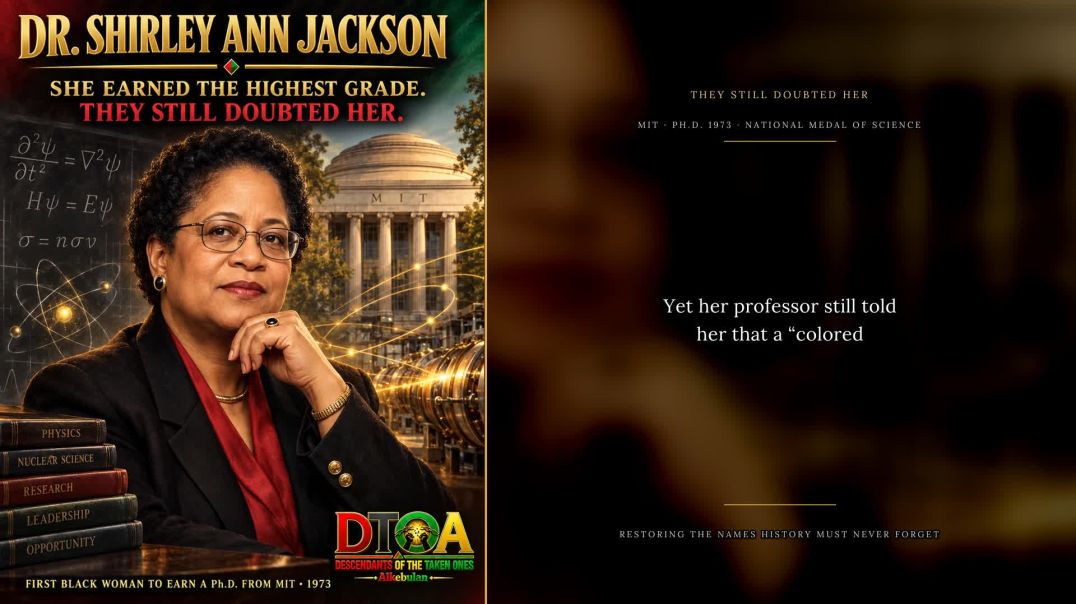
Dr. Shirley Ann Jackson They Still Doubted Her She earned the highest grade in the class.

Dr. Shirley Ann Jackson They Still Doubted Her
She earned the highest grade in the class.
Yet her professor still told her that a “colored girl” should learn a trade.
When Shirley Ann Jackson entered the Massachusetts Institute of Technology in 1964, she was an 18-year-old valedictorian from Washington, D.C. She arrived with an extraordinary mind, a fascination with mathematics and science, and the determination to become a physicist.
But intelligence did not shield her from racism.
Jackson later recalled classmates refusing to study with her, students avoiding the seat beside her, and a professor calling her and another Black woman “Tweedledum and Tweedledee.”
She was earning A’s.
She reportedly had the highest grade in that professor’s class.
The problem was never her ability. The problem was an institution and a society that struggled to recognize brilliance when it appeared in the body of a Black woman.
Jackson refused to surrender her future to someone else’s prejudice.
She earned her bachelor’s degree in physics from MIT in 1968. Following the assassination of Dr. Martin Luther King Jr., she became increasingly involved in improving conditions for Black students at the Institute.
She helped organize MIT’s Black Students’ Union and worked to expand recruitment, financial aid, and educational opportunities for African American students. Jackson later recalled that MIT had previously enrolled only a few Black students each year. Following the recruitment initiative, the next class reportedly had 57 students.
The young woman who had once been told to go away when she approached classmates for help was now helping open MIT’s doors for an entire generation.
Jackson remained at MIT to study theoretical elementary-particle physics. In 1973, she became the first Black woman to earn a doctorate from MIT in any field and the second Black woman in the United States to receive a doctorate in physics. MIT’s account and biographical sources document this historic achievement.
Her career continued through advanced research connected with Fermilab and CERN. At AT&T Bell Laboratories, she conducted research in theoretical, solid-state, quantum, and optical physics before later teaching at Rutgers University.
In 1995, President Bill Clinton appointed Jackson to the United States Nuclear Regulatory Commission.
She became the first African American to serve as an NRC commissioner—and later the first woman and first African American to chair the agency responsible for overseeing the civilian use of nuclear materials in the United States.
In 1999, Jackson became president of Rensselaer Polytechnic Institute, making history as the first Black woman to lead a nationally ranked technological research university. She served for 23 years.
Her lifetime of scientific achievement and leadership was recognized with the National Medal of Science, presented by President Barack Obama at the White House in 2016.
The professor who doubted her could see her race and gender.
He could not see her future.
He could not see the physicist.
He could not see the federal regulator.
He could not see the university president.
He could not see the woman who would help transform the very institutions that once tried to isolate her.
Dr. Shirley Ann Jackson did more than become an exception.
She helped widen the doorway for those who came behind her.
That is the deeper meaning of her legacy:
She earned the highest grade. They still doubted her. She kept going—and eventually led institutions that once questioned whether she belonged.
We are the Descendants of the Taken Ones. We remember the minds they underestimated, the barriers they shattered, and the doors they refused to leave closed. Thank you for your time. To support the channel. Please like, share, and subscribe, and pass this along to your family and friends. Remember: information kept to yourself is lost over time, but shared information becomes enduring knowledge. People who lose control of their history can be led to believe they never contributed anything.





















2 Comments
cliprize
14 days agoJOSEPH ELISHA
19 days ago