
132 Views· 09/24/26· Black History
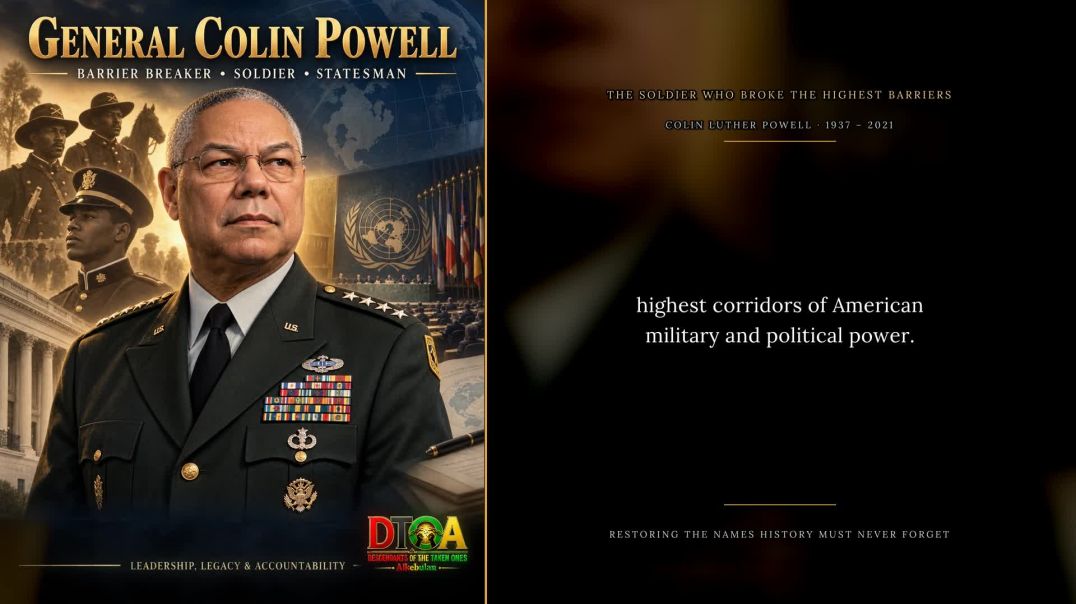
Colin Powell: The Soldier Who Broke the Highest Barriers

Colin Powell: The Soldier Who Broke the Highest Barriers
Before Barack Obama entered the White House, another Black man had already walked through the highest corridors of American military and political power. His name was Colin Luther Powell. Born in Harlem on April 5, 1937, and raised in the South Bronx, Powell was the son of Jamaican immigrants Luther and Maud Powell. He was not considered an exceptional student in his youth, but while attending the City College of New York, he found discipline, confidence, and purpose through Army ROTC.
That decision changed his life. Powell entered the United States Army as a second lieutenant in 1958. He served two tours in Vietnam, earned the Soldier’s Medal for rescuing fellow servicemen from a burning helicopter, and rose through an institution that had only recently been officially desegregated.
He eventually earned four stars. In 1989, Colin Powell became the first Black chairman of the Joint Chiefs of Staff, the highest-ranking military officer in the United States. He advised Presidents George H. W. Bush and Bill Clinton and helped direct American military operations during the invasion of Panama and the Persian Gulf War. Powell believed military force should not be used lightly. The principles of the Powell Doctrine called for clear objectives, strong public support, overwhelming force, and a defined path out of a conflict.
He understood that sending troops into battle was not a political performance. It meant putting real lives at risk. Powell also honored the Black soldiers whose service made his own career possible. In 1992, he helped dedicate the Buffalo Soldier Monument at Fort Leavenworth, Kansas, recognizing the courage and sacrifice of the 9th and 10th Cavalry regiments.
In 2001, he broke another barrier when President George W. Bush appointed him the first Black United States secretary of state. For Black Americans, his elevation carried enormous symbolic weight. A descendant of Caribbean people now represented the United States before the entire world. His career demonstrated that Black leadership could no longer be confined to the margins of American power.
But Powell’s legacy also carries a painful warning. On February 5, 2003, he appeared before the United Nations and presented the Bush administration’s case that Iraq possessed weapons of mass destruction. The intelligence supporting key parts of that presentation was later shown to be false or unreliable. No active Iraqi stockpiles of the kind described were found. Powell later called that speech a “blot” on his record and accepted responsibility for presenting those claims to the world. His reputation for credibility had been used to strengthen the case for a war that would cost countless lives and destabilize the region. That moment cannot be erased from his history.
But neither should it erase everything that came before it. Colin Powell’s life was a story of historic advancement, military service, disciplined leadership, racial progress, human imperfection, and the consequences of trusting institutions that provide flawed information. He showed that a Black man could rise from an immigrant household in the South Bronx to become America’s highest-ranking military officer and chief diplomat. He also showed that no title, uniform, or lifetime of honorable service protects a leader from making a decision history will question. Colin Powell died on October 18, 2021, at age 84.
His legacy should neither be worshipped nor discarded. It should be studied. He was a barrier-breaker—but breaking a barrier does not relieve the responsibility to question the system on the other side. We are the Descendants of the Taken Ones.
We honor the climb, acknowledge the achievement, examine the mistakes, and tell the full story. General Colin Powell—American soldier, statesman, barrier-breaker, and a reminder that representation in the halls of power must always be accompanied by truth and accountability. Thank you for your time. To support the channel. Please like, share, and subscribe, and pass this along to your family and friends. Remember: information kept to yourself is lost over time, but shared information becomes enduring knowledge. People who lose control of their history can be led to believe they never contributed anything.










![YoungBoy Never Broke Again - Finest [Official Music Video]](https://theblacktube.com/upload/photos/2025/11/cUncqoVccPpMN2hNNK3X_02_0e5bb75c5d401c5322a2f625f471638f_image.jpg)




1 Comments
cliprize
13 days ago