
44 Views· 10/12/26· Black History
Eddie Robinson Sr. — The Black Coach Who Changed College Football Forever

Eddie Robinson Sr. — The Black Coach Who Changed College Football Forever
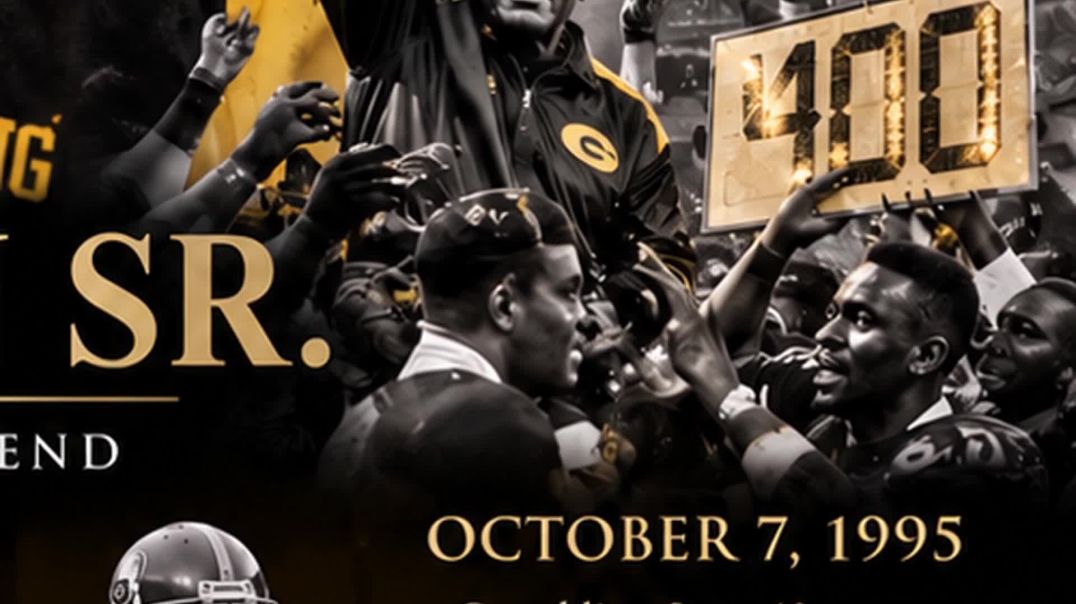
October 7, 1995 — Grambling, Louisiana.
A 76-year-old Black football coach stood on the sidelines of Robinson Stadium, watching the final seconds tick off the scoreboard. The Grambling State Tigers had just defeated Mississippi Valley State University, 42–6. Balloons filled the air. Fireworks erupted. The marching band celebrated. Thousands witnessed a moment that would become part of American sports history. For the first time, a college football coach had reached 400 career victories. His name was Eddie G. Robinson Sr. But this celebration was about more than football. It marked the extraordinary achievement of a Black man who had begun his coaching career in segregated America, when African Americans were routinely excluded from opportunities in major college athletics.
Robinson had not simply won 400 football games. He had built a nationally respected football program at a historically Black university, developed generations of young men, and helped open professional football opportunities for Black athletes. Contemporary reporting confirmed the victory, celebrations, and national recognition that followed.
From a Segregated Louisiana to Football Greatness
Eddie Gay Robinson was born on February 13, 1919, in Jackson, Louisiana. His father was a sharecropper, and his mother worked as a domestic servant. Neither parent completed high school, but they deeply valued education and encouraged their son to pursue opportunities they had never had. Robinson attended McKinley Senior High School in Baton Rouge before studying at Leland College, where he played quarterback. He later pursued graduate studies at the University of Iowa.
In 1941, at just 22, he accepted the head football coaching position at what was then the Louisiana Negro Normal and Industrial Institute, the institution that would become Grambling State University. The program had limited resources. Robinson initially handled numerous responsibilities beyond coaching, helping build a football program from the ground up. He did not inherit a nationally recognized powerhouse. He helped create one.
Building a Dynasty While America Practiced Segregation
During Robinson's early coaching years, segregation shaped nearly every aspect of Southern life. Major college football programs across much of the South excluded Black athletes. Travel accommodations, restaurants, schools, and public facilities were segregated. Yet Robinson recognized exceptional talent among young Black men who had been denied the same athletic opportunities as white students. He recruited them, coached them, and demanded academic achievement alongside athletic performance. In 1945, Grambling completed a perfect 10–0 season, earning recognition as a Black college national champion.
The team began attracting attention beyond Louisiana. Over the following decades, Grambling became a national name, playing major games in renowned stadiums such as Yankee Stadium, the Houston Astrodome, and the Los Angeles Coliseum. A football program at a small historically Black college had become an institution of national influence.
He Developed NFL Legends When Doors Were Closed
Robinson's influence reached far beyond Grambling. Among the celebrated athletes he coached were:
• Willie Davis — Five-time NFL champion with the Green Bay Packers and Pro Football Hall of Famer.
• Willie Brown — Legendary defensive back and Pro Football Hall of Famer.
• Buck Buchanan — Kansas City Chiefs defensive star and Pro Football Hall of Famer.
• Charlie Joiner — One of professional football's outstanding wide receivers and a Hall of Famer.
• Paul “Tank” Younger — A pioneering Black professional football player from an HBCU.
• James Harris — A trailblazing Black NFL starting quarterback.
• Doug Williams — The first Black starting quarterback to win a Super Bowl, earning Super Bowl XXII MVP honors.
These were not ordinary achievements in an era when Black athletes faced limited opportunities, racial stereotypes, and discrimination in recruiting and professional football. Robinson helped demonstrate that elite football talent existed at historically Black colleges and deserved national recognition. More than 200 players from his Grambling program reached professional football, according to the College Football Hall of Fame.
The Day He Surpassed Bear Bryant
October 7, 1995, was not Robinson's first historic coaching milestone. Ten years earlier, on October 5, 1985, Grambling defeated Prairie View A&M, 27–7, marking Robinson's 324th victory. That win moved him past legendary Alabama coach Paul “Bear” Bryant as college football's all-time winningest coach at the time.
For a Black coach whose career had been built at an HBCU during segregation, surpassing one of the most celebrated white coaches in American football carried enormous historical significance. Then, a decade later, Robinson reached 400 victories—a milestone no college football coach had previously reached.
His Final Record Was More Than a Number
408
Career victories
17
SWAC championships
9
Black college national titles
27
Consecutive winning seasons
Final coaching record: 408 wins • 165 losses • 15 ties
Grambling State, 1941–1942 and 1945–1997. Figures from the College Football Hall of Fame.
Robinson also coached more than 4,000 student-athletes throughout his career. The Eddie G. Robinson Museum reports that more than 80% of them earned college degrees. That distinction matters because Robinson's work was never limited to building winning teams. He understood that athletic careers could end, but education could provide opportunities for an entire lifetime.
The Man Who Became Bigger Than Football
In 1997, Eddie Robinson was inducted into the College Football Hall of Fame. That same year, he coached his final season at Grambling. On November 29, 1997, Robinson walked the sidelines for the last time in the Bayou Classic against Southern University.
He retired with 408 victories.
Eddie Robinson Sr. died April 3, 2007, at age 88.
His legacy continues through the Eddie G. Robinson Museum at Grambling State University, the national coaching award bearing his name, and the generations of athletes whose lives he influenced.
Descendants of the Taken Ones
When Eddie Robinson began coaching in 1941, Black Americans faced legal segregation, unequal educational opportunities, and discrimination across professional sports. Yet he refused to let those barriers define the limits of his ambition. He took a small Black college football program and helped transform it into a nationally recognized institution. He developed players who became professional champions. He sent young men into the world with degrees, discipline, and confidence. And on October 7, 1995, at age 76, he became the first college football coach to win 400 games.
Remember this: Eddie Robinson did not need a prestigious white university to prove his greatness. He built a legacy at a historically Black university that the entire football world had to acknowledge. His story is a reminder that Black excellence did not begin when institutions finally opened their doors. It was already flourishing in the places where Black Americans had created opportunities for themselves.
Descendants of the Taken Ones.
Know your history. Honor your ancestors. Preserve their legacy. Thank you for your time. To support the channel. Please like, share, and subscribe, and pass this along to your family and friends. Remember: information kept to yourself is lost over time, but shared information becomes enduring knowledge. People who lose control of their history can be led to believe they never contributed anything.



















1 Comments
JOSEPH ELISHA
2 hours ago