
88 Views· 09/20/26· Black History
Fidel Castro: The Revolution That Took Privilege Away

Fidel Castro: The Revolution That Took Privilege Away
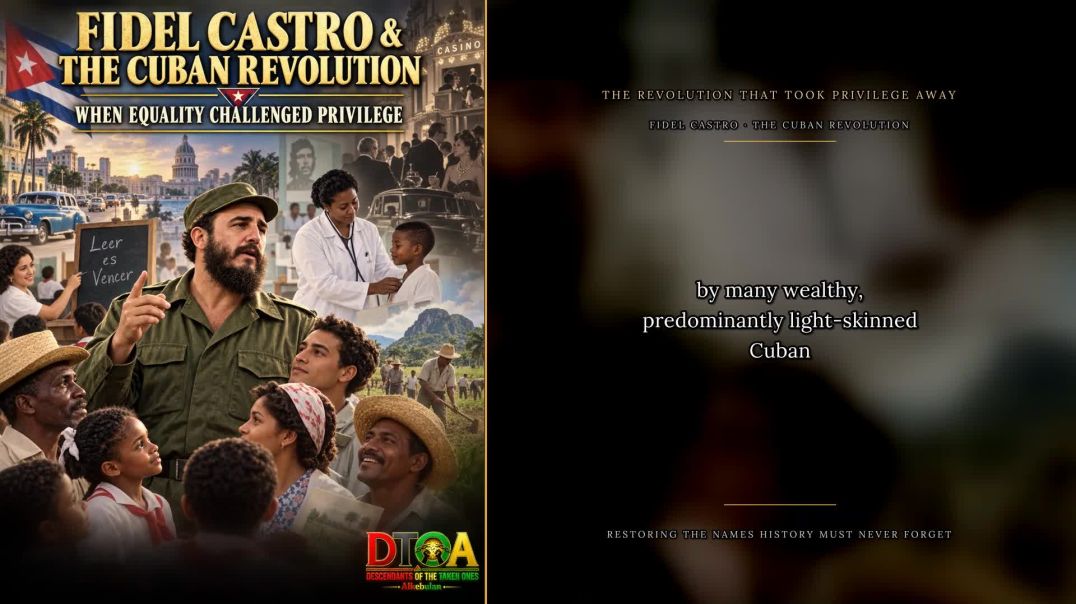
To understand why Fidel Castro remains deeply hated by many wealthy, predominantly light-skinned Cuban exile families, we must understand what Cuba looked like before the 1959 Revolution. Before Castro, Cuba was governed by the U.S.-backed dictatorship of Fulgencio Batista. Wealth, land, political influence, private schools, exclusive beaches, social clubs, and economic opportunity were concentrated among Cuba’s upper classes. Because of Cuba’s long history of slavery and racial discrimination, those privileged circles were excessively white and light-skinned. Black and poor Cubans were often excluded from the best schools, neighborhoods, professions, beaches, hotels, and social organizations. Castro’s revolution attacked that unequal order. The revolutionary government desegregated beaches and public facilities, challenged discrimination in employment and education, abolished exclusive private clubs, redistributed land, nationalized major businesses, and expanded public services to neglected rural and Black communities. A nationwide literacy campaign sent teachers across the island, making education widely accessible. Medical care was treated as a public right rather than something reserved for those who could afford it. Many poor Cubans gained opportunities that had previously been blocked by class, geography, and color. Cuba also emerged as a major international opponent of colonialism and apartheid. Cuban doctors, teachers, and soldiers served across Africa. Cuban forces fought in Angola, where their intervention helped weaken South Africa’s apartheid government and contributed to the conditions that led to Namibia’s independence. These accomplishments help explain why Castro became a symbol of resistance throughout Africa, Latin America, and much of the developing world. This created powerful enemies. Members of Cuba’s wealthy and professional classes lost plantations, businesses, rental properties, political influence, domestic servants, and exclusive access to private institutions. The first large wave of Cubans to leave after the revolution was disproportionately affluent and white. Many settled in Florida, where their memories, political impact, and opposition to Castro became deeply rooted across generations.
Castro did not merely change the government; he dismantled the social order that had placed their families near the top. However, it would be inaccurate to say that all light-skinned Cubans hate Castro or that everyone who left Cuba was defending racial privilege. Many Cubans opposed him because his government became authoritarian. It suppressed independent journalism, restricted political competition, imprisoned dissidents, seized property without adequate compensation, limited religious and civil freedoms, and punished those who challenged the Communist Party. Black Cubans, working-class Cubans, artists, religious believers, and former revolutionaries were also among those persecuted or driven into exile. The full truth is therefore more complicated than either side often admits. Fidel Castro’s government expanded literacy, education, healthcare, and opportunity while dismantling institutions that had protected racial and economic privilege. It also built a one-party state that denied Cubans fundamental political freedoms and insisted that racism had been solved, even as racial inequality persisted beneath the surface. That is why Castro’s legacy remains so fiercely contested.
To many poor, Black, and previously excluded Cubans, the revolution opened doors that old Cuba had kept locked. To many formerly powerful families, it meant the loss of wealth, property, status, and control. To political prisoners and silenced citizens, it became another form of oppression. The lesson is not that every light-skinned Cuban hated Castro because of race. The deeper lesson is that equality can feel like oppression to those who once benefited from inequality—and when a revolution redistributes power, those who lose privilege often tell a very different story than those who finally gain access. The historical distinction matters: early Cuban exiles were disproportionately affluent, yet skin color alone does not explain opposition to Castro. Sources supporting the narrative include the Library of Congress, University of Chicago scholarship on post-revolutionary race, Boston University’s analysis of Cuban migration, and Amnesty International’s.
We are the Descendants of the Taken Ones. We examine the whole history: the achievements, the contradictions, the privilege that was dismantled, and the freedom that was denied. Thank you for your time. To support the channel. Please like, share, and subscribe, and pass this along to your family and friends. Remember: information kept to yourself is lost over time, but shared information becomes enduring knowledge. People who lose control of their history can be led to believe they never contributed anything.







1 Comments
cliprize
12 days ago