

35 Views· 10/09/26· Black History
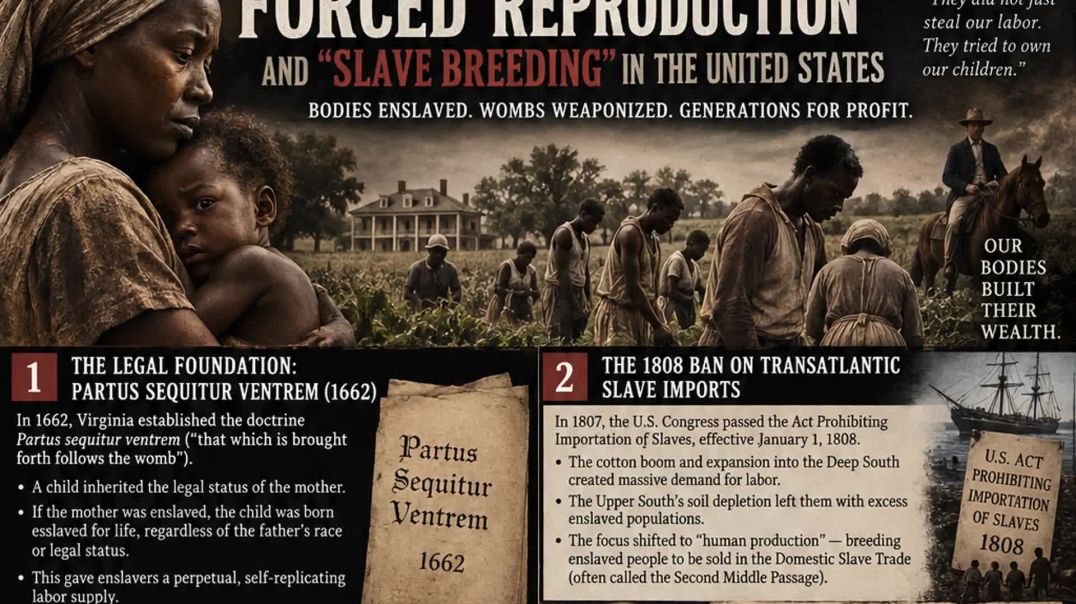
FORCED REPRODUCTION AND “SLAVE BREEDING” IN THE UNITED STATES

FORCED REPRODUCTION AND “SLAVE BREEDING” IN THE UNITED STATES
The United States’ horrible history of forced reproduction and so-called “slave breeding” is among the most brutal aspects of American chattel slavery. It arose from a convergence of legal doctrine, economic necessity, sexual violence, territorial expansion, and the complete commodification of human beings. Slavery did not simply exploit Black labor.
It created a legal and economic system in which the reproductive capacity of enslaved women could become a source of wealth. Children could be born already belonging to another human being. Pregnancy could increase the financial value of an estate. Birth could create property. Families could be deliberately separated whenever profit demanded it. This system did not require every plantation to operate a separate, specialized “breeding farm.” The broader plantation economy itself could function as a system in which reproduction was encouraged, manipulated, coerced, exploited, and monetized.
1. THE LEGAL FOUNDATION: PARTUS SEQUITUR VENTREM
The structural basis for turning human reproduction into capital began in the colonial era. In 1662, Virginia enacted a legal principle that would become fundamental to hereditary racial slavery: Partus sequitur ventrem — “that which is brought forth follows the womb.” Under this principle, a child inherited the mother’s legal status. If the mother was enslaved, the child was born enslaved, regardless of the father’s race, identity, or legal status.
That rule had enormous consequences. An enslaved woman was not merely one enslaved laborer. Under the law, every child she bore could automatically become another enslaved person owned by someone else. The law therefore created a self-reproducing system of bondage. A child conceived within marriage was enslaved. A child conceived through coercion was enslaved. A child conceived through sexual assault could also be enslaved. Even when the father was a free white man—or the enslaver himself—the child could remain legally enslaved because bondage followed the mother's condition. This gave enslavers an extraordinary financial incentive to control the reproductive lives of enslaved women. It also left enslaved Black women with virtually no meaningful legal protection against sexual exploitation by white enslavers, overseers, and other men who held power over their lives. The system transformed the womb into an instrument through which slavery could reproduce itself.
________________________________________
2. THE 1808 BAN ON THE TRANSATLANTIC SLAVE TRADE
In 1807, the United States Congress passed the Act Prohibiting Importation of Slaves. The law became effective on January 1, 1808. It prohibited the legal importation of enslaved Africans into the United States. But it did not abolish slavery. It did not abolish the buying and selling of enslaved people already inside the country. And it did not eliminate the rapidly expanding demand for enslaved labor. Instead, several powerful economic developments converged.
The Cotton Boom
The cotton gin, expanding international demand for cotton, Indigenous dispossession, and American territorial expansion transformed the Deep South. Cotton production spread aggressively through areas including:
• Alabama
• Mississippi
• Louisiana
• Arkansas
• Texas
These expanding plantation economies demanded enormous numbers of laborers, creating a massive internal market for enslaved people. Meanwhile, in the Upper South, states such as Virginia and Maryland were undergoing economic changes. Decades of tobacco cultivation had exhausted portions of the soil, agricultural practices were changing, and some slaveholders possessed more enslaved laborers than they believed they needed locally. As the Deep South demanded labor, the Upper South increasingly became a supplier of enslaved people. The result was a massive Domestic Slave Trade. Historians often refer to the forced migration created by this trade as the Second Middle Passage.
Between approximately 1790 and 1860, more than one million enslaved men, women, and children were forcibly transported from the Upper South to the expanding slave societies of the Lower South. Some traveled by ship, while others were chained together and marched hundreds of miles in coffles. Virginia became a major center of this domestic trade, and Richmond developed into one of the largest slave-trading markets in the United States. Enslaved people were sold southward toward markets including:
• New Orleans
• Natchez
• Charleston
• Mobile
• Memphis
The destruction of families was not incidental. It was built into the economics of the trade. A husband could be sold away from his wife. A mother could lose her children. Brothers and sisters could disappear into different states. The domestic slave trade converted family relationships into financial transactions.
________________________________________
3. FROM AGRICULTURAL PRODUCTION TO HUMAN PRODUCTION
As the demand for enslaved labor increased in the Deep South, the reproductive capacity of enslaved women became increasingly valuable to slaveholders. The economic logic was horrifyingly simple. If the legal status of a child followed the mother, then every child born to an enslaved woman could increase the slaveholder's wealth. Thomas Jefferson illustrated this economic calculation in an 1819 letter.
He wrote:
“I consider the labor of a breeding woman as no object, and that a child raised every 2. years is of more profit than the crop of the best laboring man.” Jefferson went even further. He explained that concerning enslaved women:
“It is not their labor, but their increase which is the first consideration with us.”
The word increase was a livestock and accounting term. In the context of slavery, it referred to children. Jefferson was therefore describing human reproduction as an economic asset. The child born to an enslaved woman increased the value of the estate. The mother was not simply producing crops.
Her body could produce additional human property.
4. VIRGINIA POLITICIANS OPENLY DISCUSSED “REARING” PEOPLE FOR MARKET
Evidence for this system does not come only from abolitionists or later historians. Members of the slaveholding political class themselves openly discussed the economic value of enslaved reproduction. During debates in the Virginia legislature in 1832, slaveholder James H. Gholson spoke about the reproductive “increase” of enslaved women. He compared that increase to the reproductive value of brood mares and acknowledged that the birth of enslaved children represented an important component of slaveholders' wealth.
Thomas Jefferson Randolph, Jefferson's grandson, also acknowledged that in parts of Virginia enslaved people were being: “reared for market.”
Those words are significant. They reveal that some members of Virginia's own political establishment understood that enslaved people were being born and raised within an economic system that anticipated their eventual sale. Human reproduction had become connected directly to market demand. Children could become future merchandise.
5. HOW FORCED REPRODUCTION FUNCTIONED
Popular culture sometimes imagines American slave breeding primarily as specialized commercial “stud farms” operating like animal breeding facilities. There are accounts and oral histories describing explicit reproductive pairings and men being selected to impregnate women. However, historians debate the extent to which large numbers of specialized breeding farms existed as separate commercial institutions.
The historical evidence for something broader is much stronger:
Enslavers systematically controlled the sexual, reproductive, marital, economic, and family lives of enslaved people.
Forced reproduction could occur through many mechanisms.
1. Forced Pairings and Coerced Relationships
Enslavers sometimes sought to influence or control relationships between enslaved men and women. Physical strength, health, work capacity, and reproductive potential could shape how enslavers evaluated people. Some formerly enslaved people recalled being pressured or ordered to form relationships. Couples who failed to produce children could face pressure, separation, sale, or reassignment. The enslaved had no legally protected right to marry that slaveholders were required to respect. A slaveholder could recognize a relationship one day and destroy it the next by selling the couple.
________________________________________
2. “Stock Men” and Coerced Studding
Some formerly enslaved people described men selected specifically for their physical strength or reproductive capacity. Certain oral histories recount men being ordered or hired out to impregnate women on neighboring plantations. The degrading language in these accounts sometimes compared human beings directly to livestock. Whether every reported practice occurred in precisely the same way across the South is debated. What is unmistakable is that slavery gave owners extraordinary power over enslaved people's sexual relationships, marriages, reproduction, and movement.
3. Sexual Violence
Forced reproduction cannot be separated from the widespread sexual exploitation of enslaved Black women. Enslaved women could not freely refuse men who possessed the power to:
• sell them
• beat them
• sell their children
• separate them from spouses
• punish family members
• control their food, housing, and work
Sexual relationships existing under such extreme coercive power cannot be understood through ordinary standards of consent. Children resulting from these assaults could legally become the property of the mother's enslaver. This created one of slavery's most grotesque contradictions. A white enslaver could father a child with an enslaved woman while simultaneously owning that child.
________________________________________
4. Incentives and Punishments for Motherhood
Some slaveholders offered minor incentives to enslaved women who produced children.
These could include:
• additional food
• clothing
• temporary reductions in workload
• small material rewards
• additional recovery time after childbirth
But these “rewards” existed inside a system of bondage. The woman still did not control the legal destiny of herself or her children. Women who failed to conceive could be viewed by slaveholders as less financially valuable. They could face harsher labor assignments, threats of sale, or other forms of coercion. Pregnancy therefore existed within an economic structure in which reproduction could affect how an enslaved woman was valued.
________________________________________
6. THE PLANTATION ITSELF COULD BECOME THE “BREEDING GROUND”
This distinction is important.
The historical case does not depend upon proving that thousands of plantations operated formally designated “slave breeding farms.” The plantation economy itself provided the necessary structure.
Slaveholders controlled:
• marriage
• mobility
• housing
• labor
• punishment
• food
• family separation
• sexual access
• the sale of children
• the sale of spouses
• reproductive incentives
• medical treatment
• pregnancy workloads
Under such conditions, reproduction could be economically managed without constructing a separate institution called a breeding farm. The plantation itself could become the breeding ground. The law supplied the mechanism. The market supplied the financial incentive. Violence supplied the enforcement.
7. CHILDREN AS CAPITAL
Once an enslaved child was born, that child immediately entered the financial system of slavery. Enslaved people appeared in:
• estate inventories
• tax assessments
• probate records
• mortgage agreements
• advertisements
• bills of sale
• inheritance documents
Human beings could be used as collateral. They could be transferred through wills. They could be seized for debt. They could be divided among heirs. They could be sold to finance land purchases or settle financial obligations. An enslaved child could therefore possess economic value years before being physically capable of performing adult labor. This helps explain Jefferson's calculation. The child represented future labor and future resale value. The mother's reproductive capacity could therefore increase an estate's financial worth.
The enslaved womb had effectively been capitalized.
________________________________________
8. SEPARATION AND THE DOMESTIC SLAVE TRADE
Children born in the Upper South could eventually be sold into the expanding plantation regions of the Deep South. Some were sold as children. Others were sold during adolescence or young adulthood, when their market value as laborers increased. Slave traders created enormous commercial networks. One of the most infamous was Franklin & Armfield, which operated from Alexandria, Virginia, and developed one of the largest slave-trading operations in the United States. People were imprisoned in slave pens before transportation south. They could then be shipped or marched to markets hundreds of miles away. For the enslaved family, the consequences were catastrophic.
There might be no forwarding address.
No telephone.
No reliable postal communication.
No legal right to visitation.
No guarantee that family members would ever see one another again.
A sale could become permanent disappearance.
________________________________________
9. SLAVE NARRATIVES AND PRIMARY ACCOUNTS
Much of the direct evidence regarding reproductive coercion comes from formerly enslaved people. During the 1930s, the Federal Writers' Project of the Works Progress Administration collected thousands of interviews with former slaves. These testimonies must be used carefully. The interviews were conducted decades after emancipation. Interview conditions varied. Some interviewers were white Southerners speaking with elderly Black people in areas still controlled by racial violence and segregation. Nevertheless, taken together with plantation records, slaveholder correspondence, legal documents, advertisements, autobiographies, and other evidence, these accounts provide invaluable testimony regarding the intimate realities of slavery.
Formerly enslaved Maggie Stenhouse recalled: “Master would hire out a big strong colored man for breeding, just like a bull or stallion.” The language itself reveals the dehumanizing framework enslaved people remembered. People were being compared to livestock because enslavers viewed reproductive capacity through the language of property.
________________________________________
10. HARRIET JACOBS
Harriet Jacobs provided one of the most important firsthand accounts of the sexual exploitation endured by enslaved women. Born enslaved in North Carolina, Jacobs eventually escaped and published Incidents in the Life of a Slave Girl in 1861. Her autobiography described the relentless sexual harassment and coercion she experienced from her enslaver. Jacobs exposed a reality often minimized in earlier discussions of slavery: For enslaved women, bondage included the constant threat of sexual domination.
Motherhood created another form of vulnerability. An enslaved mother understood that her children legally belonged to someone else. Her enslaver possessed the power to sell them. Jacobs therefore revealed the psychological terror built into enslaved motherhood. A woman could love a child completely while possessing almost no legal authority to keep that child.
11. FREDERICK DOUGLASS AND FAMILY DESTRUCTION
Frederick Douglass also described the destruction of family relationships under slavery. Douglass himself was separated from his mother as an infant. He later recalled seeing her only a handful of times before her death. This practice weakened family attachments and reinforced the enslaver's control. Across slave narratives and abolitionist testimony, formerly enslaved people repeatedly described:
• forced separation
• sexual violence
• family sales
• reproductive coercion
• children treated as property
The evidence demonstrates that slavery reached far beyond forced labor. It penetrated the most intimate areas of human existence.
Marriage.
Sex.
Pregnancy.
Childbirth.
Parenthood.
Family.
12. THE SECOND MIDDLE PASSAGE
The Domestic Slave Trade created one of the largest forced migrations in American history.
More than one million enslaved people were transported from older slaveholding states toward the Deep South during the first half of the nineteenth century. Imagine what those numbers represented. Not one million anonymous labor units. One million human beings.
Mothers.
Fathers.
Children.
Husbands.
Wives.
Brothers.
Sisters.
Entire family networks were fractured as America's cotton economy expanded westward. The transatlantic slave trade had transported Africans across an ocean. The domestic slave trade transported their descendants across a continent. That is why historians have called it the Second Middle Passage.
13. HISTORIOGRAPHICAL DEBATE
The strongest historical argument requires precision. Historians continue to debate exactly how widespread formalized slave-breeding programs were and whether claims about specialized “breeding farms” sometimes exceed the surviving documentary evidence. That debate should not be confused with a debate over whether enslaved reproduction was economically exploited. That fact is overwhelmingly documented. The evidence demonstrates that slaveholders understood that children increased wealth.
They controlled marriages.
They separated families.
They sexually exploited enslaved women.
They sold children.
They discussed enslaved people being “reared for market.”
They calculated reproductive “increase.”
They recorded children as property.
They transferred people through inheritance.
They mortgaged human beings.
They sold more than one million people through the Domestic Slave Trade.
Therefore, the systematic commodification of Black reproduction was not merely an accidental byproduct of slavery.
It was embedded in the economic and legal structure of American chattel slavery.
THE CAPITALIZED WOMB
The horror was not simply that enslaved Africans and their descendants were forced to work. America constructed a system in which Black reproduction itself could create wealth for someone else. A child conceived through love could become property. A child conceived through coercion could become property. A child conceived through rape could become property. The father could be white. The father could be free. The father could even be the enslaver. It did not matter. If the mother was enslaved, the law could enslave the child. This was not simply forced labor. It was hereditary human commodification. Pregnancy could increase an estate's balance sheet. Birth could create collateral. Children could be inherited. Children could be mortgaged. Children could be sold. Children could be transported hundreds of miles away from everyone they had ever known. The American slave system attempted to transform the Black womb into a machine for producing capital.
BUT THEY WERE NEVER JUST PROPERTY
The accounting books called them property.
The advertisements called them slaves.
The auction blocks assigned them prices.
The law treated their children as commodities.
But they were always human beings.
They loved.
They married.
They created families.
They named their children.
They protected one another.
They remembered parents from whom they had been separated. After emancipation, thousands searched desperately for missing relatives. Newspaper advertisements appeared for decades as formerly enslaved people attempted to find mothers, fathers, husbands, wives, brothers, sisters, and children who had been sold away years earlier. That search itself represents resistance. Because slavery attempted not merely to steal labor. It attempted to destroy genealogy. It attempted to determine who could remain together. It attempted to determine where children would live. It attempted to determine whether families would survive. And yet they survived. Their descendants survived. Their names survived. Their traditions survived. Their memories survived. The slaveholding system tried to transform Black reproduction into capital. Instead, those children created generations the system could never permanently own.
DESCENDANTS OF THE TAKEN ONES
They tried to own the labor.
They tried to own the body.
They tried to own the womb.
They tried to own the child.
They tried to sell the family.
They tried to turn generations into profit.
They tried to enslave the future.
But we are still here.
We are not the descendants of property.
We are the descendants of people who survived a system that tried to turn human life into property.
People are not property.
Women are not breeding stock.
Children are not capital.
And the descendants of the Taken Ones are still here to tell the story. Thank you for your time. To support the channel. Please like, share, and subscribe, and pass this along to your family and friends. Remember: information kept to yourself is lost over time, but shared information becomes enduring knowledge. People who lose control of their history can be led to believe they never contributed anything.
REFERENCES AND FURTHER READING
• Virginia law establishing Partus Sequitur Ventrem (1662)
• Thomas Jefferson correspondence with Joel Yancey, January 17, 1819
• Virginia legislative debates concerning slavery and colonization, 1832
• Harriet Jacobs, Incidents in the Life of a Slave Girl (1861)
• Frederick Douglass, autobiographical writings
• Federal Writers' Project / WPA Slave Narratives
• Records of Franklin & Armfield and the Domestic Slave Trade
• Steven Deyle, Carry Me Back: The Domestic Slave Trade in American Life
• Walter Johnson, Soul by Soul: Life Inside the Antebellum Slave Market
• Michael Tadman, Speculators and Slaves
• Ned and Constance Sublette, The American Slave Coast
• Daina Ramey Berry, The Price for Their Pound of Flesh
• Jennifer L. Morgan, Laboring Women: Reproduction and Gender in New World Slavery












0 Comments