
320 Views· 09/04/26· Black History
JUSTICE DELAYED FOR 83 YEARS PRIVATE ALBERT KING

JUSTICE DELAYED FOR 83 YEARS PRIVATE ALBERT KING
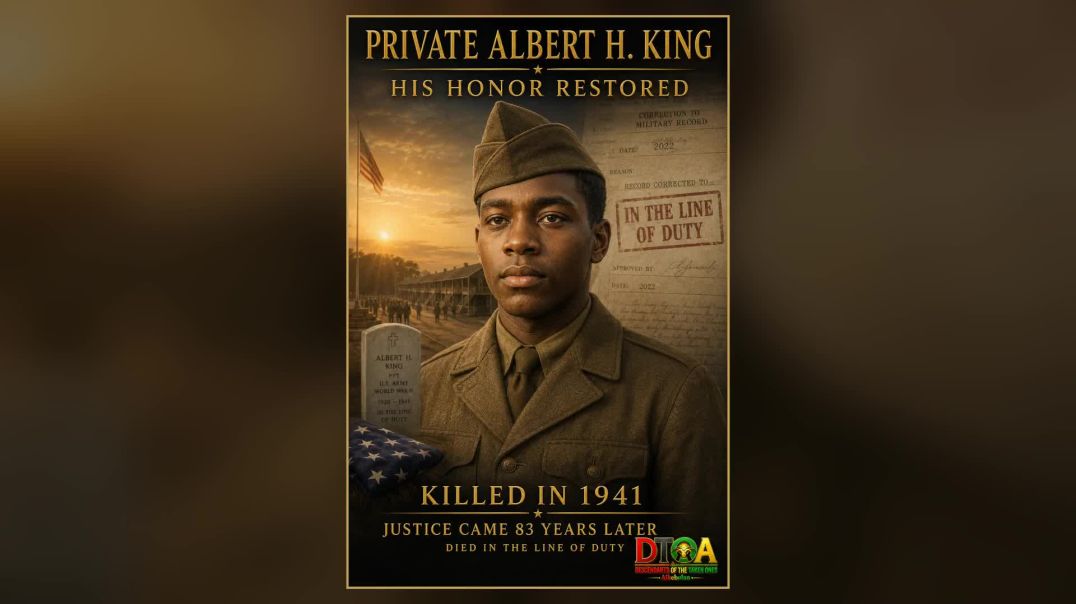
On March 24, 1941, Private Albert H. King—a 20-year-old Black soldier serving at Fort Benning, Georgia—was returning to the military post when he was violently killed. King had been accused of disorderly conduct during a bus ride from Columbus to Fort Benning. After he left the bus, Sergeant Robert Lummus, a white military police officer, pursued him. Lummus shot the young soldier five times, including once in the back. Lummus claimed that King had attacked him and that he fired in self-defense. Yet evidence showed that King was not carrying a gun or knife. Only 13 hours after the killing, a military court cleared Lummus of wrongdoing.
The injustice did not end with King’s death. An initial Army investigation reportedly found that King had died in the line of duty. However, senior military officials ordered the matter to be reconsidered. The finding was reversed, and the Army officially declared that King’s death was “not in the line of duty,” blaming the young soldier’s alleged misconduct for his own killing. That decision damaged King’s reputation, denied his family the recognition and benefits associated with his service, and forced him to be buried without the military honors he had earned.
During the Jim Crow era, Black soldiers were expected to wear the uniform, obey orders, and defend the United States—even as the country denied them equal protection under the law. King’s uniform could not shield him from the racism around him, even on an Army installation. William H. Hastie, then the civilian aide to Secretary of War Henry Stimson, challenged the Army’s handling of King’s case. King’s family also sought to clear his name, but the government refused to correct the injustice.
For more than eight decades, the false judgment remained in his military record. The truth endured. Researchers with Northeastern University’s Civil Rights and Restorative Justice Project reopened the case. Working with King’s surviving cousin, Helen Russell, and pro bono attorneys from Morgan Lewis, they petitioned the Army Board for Correction of Military Records. In November 2022—81 years after King was killed—the Army finally corrected his record and officially recognized that he had died “in the line of duty.” The Army acknowledged that an error and an injustice had occurred. Civil Rights and Restorative Justice Project
But correcting a document was not enough. On March 24, 2024, exactly 83 years after his death, Private Albert King finally received the full military service that had been denied to him. At Porterdale Cemetery in Columbus, Georgia, military representatives presented the American flag, unveiled a new headstone, and restored the honor of a soldier whose country had failed him. Northeastern Global News. His headstone carries a message inspired by the cousin who fought to restore his name: “For my beloved cousin, I fought the fight.” Private Albert King’s story teaches us that official records are not always the same as historical truth. Institutions can hide injustice behind reports, rulings, and uniforms—but determined families, researchers, and advocates can force the truth back into the light. Justice delayed for 83 years could never return King’s life or erase his family’s pain. But restoring his record returned something the Army should never have taken from him:
His honor. We remember Private Albert H. King—not for the false accusations recorded against him, but as a young Black soldier who served his country and deserved its protection. His name is cleared. His service is recognized. His story will not be forgotten.
In Closing, Descendants of the Taken Ones Recovering the stories that history tried to bury. To support the channel, please click the like button and subscribe to receive new videos








![Sturrage ---MY SOUND BUBOOM BUBOOM [ King Tubbys Boulevard Ride ] King Sturrage Production](https://theblacktube.com/upload/photos/2026/10/3f67d65bb1cba9cdfd4bf98028e2a5296aa66348Md9JEf8g4LGfoyuQ6I1g.video_thumb_8945_11.jpeg)




1 Comments
cliprize
11 days ago