
198 Views· 09/28/26· Black History
King Yambio: The Azande Ruler Who Resisted Colonial Conquest

King Yambio: The Azande Ruler Who Resisted Colonial Conquest
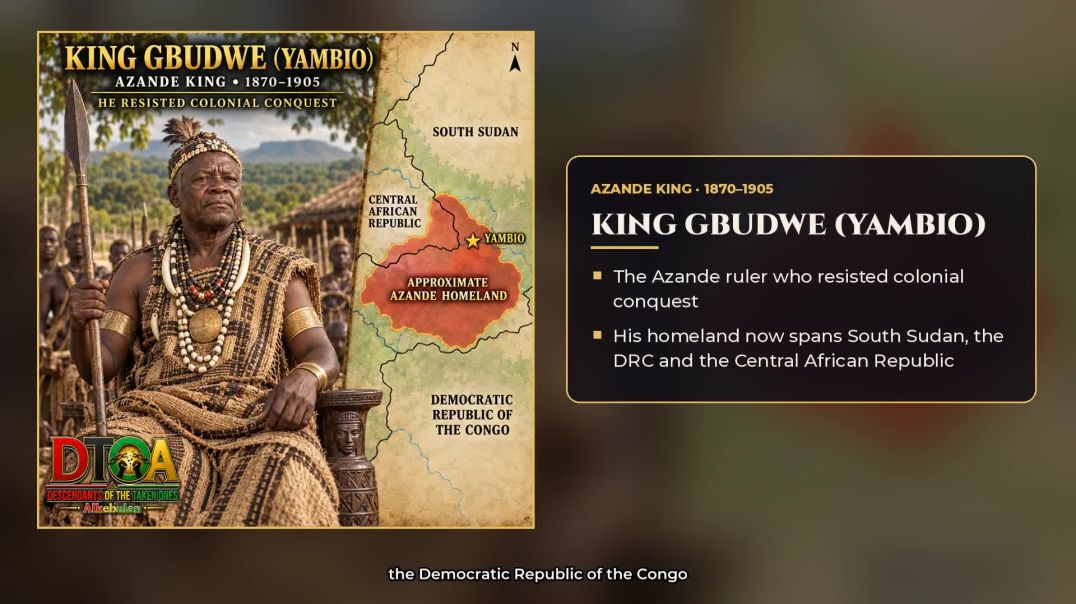
Before the modern borders of South Sudan, the Democratic Republic of the Congo, and the Central African Republic, the Azande people maintained powerful kingdoms across Central Africa. One of their most prominent rulers was King Gbudwe Bazingbi, also known in historical accounts as Yambio and Mbio.
Born around 1835, Gbudwe ruled a major Azande kingdom from approximately 1870 to 1905. His authority extended across territory now in southwestern South Sudan.
The Azande were not a people waiting to be governed by outsiders. They had their own political institutions, military organization, agriculture, trade, law, and royal authority. King Gbudwe defended that independence as European powers competed to seize African territory during the Scramble for Africa. Belgian forces linked to the Congo Free State advanced from the south and west, while British and Anglo-Egyptian authorities approached from the north and east. Colonial officials drew borders through Azande territory without the consent of the people living there.
Gbudwe resisted foreign occupation. In 1904, Azande forces attacked Belgian positions established within the territory the king regarded as his own. The assault suffered heavy losses against European firearms, weakening his kingdom. In February 1905, a British-led column entered his territory. Accounts of his final confrontation vary in detail, but they agree that Gbudwe refused to surrender quietly. Even when isolated and confronted by armed colonial troops, the aging king resisted. He was wounded, captured, and died shortly afterward.
His death marked the end of independent Azande royal authority as colonial governments divided the Azande homeland among European administrations. Yet they could not erase his name. The present-day city of Yambio, capital of Western Equatoria State in South Sudan, preserves the memory of the Azande ruler and remains an important center of Azande cultural identity. In 2022—117 years after Gbudwe’s death—the Azande monarchy was formally restored with the coronation of his great-grandson, King Atoroba Peni Rikito. Colonial rule interrupted the throne.
It did not destroy the nation. King Yambio’s story reminds us that Africa was not an empty continent carved up by Europeans. It was home to organized societies, sovereign kingdoms, and leaders who fought to defend their people.
The colonizers drew new borders, but the Azande remembered their king.
We are the Descendants of the Taken Ones, and we remember the African rulers who resisted conquest rather than surrender their people’s freedom. Thank you for your time. To support the channel. Please like, share, and subscribe, and pass this along to your family and friends. Remember: information kept to yourself is lost over time, but shared information becomes enduring knowledge. People who lose control of their history can be led to believe they never contributed anything.



![SIZZLA KALONJI --- CHILDREN PROTECTION[ INI BANDS ]KING STURRAGE PROD](https://theblacktube.com/upload/photos/2026/10/141714c0fee7a0458ab096f52a4959513bb44f93RhZWr2uaNfglBM2YsC8v.video_thumb_7651_11.jpeg)
![Singing Sweet - [ONE MAN GIRL] ( King Sturrage Production)INI BANDS RIDDIM](https://theblacktube.com/upload/photos/2026/10/a30f988e6f4f0916f66c75ac24dc31faa7197588O9ZYto8PGtWSfDOEZBPD.video_thumb_4089_11.jpeg)
















2 Comments
cliprize
17 days agoJOSEPH ELISHA
22 days ago