

193 Views· 09/03/26· Black History
Maggie Lena Walker_ The Woman Who Turned Nickels Into Black Power _ DTOA

Maggie Lena Walker The Woman Who Turned Nickels Into Black Power
Maggie Lena Walker was a banker, newspaper publisher, educator, business executive and civil-rights leader who transformed Black economic cooperation into a powerful weapon against Jim Crow segregation.
Born Maggie Lena Draper on July 15, 1864, in Richmond, Virginia, she was the daughter of Elizabeth Draper, a formerly enslaved woman who worked as a cook and laundress. Walker grew up helping her mother collect and deliver laundry, witnessing how hard Black women worked while receiving little economic security or respect. (Virginia Museum of History & Culture)
A Young Organizer
Walker attended Richmond’s segregated schools and graduated from the Richmond Colored Normal School in 1883. Even before graduation, she helped organize Black students protesting the unequal treatment they received compared with white students during commencement ceremonies. (Encyclopedia Virginia)
She became a teacher but was forced to leave the profession after marrying Armstead Walker Jr. in 1886 because Richmond’s school system prohibited married women from teaching.
The rule may have ended her classroom career, but it did not end her work as an educator. Walker would spend the remainder of her life teaching Black communities how to organize, save, invest and build institutions of their own. (Encyclopedia Virginia)
The Independent Order of St. Luke
In 1881, Walker joined the Independent Order of St. Luke, a Black fraternal organization that provided burial insurance, assistance to the sick and financial protection for families excluded from many white-controlled institutions.
She rose through its ranks and established a juvenile division that taught Black children education, community service, thrift and racial pride. In 1899, she was elected Right Worthy Grand Secretary, the Order’s highest leadership position. She held that office until her death. (Encyclopedia Virginia)
When Walker assumed leadership, the organization was struggling financially. Under her direction, it developed into a national institution with approximately 100,000 members across twenty-four states. (Virginia Museum of History & Culture)
She understood that Black communities needed more than charity. They needed businesses, employment, information, credit and control over their own money.
A Newspaper, a Bank and a Department Store
In a major 1901 address, Walker presented an ambitious plan: the Order would establish a newspaper, a bank and a department store operated for the benefit of Black people.
In 1902, she created The St. Luke Herald, a newspaper that circulated information throughout the organization while speaking against racial injustice, disfranchisement, mob violence and Jim Crow segregation. (National Park Service)
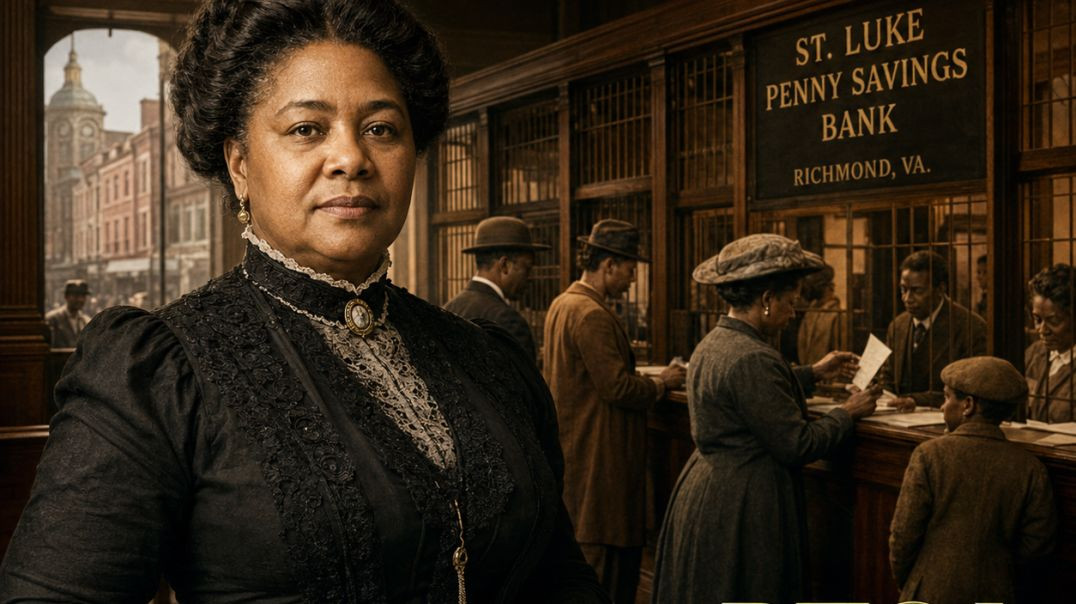
The following year, she chartered the St. Luke Penny Savings Bank in Richmond and became its president. She was the first Black woman in the United States to establish and serve as president of a bank. (Virginia Museum of History & Culture)
Walker declared:
“Let us have a bank that will take the nickels and turn them into dollars.”
Her bank encouraged Black workers and children to save their money. It also created a place where African Americans could conduct financial business without the humiliation and discrimination frequently encountered in white-owned banks. (National Park Service)
The institution represented far more than banking.
Deposits created lending power.
Loans supported businesses.
Mortgages helped families pursue homeownership.
Savings created protection against emergencies.
Black money deposited in a Black-controlled institution could circulate through the community instead of enriching businesses that practiced segregation.
The St. Luke Emporium
In 1905, Walker and other women of the Order opened the St. Luke Emporium, a department store owned and operated by African Americans.
The enterprise created professional employment for Black women and offered Black consumers an alternative to white businesses that accepted their money while treating them as inferior. Organized opposition and financial difficulties eventually forced the store to close, but the venture demonstrated Walker’s determination to construct an entire Black economic network. (Encyclopedia Virginia) She was not simply opening separate businesses. She was attempting to create an interconnected system of Black-controlled banking, journalism, insurance, retail and employment.
Leading Through the Great Depression
When the Great Depression threatened financial institutions across the country, Walker helped preserve the bank by merging it with two other Black-owned banks in 1930. The new institution became the Consolidated Bank and Trust Company, with Walker serving as chairman of its board. (Virginia Museum of History & Culture)
The institution survived at a time when thousands of American banks failed. It continued operating as a Black-owned bank until 2005, extending Walker’s financial legacy far beyond her lifetime. (Virginia Museum of History & Culture)
Civil Rights and Political Power
Walker’s struggle was never limited to business.
She supported women’s suffrage, Black voting rights and the campaign against lynching. She helped organize a 1904 boycott against segregated streetcars in Richmond, co-founded the Richmond chapter of the NAACP, led voter-registration efforts and helped establish the Richmond Council of Colored Women. (Virginia Museum of History & Culture)
In 1921, she ran for Virginia superintendent of public instruction on an all-Black Republican ticket. Although she was not elected, her candidacy challenged a political system designed to silence both Black citizens and women. (Encyclopedia Virginia)
Leadership From a Wheelchair
Diabetes and a leg wound eventually confined Walker to a wheelchair. Yet disability did not remove her from public life.
She continued leading the Independent Order of St. Luke, directing business affairs and advocating for civil rights. Her wheelchair became evidence not of surrender, but of her refusal to allow physical limitations, racism or sexism to determine the boundaries of her service. (Encyclopedia Virginia)
Maggie Lena Walker died on December 15, 1934, in Richmond. Her home in Jackson Ward is now preserved as the Maggie L. Walker National Historic Site. (National Park Service)
She began as the daughter of a formerly enslaved laundress.
She became a teacher.
She became a newspaper publisher.
She became a national fraternal leader.
She became a bank founder and president.
She became a builder of Black economic power.
Maggie Lena Walker understood that political freedom without economic power remained incomplete. She taught her people to combine their nickels, build their own institutions and transform collective savings into collective strength.




















2 Comments
cliprize
10 days agoCopuffs843
1 month ago