
32 Views· 10/07/26· Black History
MAMÁ TINGÓ — SHE STOOD HER GROUND
MAMÁ TINGÓ — SHE STOOD HER GROUND
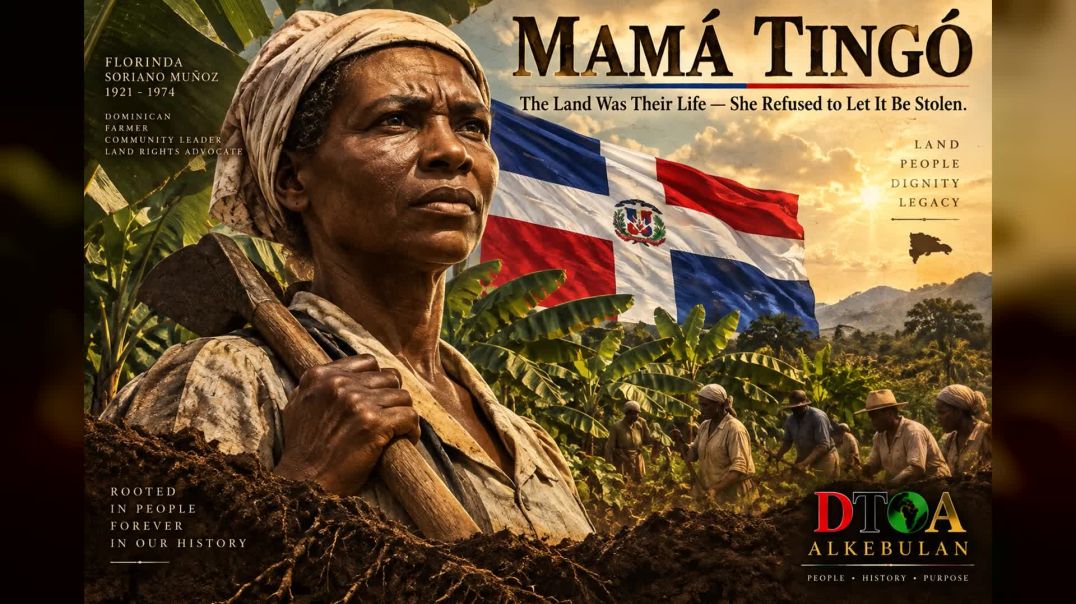
Her name was Florinda Soriano Muñoz, but history remembers her as Mamá Tingó.
Born on November 8, 1921, in Villa Mella, Dominican Republic, she was not born into wealth, political influence, or privilege. She was a campesina—a rural working woman whose life was tied directly to the soil. She planted it, worked it, raised her family from it, and understood something powerful:
Land was more than property. Land was survival. Land was independence.
Mamá Tingó eventually settled with her family in Hato Viejo, Yamasá, where farming families had occupied and cultivated land for decades. In 1974, landowner Pablo Díaz Hernández claimed ownership of property occupied by those farmers and moved to remove them. Accounts describe fencing being erected and crops being destroyed as the dispute intensified. CPEP
But the farmers were not silent.
And neither was Mamá Tingó.
She became active with the Federación de Ligas Agrarias Cristianas — FEDELAC, helping organize rural families fighting to remain on the land they had worked for generations. Dominican historical sources remember her specifically as an activist and defender of campesino rights. CPEP
She reportedly had little formal education, but she understood power.
She understood that poor farmers fighting individually could be pushed aside.
Organized farmers were different.
So she attended meetings.
She participated in demonstrations.
She went to court.
She encouraged her neighbors to defend their claims together.
And she refused to surrender simply because those opposing them had more money, influence, or legal power.
November 1, 1974
That day, Mamá Tingó and other farmers went to the court in Monte Plata concerning their land dispute. The opposing land claimant did not appear, and the matter was postponed. She returned to Hato Viejo. Proceso
She would never leave alive.
According to Dominican historical accounts, Ernesto Díaz, known as Durín, a foreman working for the landowner, confronted Mamá Tingó after she returned. She was shot and killed. Proceso
She was 52 years old, only days away from her 53rd birthday.
But killing the woman did not kill what she represented.
Her death transformed Mamá Tingó from a local campesina organizer into one of the Dominican Republic's enduring symbols of the struggle for land, dignity, and rural justice. The Dominican government's Permanent Commission of Patriotic Ephemerides recognizes her as a historical figure and defender of campesino rights. CPEP
Today her name survives in monuments, cultural works, organizations, public commemorations—and even a major Santo Domingo Metro station bearing the name Mamá Tingó. Dominicana Online
Descendants of the Taken Ones Mamá Tingó's story reminds us that history is not made only inside presidential palaces, universities, or military headquarters. Sometimes history is made by a woman standing in a field. A woman with no army. No fortune. No political title.
Just land beneath her feet, neighbors beside her, and the conviction that powerful people should not be able to simply take what ordinary families have spent generations building.
They could take her life.
They could not erase her name.
MAMÁ TINGÓ
1921–1974
Farmer.
Organizer.
Defender of the campesino.
Daughter of the Dominican Republic.
• The land was their life.
She refused to let it be taken without a fight.
Thank you for your time. To support the channel. Please like, share, and subscribe, and pass this along to your family and friends. Remember: information kept to yourself is lost over time, but shared information becomes enduring knowledge. People who lose control of their history can be led to believe they never contributed anything.
Facebook Comments
Up next





J Funk's FAVORITE Breakfast Smoothie! 🥤 | Mama Diva Shares the Viral Recipe

Baby Josiah does PUSHUPS and works out with Coach Ap and Mama Diva







1 Comments
JOSEPH ELISHA
1 hour ago