
335 Views· 09/02/26· Black History
Maria Firmina dos Reis The Black Woman Who Gave the Enslaved a Voice

Maria Firmina dos Reis
The Black Woman Who Gave the Enslaved a Voice
In nineteenth-century Brazil, slavery controlled not only Black bodies but also the stories the nation told about Black people. Enslaved Africans often appeared in literature as nameless servants, comic figures, or silent victims. Their memories, families, and inner lives were pushed aside as white writers spoke about and for them. Then a free Black woman from Maranhão picked up her pen.
Her name was Maria Firmina dos Reis. Born on March 11, 1822, in São Luís, Maranhão, Maria entered a country where millions of Africans and their descendants remained enslaved. Records identify her mother as Leonor Felipa, a Black woman who had once been enslaved. Maria’s father was not named in her baptismal record, reflecting the uncertainty surrounding many families formed within a slaveholding society. As a child, Maria moved with her family to Guimarães. Educational opportunities for Black girls were exceptionally limited, yet she acquired the knowledge needed to compete for a public teaching position. In 1847, Maria earned an appointment as a primary-school teacher. That achievement alone was extraordinary. She was a Black woman entering public education during the Brazilian Empire, when political, intellectual, and professional life remained dominated by white men.
But the classroom was only the beginning. Maria wrote poetry, essays, short fiction, songs, and other literary works for Maranhão’s newspapers and journals. She entered the publishing world cautiously, aware that her race, gender, and provincial background could be used to dismiss her. In 1859, she published her groundbreaking novel Úrsula, described as “Uma Maranhense”—“A Woman from Maranhão.” Her name did not appear prominently on the original publication. The novel initially resembles a tragic nineteenth-century romance, but within that familiar structure, Maria launched a direct attack on slavery and patriarchal violence. She did something revolutionary: she allowed enslaved African characters to speak as fully realized human beings.
One of the novel’s most important characters, Mãe Susana, remembers her life in Africa before her capture. She recalls freedom, family and community—and then recounts the horror of being seized, placed aboard a slave ship and transported across the Atlantic. Through Susana’s voice, Africa is not portrayed as an empty or uncivilized place. It is a homeland filled with relationships, meaning and freedom. The Atlantic crossing is not presented as the beginning of the African captive’s existence. It is exposed as the violent destruction of a life that already possessed value.
Another character, Túlio, is portrayed with dignity, compassion and moral intelligence. Rather than existing solely to advance the lives of white characters, the enslaved people in Úrsula express their own emotions, memories and judgments about bondage.
Maria’s novel condemned slavery from within the experience of those it oppressed. For this reason, Úrsula is widely recognized as a foundational work of Afro-Brazilian literature and as one of Brazil’s earliest abolitionist novels. Maria Firmina dos Reis is frequently identified as Brazil’s first Black woman novelist. Her protest did not end with Úrsula. In 1887—one year before Brazil finally abolished slavery—Maria published the short story “A Escrava,” or “The Enslaved Woman.” The story depicts an enslaved mother whose family is torn apart by sale and forced separation. It confronts the cruelty of slavery through a Black woman’s suffering and through the actions of those who resist the system. Maria also composed the “Hymn to the Liberation of the Enslaved,” celebrating emancipation when abolition arrived in 1888.
But she was not satisfied with merely writing about freedom. She practiced it through education. After decades of teaching, Maria established a free school that brought boys and girls together in the same classroom. Coeducational instruction challenged the rigid gender expectations of her time, while free enrollment extended access to children whose families could not afford it. The experiment did not last, but its purpose was unmistakable: knowledge should not belong only to the wealthy, white, or male. Maria never married. She spent much of her life teaching, writing, composing music, and helping raise children in her extended community. She retired from public teaching in 1881 after more than three decades of service. Despite her accomplishments, Brazil’s literary establishment nearly erased her. Úrsula disappeared from widespread circulation. Later histories of Brazilian literature celebrated male writers, while Maria’s work remained largely unknown. She died in Guimarães on November 11, 1917, at approximately 95 years old—poor, visually impaired, and far removed from the national recognition she deserved.
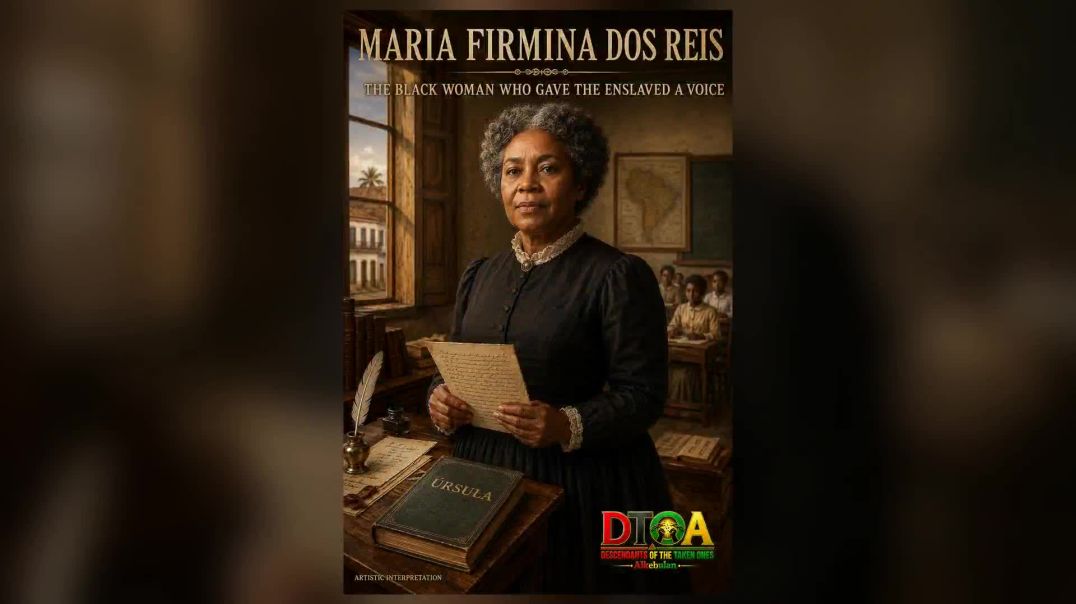
For decades, even her face was lost to history. Images commonly used to represent Maria are later artistic interpretations, not verified photographs. Her work returned to public attention in the twentieth century, particularly after scholars recovered and republished Úrsula in the 1970s. Researchers recognized what Brazil’s literary establishment had overlooked: a Black woman had written against slavery before abolition, given enslaved Africans a voice, and challenged the structures oppressing women. Today, Maria Firmina dos Reis is honored as a founding mother of Afro-Brazilian literature.
Her importance reaches beyond being “the first.” She changed the position from which the story was told.
She did not portray enslaved people as objects waiting for pity. She presented them as human beings who remembered freedom, understood injustice and possessed voices worthy of being heard.
The slaveholding nation tried to define Black people through silence. Maria Firmina dos Reis answered with literature. We speak your name, Maria Firmina dos Reis.
DTOA Reflection
Maria understood that controlling a people’s story is another form of controlling their lives. By giving enslaved characters memory, emotion, and moral authority, she challenged the lies that allowed slavery to persist. Her classroom opened minds. Her school challenged exclusion. Her writing restored humanity to people whom Brazil’s literature had pushed into the background.
Descendants of the Taken Ones honors Maria Firmina dos Reis—the Black woman who gave the enslaved a voice. To support the channel, please click the like button and subscribe to receive new videos





















2 Comments
cliprize
9 days agoJOSEPH ELISHA
1 month ago