
82 Views· 10/02/26· Black History
Meret-Neith: The Female King Who Ruled Egypt

Meret-Neith: The Female King Who Ruled Egypt
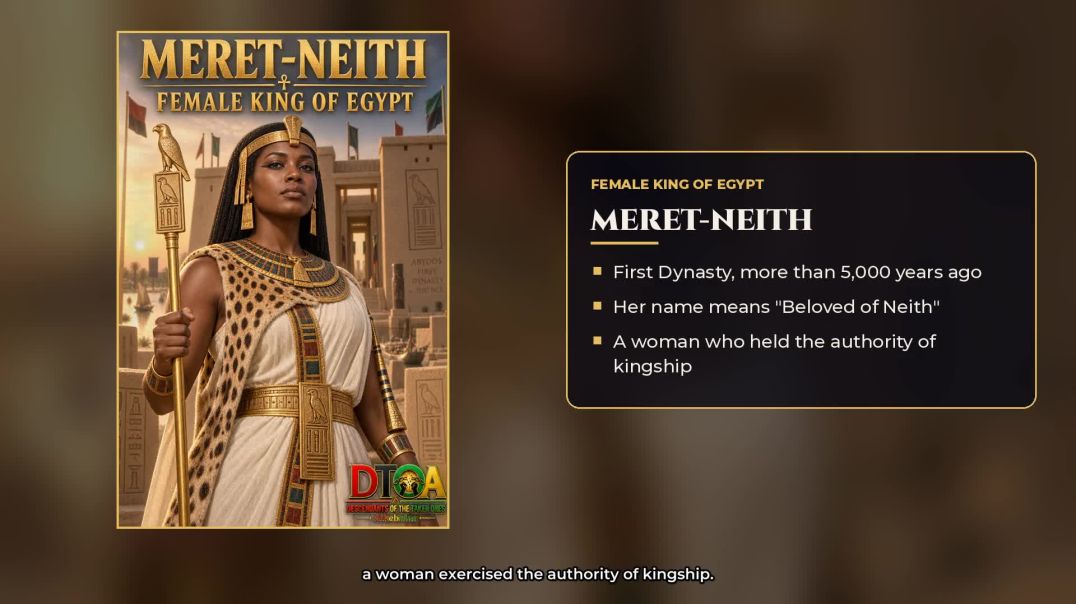
More than 5,000 years ago, during Egypt’s First Dynasty, a woman exercised the authority of kingship.
Her name was Meret-Neith, meaning “Beloved of Neith.”
For generations, historians described her as a queen, royal mother, or temporary regent who governed until her son, Den, could assume the throne. But new research suggests that Meret-Neith’s political role was far greater.
She was a female King of Egypt.
In a 2026 peer-reviewed study published in Prague Egyptological Studies, researchers Sue Kelly and Crystal Miller reexamined the surviving photograph of inscriptions on 13 ancient mud jar stoppers discovered at Saqqara.
The original artifacts and photographic plate have been lost, but the researchers used advanced digital imaging to isolate and clarify the surviving hieroglyphs.
What emerged was significant.
Meret-Neith’s name appeared within serekhs—the palace-shaped royal emblems used to identify Egypt’s kings. During the First Dynasty, the serekh was one of the clearest symbols of sovereign authority.
This was not simply the title of a royal wife.
It was the mark of a ruler.
The evidence suggests that Meret-Neith’s political career lasted at least 30 years and progressed through several stages. She may have served alongside King Djer as a co-regent, later governed as the mother of King Den, and exercised direct authority over Egypt’s treasury, officials, and government departments.
Her enormous tomb at Abydos was built among the tombs of Egypt’s kings. It contained a large burial chamber, subsidiary graves, valuable provisions, and hundreds of vessels—including containers holding remnants of approximately 5,000-year-old wine.
These were not ordinary honors bestowed on a king’s wife.
They were the honors of sovereignty.
Meret-Neith ruled at the dawn of unified Egypt centuries before Hatshepsut and thousands of years before women gained political authority in many other civilizations.
She was not merely standing beside the throne.
She was not simply preserving it for a man.
Meret-Neith occupied the throne, exercised royal power, and carried the recognized emblem of Egyptian kingship.
More than 5,000 years ago, an African woman was directing one of the world’s earliest centralized governments.
She was the authority.
She was the ruler.
She was a King of Egypt.
We are the Descendants of the Taken Ones, and we restore the African history the world was taught to overlook. Meret-Neith was not merely a queen beside the throne or a mother temporarily protecting it. New digital analysis of First-Dynasty royal inscriptions identifies her by the serekh—the primary emblem reserved for Egypt’s rulers. The evidence now supports recognizing her as a female king of Egypt, exercising the same sovereign authority represented by the kingship of her age. Thank you for your time. To support the channel. Please like, share, and subscribe, and pass this along to your family and friends. Remember: information kept to yourself is lost over time, but shared information becomes enduring knowledge. People who lose control of their history can be led to believe they never contributed anything.






![SIZZLA KALONJI --- CHILDREN PROTECTION[ INI BANDS ]KING STURRAGE PROD](https://theblacktube.com/upload/photos/2026/10/141714c0fee7a0458ab096f52a4959513bb44f93RhZWr2uaNfglBM2YsC8v.video_thumb_7651_11.jpeg)
![Singing Sweet - [ONE MAN GIRL] ( King Sturrage Production)INI BANDS RIDDIM](https://theblacktube.com/upload/photos/2026/10/a30f988e6f4f0916f66c75ac24dc31faa7197588O9ZYto8PGtWSfDOEZBPD.video_thumb_4089_11.jpeg)













1 Comments
cliprize
20 days ago