
30 Views· 10/11/26· Black History
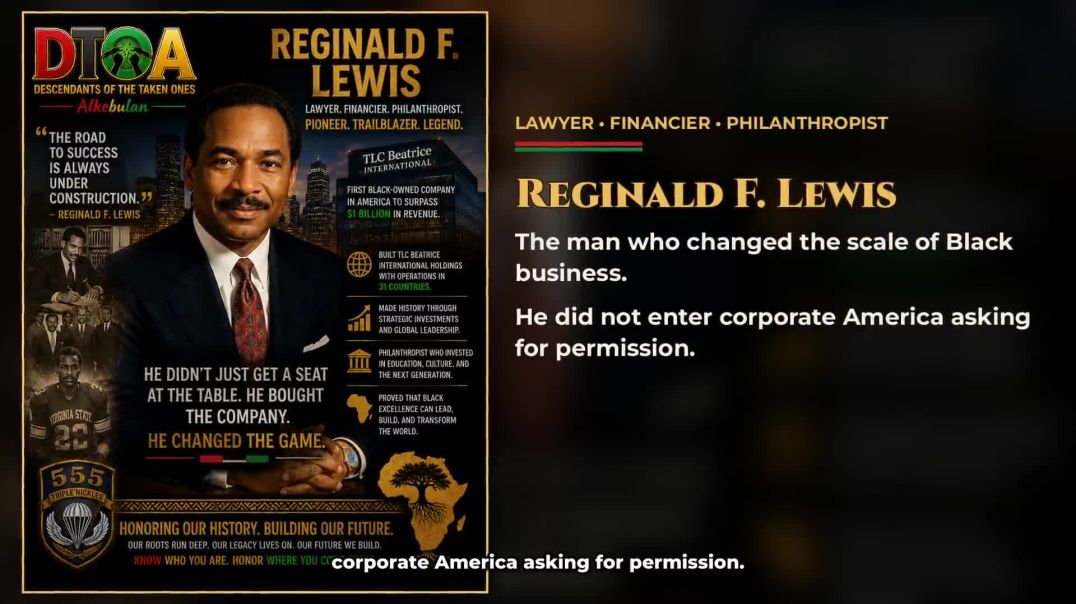
Reginald F. Lewis — The Man Who Changed the Scale of Black Business
Reginald F. Lewis — The Man Who Changed the Scale of Black Business
Reginald F. Lewis did not enter corporate America asking for permission. He entered determined to master its rules, command its resources, and prove that Black ownership could operate at the highest levels of global finance.
Born in East Baltimore on December 7, 1942, Lewis was raised in a family that emphasized discipline, integrity, education, and self-reliance. His entrepreneurial instincts appeared early: at ten years old, he established a newspaper route, expanded it from roughly ten customers to more than one hundred, and eventually sold the business for a profit. (Reginald F. Lewis)
Lewis attended Virginia State University on a football scholarship in 1961. After an injury ended his football career, he redirected his competitive drive toward academics and graduated on the dean’s list. In 1965, he participated in a Harvard Law School summer program intended to introduce promising Black students to legal education. His performance was so impressive that Harvard invited him to enroll before he had formally applied. He graduated from Harvard Law School in 1968. (Reginald F. Lewis)
After law school, Lewis joined the prestigious New York firm Paul, Weiss, Rifkind, Wharton & Garrison. Within two years, he helped establish what his official biography describes as Wall Street’s first African American law firm. He concentrated on corporate law, securities, and financing minority-owned businesses, gaining the technical knowledge and relationships necessary to operate inside America’s financial establishment. (Reginald F. Lewis)
But Lewis did not intend to spend his life merely advising other people on transactions. He wanted to control the deals himself.
In 1983, he formed TLC Group, a private investment firm. One of its first major transactions was the leveraged acquisition of the struggling McCall Pattern Company. Lewis and his team reorganized the business, strengthened its operations, and restored profitability. When the company was sold in 1987, the transaction produced an extraordinary return for his investment group. (Reginald F. Lewis)
Lewis then pursued the deal that would place his name permanently in American business history.
In 1987, he acquired the international food division of Beatrice Companies for approximately $985 million. The operation included dozens of companies conducting business across 31 countries. Renamed TLC Beatrice International Holdings, the corporation generated approximately $1.8 billion in annual sales, becoming the first Black-owned company in the United States to surpass the billion-dollar revenue mark. At the time, the acquisition was described as the largest offshore leveraged buyout completed by an American company. (Reginald F. Lewis)
This achievement was larger than personal wealth. Lewis demonstrated that a Black entrepreneur could negotiate with major financial institutions, acquire an international corporation, manage operations across national borders, and compete within the most powerful sectors of global capitalism.
He also understood that achievement carried an obligation to build institutions for those who would follow. Lewis established the Reginald F. Lewis Foundation in 1987 and supported education, civil rights, cultural preservation, and social justice. Shortly before his death, he gave Harvard Law School $3 million, the largest grant in the school’s history at that time. Harvard subsequently named its International Law Center in his honor—the first building at the university named for an African American. (Reginald F. Lewis)
Reginald F. Lewis died on January 19, 1993, at only fifty years old, but his influence did not end with his life. His business record expanded the boundaries of what Black entrepreneurs were believed capable of accomplishing. His story continues to challenge every generation to think beyond employment, beyond participation, and toward ownership, control, and institution-building. (Cambridge University Press)
Reginald F. Lewis did not simply secure a place at the table. He acquired the company, expanded the table, and left a blueprint showing that Black ambition has no legitimate ceiling.
DTOA honors Reginald F. Lewis—a lawyer, financier, philanthropist, global business leader, and Descendant of the Taken Ones who transformed economic possibility into economic power.











0 Comments