
191 Views· 09/11/26· Black History
Teddy Roosevelt Destroyed the Careers of 167 Black Soldiers Without a Single Trial

Teddy Roosevelt Destroyed the Careers of 167 Black Soldiers Without a Single Trial
The Brownsville Affair — When America Condemned the Buffalo Soldiers Without Evidence
On the night of August 13, 1906, gunfire erupted in Brownsville, Texas. A white bartender, Frank Natus, was killed, and police lieutenant M. Y. Dominguez was wounded.
Before the smoke had cleared, Black soldiers stationed at nearby Fort Brown were blamed.
These men belonged to Companies B, C, and D of the United States Army’s 25th Infantry Regiment—one of the celebrated units known as the Buffalo Soldiers. They had served their country with discipline and distinction, but in segregated America, their uniforms could not protect them from racism.
White residents claimed that Black soldiers had entered the town and opened fire. The soldiers denied the accusation. Their officers reported that the men were inside the fort when the shooting occurred. No individual soldier was positively identified, and a local grand jury returned no indictments.
The physical evidence was also questionable. Spent Army rifle cartridges were reportedly discovered in suspicious groupings, raising the possibility that they had been planted to frame the soldiers.
But President Theodore Roosevelt did not require proof.
He demanded that the soldiers identify the alleged gunmen. The men maintained that they knew nothing about the attack. Roosevelt interpreted their refusal to accuse one another as a “conspiracy of silence.”
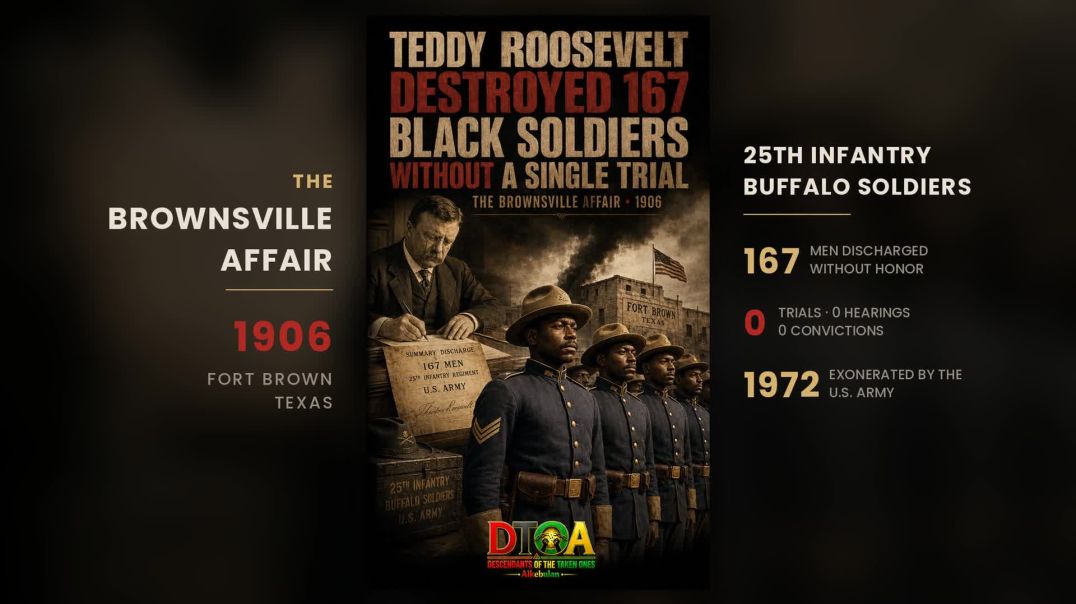
On November 5, 1906, Roosevelt ordered all 167 enlisted men discharged “without honor”—collective punishment imposed without a court-martial, individual hearing or trial.
Their military careers were erased with a presidential order.
Many of these soldiers had devoted years to the United States Army. Some were nearing retirement. The discharges stripped them of military benefits and pensions and prevented them from obtaining federal employment.
Their families also suffered the economic consequences.
Roosevelt punished 167 men for an offense the government could not prove any one of them had committed. He did not merely remove them from the Army—he branded them as dishonorable before the entire nation.
Booker T. Washington appealed to Roosevelt to reconsider. Black newspapers, civil-rights organizations and community leaders protested. Senator Joseph B. Foraker of Ohio became one of the soldiers’ strongest defenders, arguing that the evidence did not justify their punishment.
Roosevelt refused to reverse his decision.
The truth remained buried for more than six decades.
In 1972, after historian John D. Weaver’s research renewed public attention, the United States Army reopened the case. The investigation concluded that the accused soldiers were innocent. Their records were corrected to show honorable discharges.
But justice arrived far too late.
Nearly all the men had died. There was no general award of back pay or compensation to their families. The last surviving affected soldier, Private Dorsie Willis, eventually received $25,000 through an act of Congress.
The Brownsville Affair exposes a side of Theodore Roosevelt’s legacy that popular history frequently softens or ignores. The president celebrated military courage, yet denied 167 Black soldiers the basic protections owed to members of the United States Army.
They received no individual charges.
They faced no witnesses.
They were allowed no defense.
They were given no trial.
The Buffalo Soldiers survived hostile frontiers, overseas campaigns and the dangers of military service. What they could not escape was a government willing to place white accusations above Black testimony.
Their names were eventually cleared—but their careers, pensions, reputations and lost years could never be returned.
This was not simply a military mistake.
It was collective punishment enforced by presidential power—and one of the most devastating racial injustices in United States military history.
Their uniforms represented America. America failed to represent them.
To support the channel, please click the like button and subscribe to receive new videos
Sources: Texas State Historical Association, University of Texas Rio Grande Valley Special Collections, New York State Military Museum








2 Comments
cliprize
21 days agoJOSEPH ELISHA
1 month ago