
114 Views· 09/29/26· Black History
The Promise That Left Millions Out

The Promise That Left Millions Out
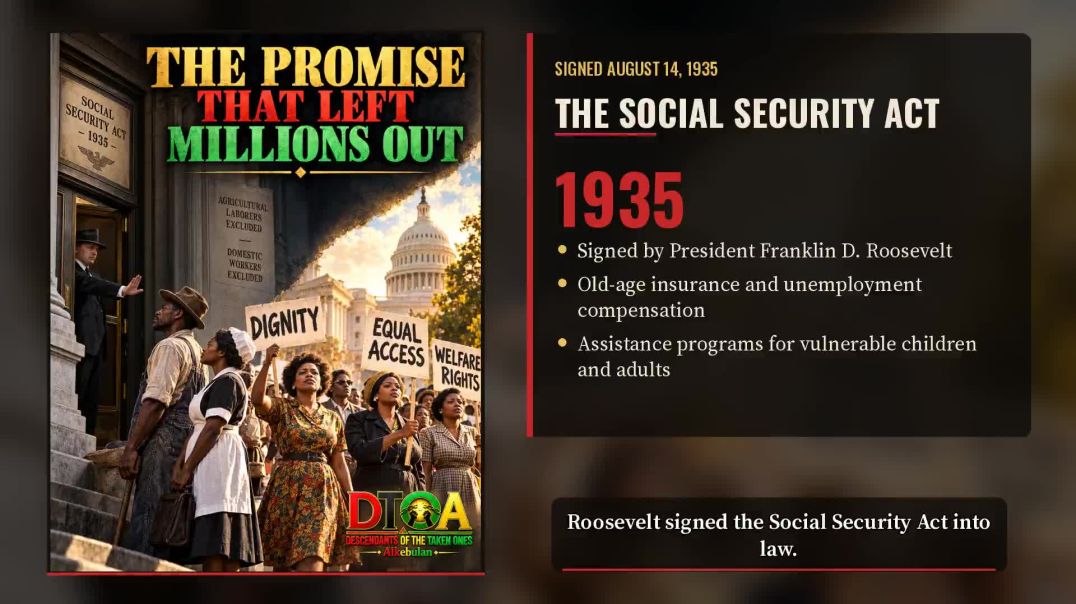
On August 14, 1935, President Franklin D. Roosevelt signed the Social Security Act into law.
It was one of the most significant pieces of social legislation in American history. It established old-age insurance, unemployment compensation, and assistance programs for vulnerable children and adults.
But America’s new promise of economic security did not reach everyone equally.
The original old-age insurance program excluded agricultural laborers and domestic workers. These were not the only occupations excluded, but the consequences for Black America were enormous: approximately 65% of employed Black Americans worked in agriculture or domestic service at the time. As a result, most Black workers were outside the new retirement-insurance system at its inception. (ssa.gov)
Historians continue to debate why these occupations were excluded. Some argue that the structure accommodated powerful Southern politicians and employers who sought to preserve a cheap, tightly controlled Black workforce. Others emphasize the administrative challenges of collecting payroll taxes from seasonal, temporary, and household employment. The historical record supports examining both the practical explanation and the unmistakably unequal racial impact.
Whatever the lawmakers’ intentions, the outcome was clear:
A supposedly national system of economic security left most working Black Americans outside its protection.
The 1950 Social Security amendments extended coverage to regularly employed farm and domestic workers. The 1954 amendments added more agricultural and domestic workers to the system. These changes significantly expanded Black participation, though coverage remained tied to specific employment and earnings requirements. Federal disability insurance was not established until 1956, so the earlier struggle focused on retirement and survivor coverage—not disability benefits. (ssa.gov)
But retirement insurance was only one part of the story.
The 1935 law also created Aid to Dependent Children (ADC), a federal-state program that provided assistance to children in financially distressed households. Although Black families were not explicitly prohibited from applying, states and local administrators controlled eligibility.
That authority became another instrument of Jim Crow. Officials used “suitable home” rules to judge mothers’ morality rather than their children’s needs. Black mothers could be denied assistance for having children outside marriage or for allegedly maintaining an “unsuitable” household. Southern administrators also used so-called employable-mother policies to remove Black women from assistance during agricultural seasons, pushing them back into low-paid field labor.
The “Man-in-the-House” Rule
During the 1950s and 1960s, various states enforced what became known as the “man-in-the-house” or “substitute father” rule. There was no single national starting date because individual states adopted and administered their own versions of the policy.
Caseworkers sometimes conducted unannounced home inspections to find evidence that a man was associated with a mother’s household. Men’s clothing, a razor, or the presence of a male visitor could be used to declare that the children had a breadwinner—even when that man did not live there and had no legal obligation to support them.
Then came the “man-in-the-house” or “substitute father” rules. Caseworkers searched for evidence that a man was associated with a mother’s household. A man’s clothing, a razor, or the presence of a male visitor could be used to declare that the children had a breadwinner—even when that man had no legal duty to support them.
The system often treated poverty as a moral offense and motherhood as something the government had the authority to police.
The Louisiana Incident
In 1960, Louisiana used a “suitable home” law to remove approximately 23,000 children from its assistance rolls. About 95% of the affected children were Black. The action was not merely an accounting decision. It occurred amid Louisiana’s resistance to school desegregation and disproportionately punished Black mothers and children.
The federal response became known as the Flemming Rule. Beginning in 1961, states receiving federal funds could no longer abandon a needy child simply because officials considered the home unsuitable. The state had to help correct unsafe conditions or arrange alternative care; it could not withdraw assistance while leaving the child in the same home. (ASPE)
Another major victory arrived in 1968.
In 1968, the United States Supreme Court struck down these policies in King v. Smith. The Court ruled that Alabama could not deny federally supported assistance to children merely because their mother had a relationship with a man who was not legally obligated to support them. This decision effectively invalidated “man-in-the-house” rules nationwide.
Black Women Forced the Door Open
These victories were not simply handed down by sympathetic officials. Poor women, particularly Black women, organized, marched, challenged welfare departments, and carried their cases into court.
Johnnie Tillmon emerged as one of the movement’s most important leaders. She organized mothers in Los Angeles and served as the first chairperson of the National Welfare Rights Organization, a multiracial movement whose membership grew to nearly 25,000.
The organization demanded more than checks.
Its members demanded dignity, privacy, economic justice, and freedom from government policies that treated poverty as evidence of personal failure. Their work also influenced the broader Civil Rights Movement and its growing demand for economic justice. (Teen Vogue)
Black Americans were never categorically barred from every program created in 1935. But occupational exclusions, decentralized state authority, and discriminatory administration prevented millions from receiving equal and practical access.
That distinction matters.
The law did not always have to mention race to preserve a racial hierarchy. It could exclude the jobs disproportionately held by Black people, delegate authority to segregationist states, and allow local officials to decide whose family was “deserving.”
The welfare state eventually became more inclusive—but only because excluded people challenged it.
The promise did not naturally expand.
Black workers fought their way into it.
Black mothers organized their way into it.
And Black families forced America to recognize that economic security was a right—not a privilege reserved for those whom the system considered worthy.
DTOA — Descendants of the Taken Ones
We remember those the official story leaves out. Thank you for your time. To support the channel. Please like, share, and subscribe, and pass this along to your family and friends. Remember: information kept to yourself is lost over time, but shared information becomes enduring knowledge. People who lose control of their history can be led to believe they never contributed anything.





















1 Comments
cliprize
17 days ago