
203 Views· 10/05/26· Black History
Ann Lowe: The Woman Behind the Wedding Gown

Ann Lowe: The Woman Behind the Wedding Gown
Before Ann Lowe designed one of the most famous wedding gowns in American history, she had already learned what it meant to have her talent welcomed while she was kept apart.
Lowe was born in Clayton, Alabama, into a family of skilled dressmakers. She learned to sew from her mother and grandmother and carried that knowledge to New York. In 1917, she entered the S. T. Taylor School of Design. Her white classmates refused to share a classroom with a Black woman, so the school placed Lowe in a separate room. Yet her work was so accomplished that it was shown to those same students as an example. nmaahc.si.edu
After running a successful boutique in Tampa, Florida, Lowe established herself permanently in New York City in 1928. She catered strictly to client families listed on the Social Register, including the Rockefellers, Roosevelts, du Ponts, Auchinclosses, and Vanderbilts.
Lowe went on to make gowns for some of America’s wealthiest families. In 1953, she was commissioned to create Jacqueline Bouvier’s wedding gown and dresses for her bridal party ahead of Bouvier’s marriage to Senator John F. Kennedy. nmaahc.si.edu
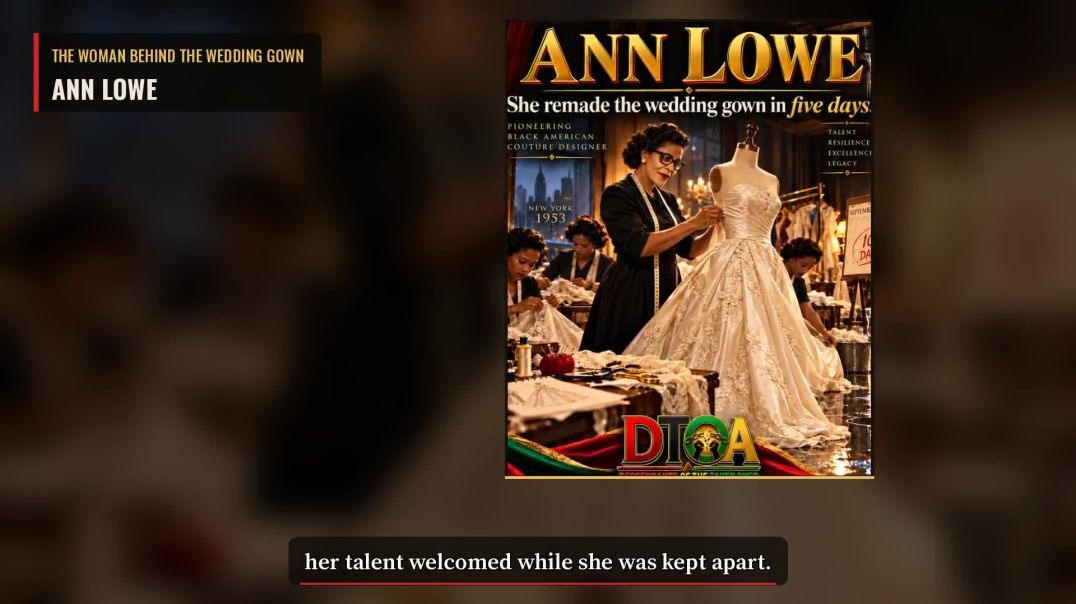
Then, about ten days before the wedding, a pipe burst in Lowe’s workroom. Water destroyed the bridal gown and ten bridesmaids’ dresses. The wedding gown had taken roughly eight weeks to make. Lowe and her seamstresses bought new fabric and worked around the clock; they remade the bridal gown in five days and delivered the dresses in time. Lowe bore the added expense herself, turning an expected profit into a $2,200 loss. She did not tell the family about the disaster. americanhistory.si.edu
When Lowe arrived to deliver the dresses, staff reportedly directed her to the back entrance. She insisted on going through the front door. On the wedding day, photographs carried her work around the world, but she was not publicly credited as its designer at the time. americanhistory.si.edu
The specific construction and restoration details of Jacqueline Kennedy's 1953 wedding dress.
Construction Details
• Fabric and Weight: The gown was crafted from approximately 50 yards of heavy ivory silk taffeta, supported by an internal superstructure that included 10 yards of silk faille between the petticoat, corset, and trims. In total, the completed dress weighs at least 12 pounds and is roughly 70% hand-sewn.
• Bodice Architecture: Designed with a dramatic portrait neckline, the fitted bodice features intricate vertical pleating across the bust that took three days to drape and assemble. It contains Lowe's signature "30-15" sleeves—a design pattern requiring over 30 hours to draft and a full day of hand-draping and sewing.
• The Bouffant Skirt: The sprawling skirt features concentric, interwoven bands of tucking and sweeping fabric swags. Lowe and her team transformed fabric into 154 yards of hand-folded swags and rosettes. The bottom hem alone required 50 hours of hand-stitching to attach ten spiraling layers of fabric and seven circular rosettes.
• Hidden Details: The interior features a custom-built, fully boned corset and petticoat foundation. Stitched inside the petticoat trim is a secret six-loop blue bow for "something blue". Uniquely, this gown included an official woven "Ann Lowe" label—a rarity, as she seldom labeled her private client work.
Ann Lowe Museum Collections and Signature Holdings
• Industry Challenges: Despite her talents, she was frequently underpaid, under-credited in contemporary press accounts, and faced persistent financial struggles stemming from low margins and racial prejudice.
• Historical Recognition: Today, her surviving garments are held in major institutions, including the Metropolitan Museum of Art, the Smithsonian National Museum of African American History and Culture, and The Museum at FIT.
• The Metropolitan Museum of Art (New York): The Costume Institute holds multiple 1950s and 1960s debutante and ball gowns. Notable pieces feature intricate silk-organza floral appliqués across the bodice and tiered tulle skirts.
• Smithsonian National Museum of African American History and Culture (Washington, D.C.): Features several prominent gowns, including a blue silk-satin debutante gown made for the Auchincloss family, as well as archival photographs and sewing implements.
• The Museum at FIT (New York): Preserves key examples showcasing her inner foundation architecture, including silk faille evening dresses decorated with trapunto stitching and signature floral trims.
• Winterthur Museum, Garden & Library (Delaware): Holds an extensive collection of her works acquired through private estate donations, highlighted in the retrospective exhibition Ann Lowe: American Couturier.
Descendants of the Taken Ones remembers Ann Lowe. In school, people studied her work while keeping her apart. At the Kennedy wedding, millions saw her gown without hearing her name. Neither injustice defines her. Ann Lowe was an artist and master dressmaker whose skill, determination, and designs earned a lasting place in American fashion history. Thank you for your time. To support the channel. Please like, share, and subscribe, and pass this along to your family and friends. Remember: information kept to yourself is lost over time, but shared information becomes enduring knowledge. People who lose control of their history can be led to believe they never contributed anything.










2 Comments
cliprize
21 days agoJOSEPH ELISHA
21 days ago