
68 Views· 10/01/26· Black History
Hatshepsut: The Woman Who Ruled as Pharaoh

Hatshepsut: The Woman Who Ruled as Pharaoh
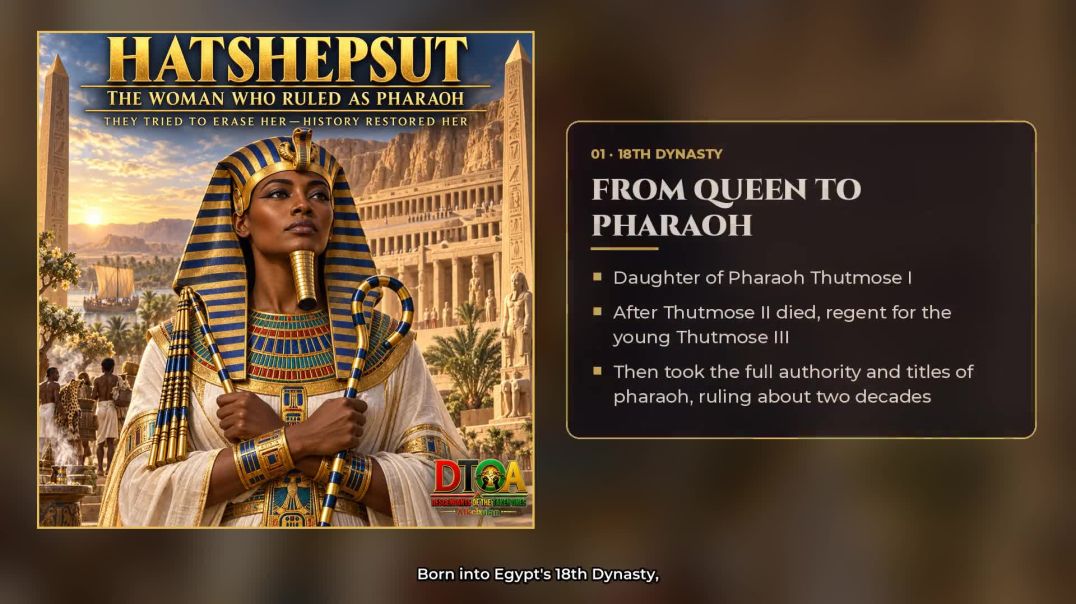
She was not merely a queen standing beside a king. Hatshepsut ruled Egypt as pharaoh. Born into Egypt’s 18th Dynasty, Hatshepsut was the daughter of Pharaoh Thutmose I. After her husband, Thutmose II, died, she initially governed as regent for the young Thutmose III. But Hatshepsut eventually assumed the full authority and titles of a pharaoh. She ruled for approximately two decades in the 15th century BCE—one of the longest and most successful reigns by a woman in ancient Egyptian history.
Egypt prospered under her leadership. Rather than building her reputation primarily through conquest, Hatshepsut strengthened Egypt through international trade, construction, and religious authority. Her famous expedition to the African land of Punt returned with gold, ivory, ebony, incense, animals, and living myrrh trees.
She commissioned enormous obelisks at Karnak and built her magnificent mortuary temple at Deir el-Bahri, one of the ancient world's architectural masterpieces. Hatshepsut was sometimes portrayed with the traditional symbols of male kingship, including the ceremonial false beard. This did not mean she was concealing her gender. Her inscriptions acknowledged her female identity, while her royal imagery conveyed that she possessed the full authority of the pharaoh.
Years after her death, parts of her name and image were removed from monuments. Scholars continue to debate the precise political and dynastic reasons. Yet those efforts failed. Her statues, temple, and accomplishments endured. Hatshepsut demonstrated that leadership was not determined by gender. She governed one of Africa’s greatest civilizations with intelligence, stability, and vision.
They attempted to remove her from history. History restored her to the throne.
We are the Descendants of the Taken Ones, and we remember the African woman who did not rule from behind the throne—she occupied it. Thank you for your time. To support the channel. Please like, share, and subscribe, and pass this along to your family and friends. Remember: information kept to yourself is lost over time, but shared information becomes enduring knowledge. People who lose control of their history can be led to believe they never contributed anything.














1 Comments
cliprize
19 days ago