
305 Views· 10/04/26· Black History
The Woman Whose Courage Helped Ignite the Civil Rights Movement, Recy Taylor

The Woman Whose Courage Helped Ignite the Civil Rights Movement, Recy Taylor
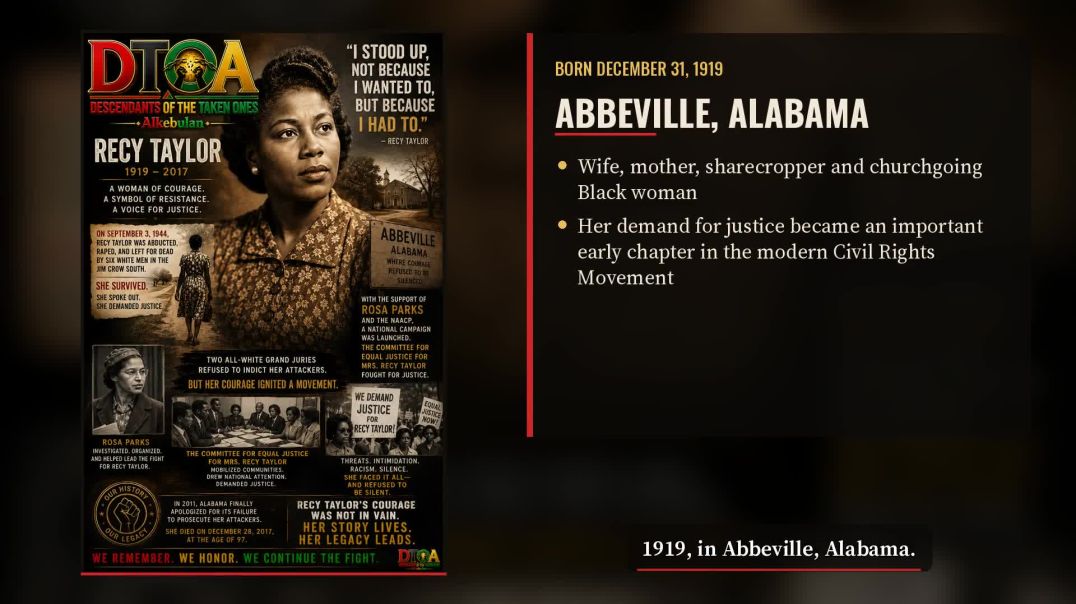
Recy Taylor was born on December 31, 1919, in Abbeville, Alabama. She was a wife, mother, sharecropper, and churchgoing Black woman whose demand for justice became an important early chapter in the modern Civil Rights Movement. (National Women's History Museum)
On September 3, 1944, the 24-year-old Taylor was walking home from church when six white men abducted and sexually assaulted her at gunpoint. Despite the danger of speaking out in the Jim Crow South, she immediately reported the crime and identified her attackers. (The Library of Congress)
Taylor refused to remain silent.
The Montgomery branch of the NAACP sent Rosa Parks to investigate. Parks helped establish the Committee for Equal Justice for Mrs. Recy Taylor, which organized letters, public meetings, newspaper coverage, and national pressure demanding prosecution. The campaign drew support from prominent Black leaders and organizations across the country. (National Museum of African American History)
Although evidence existed and at least one attacker admitted involvement, two all-white grand juries refused to issue indictments. Taylor and her family also endured threats and violence because she had dared to accuse white men publicly. She never received justice through the courts. (National Women's History Museum)
Yet her courage had a lasting impact.
The national campaign surrounding her case strengthened networks of Black women activists and demonstrated how organized resistance could challenge racial and sexual violence. Rosa Parks’ work on Taylor’s behalf occurred more than a decade before the Montgomery Bus Boycott, revealing that Parks was already an experienced investigator and civil-rights organizer. (National Park Service)
In 2011, the Alabama Legislature formally apologized for the state’s failure to prosecute Taylor’s attackers. She died in 2017 at the age of 97. (National Women's History Museum)
In closing
Recy Taylor lived in a society that expected Black women to suffer in silence.
She refused.
She spoke her name.
She identified her attackers.
She demanded justice from a system designed to deny it.
The courts failed Recy Taylor, but history did not forget her.
Her courage helped build the foundation upon which later Civil Rights victories would stand.
She was not merely a victim of injustice. She was a witness, a resistor, and a catalyst for change. To support the channel, please click the like button and subscribe to receive new videos



















1 Comments
cliprize
20 days ago