
256 Views· 08/31/26· Re-Education
Baby Esther's

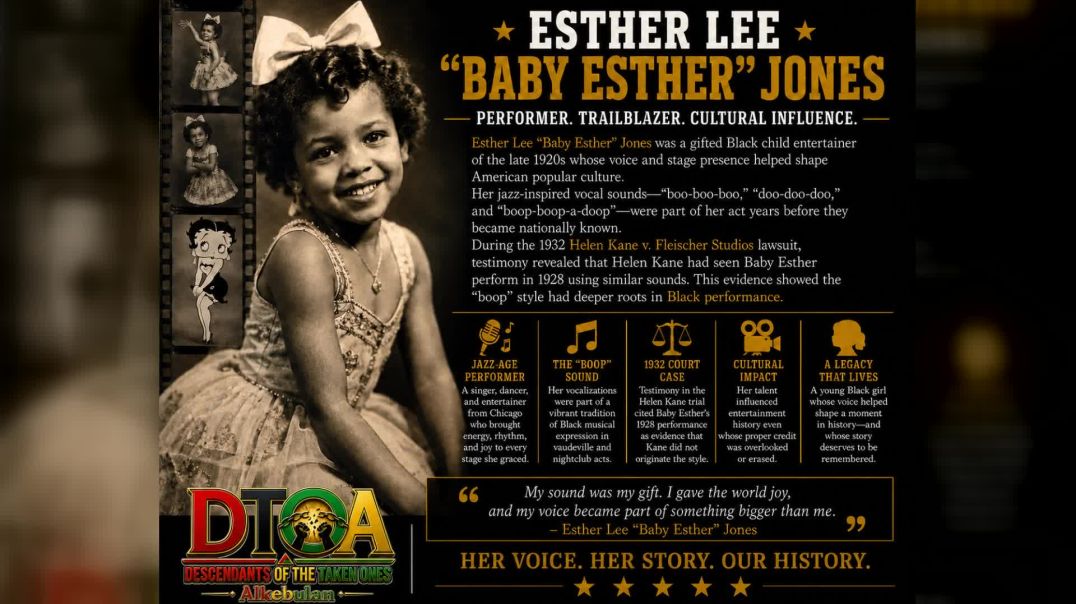
Esther Lee “Baby Esther” Jones
Esther Lee Jones, better known on stage as “Baby Esther,” “Little Esther,” or “Li’l Esther,” was a gifted Black child entertainer of the late 1920s whose voice, timing, and stage presence made her central to one of the most debated stories in animation and music history.
Born in Chicago, Esther entered show business as a young performer. She was known as a singer, dancer, scat-style vocalist, and entertainer who could command the stage with charm and precision. During her brief career, she performed across major entertainment circuits and became known for her vocal phrases and rhythmic sounds, such as “boo-boo-boo,” “doo-doo-doo,” and similar playful interpolations. These sounds were part of a broader jazz and vaudeville performance style that gained popularity in the 1920s.
Her importance became nationally significant during the 1932 Helen Kane v. Fleischer Studios lawsuit. Helen Kane, a white singer known for the phrase “boop-boop-a-doop,” sued the creators of Betty Boop, claiming the cartoon had copied her style. But during the trial, theatrical manager Lou Bolton testified that Helen Kane had seen Baby Esther perform in 1928 and that Esther had used similar vocal sounds before Kane became famous for them. An early test film of Esther’s performance was reportedly introduced as evidence, though that film is now considered lost.
Because of that case, Esther Jones became connected to the Betty Boop story. But her legacy should be handled carefully. It is safer to say that Baby Esther was an important Black child performer whose vocal style was cited in court as evidence that Helen Kane did not originate the “boop.” The historical record is complicated, and many images circulating online that claim to show Esther are misidentified.
Still, Esther’s story matters. It shows how Black performance shaped American entertainment, even when Black artists were not properly credited, protected, or remembered. Her voice traveled through vaudeville, jazz, nightclub performances, and courtroom testimony — yet history nearly erased the child behind the sound.
Esther Lee “Baby Esther” Jones reminds us that cultural influence is not always recorded in contracts or captured in headlines. Sometimes it endures in rhythm, imitation, and the echoes of a voice others borrowed.
In closing, Esther Lee “Baby Esther” Jones — the young Black performer whose sound helped expose the hidden roots of American popular culture. She was a Black child entertainer from Chicago who performed in the late 1920s. A singer, dancer, and stage performer known for her work. Esther Lee “Baby Esther” Jones • Child Entertainer • Jazz-Age Performer • Cultural Influence. Before the world heard “boop,” a young Black performer had already helped shape the sound.












3 Comments
cliprize
6 days agoJOSEPH ELISHA
27 days agoCopuffs843
1 month agoJOSEPH ELISHA
27 days ago