
58 Views· 10/21/26· Black History
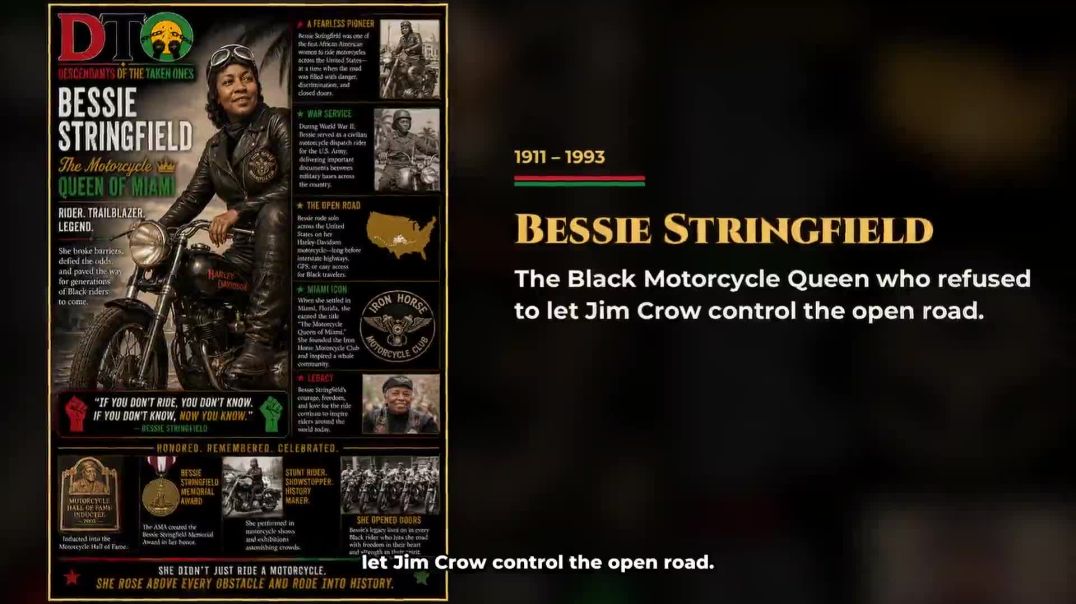
Bessie Stringfield (1911–1993): The Black Motorcycle Queen Who Refused to Let Jim Crow Control the O

Bessie Stringfield (1911–1993): The Black Motorcycle Queen Who Refused to Let Jim Crow Control the Open Road
6
Born: 1911 — North Carolina, according to later biographical research. Died: February 16, 1993 — Florida. Known as: The Motorcycle Queen of Miami. Legacy: Pioneering Black motorcyclist, World War II civilian Army courier, and trailblazer for women in motorcycling
1. A Black Woman Who Would Not Accept Boundaries
In the 1930s, America was a dangerous place for a Black woman traveling alone. Segregation dictated where Black Americans could eat, sleep, and find shelter. Racial violence threatened their safety, especially in the South. Women were also expected to conform to strict social norms.
But one Black woman refused to let those restrictions define her life. Her name was Bessie Stringfield. Armed with determination, mechanical skill, and extraordinary courage, she mounted a motorcycle and began exploring a country that often denied her basic dignity. She would eventually complete eight long-distance solo journeys across America, becoming a legend in motorcycle history.
2. Childhood and the Beginning of Her Motorcycle Journey
Bessie Stringfield's early life is surrounded by conflicting accounts. Some older biographies describe her as having been born in Jamaica and raised in Boston by an Irish adoptive mother. Later historical research identifies North Carolina as her birthplace in 1911 and challenges parts of the adoption story.
What is well established is that she learned to ride motorcycles as a teenager, beginning with a 1928 Indian Scout. At approximately 16, she discovered a passion that would shape her entire life. Motorcycles offered her something society refused to guarantee: independence. She did not need anyone's permission to dream of distant places, and she refused to believe that traveling alone was exclusively a man's privilege.
3. Eight Cross-Country Journeys Through Segregated America
Beginning around 1930, Stringfield traveled thousands of miles across the United States. She reportedly chose destinations by tossing a penny onto a map and riding toward where it landed. But these were not ordinary sightseeing trips. She traveled before the interstate highway system existed, navigating rough roads, isolated highways, unpredictable weather, and mechanical breakdowns. As a Black woman, she also faced the dangers of Jim Crow segregation. White-owned hotels frequently refused her accommodations, and restaurants and other establishments could deny her service. Traveling through unfamiliar communities carried the risk of racial harassment or violence. When she could not obtain lodging, she slept on her motorcycle at gas stations or stayed with Black families who offered her shelter. According to accounts of her travels, she persisted until she had ridden through all 48 contiguous states. Every journey challenged two deeply entrenched prejudices: that Black Americans had no right to move freely and that women were incapable of undertaking demanding motorcycle expeditions alone.
4. A Motorcycle Stunt Rider Who Challenged Men
Bessie was not merely a long-distance traveler. She became an exceptionally skilled rider who competed in motorcycle races and stunt exhibitions. Her demonstrations impressed spectators who rarely expected a woman, particularly a Black woman, to handle a powerful motorcycle with such confidence. Accounts describe her competing in flat-track races, sometimes disguising herself as a man. When her sex became known, she reportedly faced discrimination regarding prize money. She also performed stunts at carnivals and exhibitions, earning money to support her travels. Her abilities challenged the assumption that racing and advanced motorcycle handling belonged exclusively to men.
5. World War II: Serving the U.S. Army as a Motorcycle Courier
When World War II began, Stringfield found another use for her remarkable riding skills. She became a civilian motorcycle dispatch rider for the United States Army, carrying important messages and documents between military installations. Riding her own Harley-Davidson, she worked in a demanding environment where speed, endurance, reliability, and navigation skills were essential. She served during a period when the American military remained racially segregated. Although she was not a uniformed Army soldier, her civilian courier work contributed to wartime military communications. Her story illustrates a powerful contradiction: Black Americans were helping defend democracy overseas while still confronting discrimination at home.
6. The Motorcycle Queen of Miami
After the war, Stringfield made her home in the Miami area. There, she continued riding and became a prominent figure in the local motorcycle community. She founded the Iron Horse Motorcycle Club and was known for her riding skills, confidence, and independent personality. Yet even in Miami, discrimination persisted. According to her recollections, police officers repeatedly challenged her right to ride. She eventually demonstrated her exceptional handling skills to a police captain, impressing him with maneuvers that included precise figure-eight turns. Her reputation grew until she was widely recognized as the Motorcycle Queen of Miami. She also worked as a nurse, showing that her life extended beyond motorcycles into service and employment in her community.
7. Twenty-Seven Harley-Davidsons and a Lifetime of Freedom
Throughout her life, Stringfield owned 27 Harley-Davidson motorcycles, in addition to her original Indian Scout. Her devotion to riding endured into old age. For Bessie, motorcycling was not merely transportation or recreation. It represented personal freedom, self-reliance, and a refusal to accept others' limitations. She remained connected to the motorcycle community in her later years, sharing stories of her adventures and inspiring younger riders. Author Ann Ferrar interviewed and befriended Stringfield during her final years, helping preserve her history through recorded accounts and published writing. Without that work, much of Stringfield's extraordinary legacy might have remained unknown beyond Miami.
8. Death, Recognition, and Her Enduring Legacy
Bessie Stringfield died on February 16, 1993. Her achievements eventually received national recognition. In 2002, she was posthumously inducted into the American Motorcyclist Association Motorcycle Hall of Fame. The American Motorcyclist Association also established an award in her name to recognize individuals who help expand participation in motorcycling. Her influence remains visible through women-led motorcycle organizations, including the Bessie Belles Riding Club, established in 2021. In 2025, Miami Gardens further honored her by dedicating Bessie Stringfield Way. Her name lives on as a symbol of courage, independence, and the right to pursue freedom without regard to race or gender.
9. The DTOA Alkebulan Message: Freedom Was More Than a Destination
Bessie Stringfield's story forces us to confront an uncomfortable truth about American history. A Black woman could serve in the American military during World War II, travel thousands of miles, and demonstrate extraordinary professional skill—yet still be denied a hotel room because of the color of her skin. She lived in a society that tried to dictate where Black people could go, where women belonged, and what opportunities they deserved. But Bessie refused to surrender control of her journey. She did not wait for segregation to end to travel. She did not wait for motorcycle clubs to welcome women. She did not wait for society to declare that a Black woman belonged on the open highway. She simply mounted her motorcycle and rode. Her legacy shows that freedom is more than a promise written into law. It is also the determination to challenge unjust restrictions and expand possibilities for those who follow.
Bessie Stringfield broke barriers not through speeches or political office, but through the powerful example of a life lived on her own terms. She opened the road for future generations of Black riders and women motorcyclists. They tried to restrict her movement. She crossed the country. They questioned her abilities. She became a legend. They tried to define her place in society. She chose her own destination. This is the story of Bessie Stringfield, the Motorcycle Queen of Miami.
Descendants of the Taken Ones Alkebulan.
Know the history. Honor the ancestors. Preserve the legacy. Historical clarification: Details of Stringfield's birthplace and childhood are disputed. The narrative distinguishes these uncertainties from her well-documented motorcycle achievements. Thank you for your time. To support the channel. Please like, share, and subscribe, and pass this along to your family and friends. Remember: information kept to yourself is lost over time, but shared information becomes enduring knowledge. People who lose control of their history can be led to believe they never contributed anything.




0 Comments