
44 Views· 11/04/26· Black History
MUHAMMAD ALI: THE CHAMPION WHO REFUSED TO SURRENDER HIS CONSCIENCE

MUHAMMAD ALI: THE CHAMPION WHO REFUSED TO SURRENDER HIS CONSCIENCE
Descendants of the Taken Ones – Alkebulan
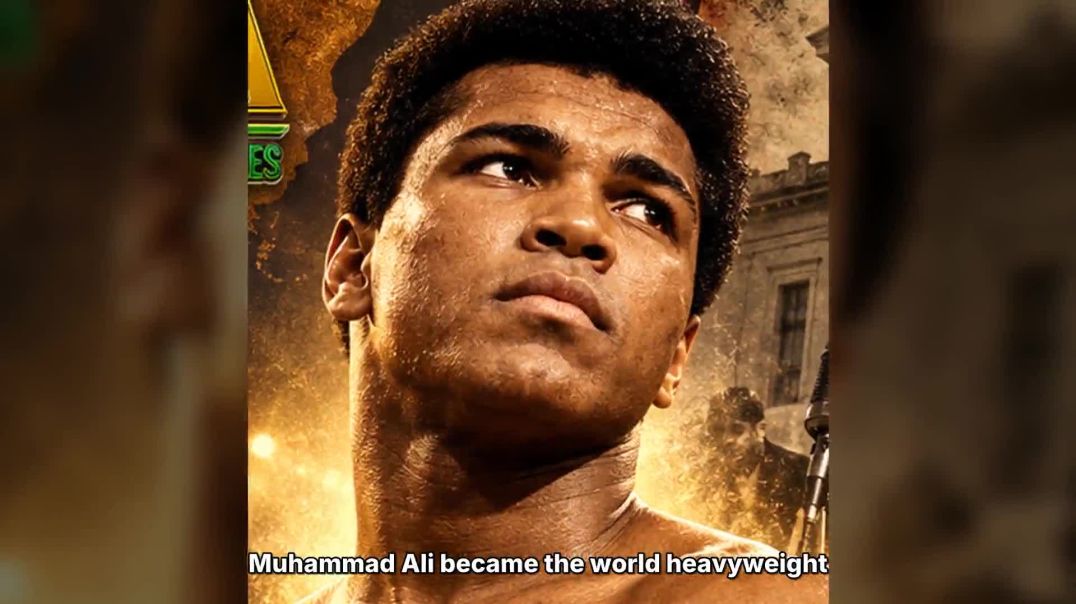
Muhammad Ali became the world heavyweight champion. When he refused military induction during the Vietnam War, he lost his title, his ability to fight in much of the United States, and years of his athletic prime.
His case forced America to confront a question that reached far beyond boxing: how much freedom does a person possess when exercising his conscience threatens everything he has earned?
Born Cassius Marcellus Clay Jr. on January 17, 1942, in Louisville, Kentucky, Ali grew up under segregation. He began boxing at twelve after reporting his stolen bicycle to police officer and boxing trainer Joe Martin.
The angry boy who wanted to confront a bicycle thief became an extraordinarily disciplined athlete.
At the 1960 Rome Olympics, he won the light heavyweight gold medal. He turned professional and built a reputation for speed, skill, confidence, and an unmistakable talent for commanding attention.
On February 25, 1964, at twenty-two, he defeated Sonny Liston to become the world heavyweight champion.
Soon afterward, he publicly affirmed his affiliation with the Nation of Islam and adopted the name Muhammad Ali.
He insisted on the right to define himself.
His name and religion became subjects of public hostility. Some commentators continued to call him Cassius Clay after he had rejected that name. His confidence, which helped sell fights, became more threatening to critics when it was linked to Black independence and religious conviction.
Ali’s fame also attracted government scrutiny. The FBI collected records concerning him, while the National Security Agency’s surveillance captured communications involving him. Those were distinct agencies and activities; they should not be collapsed into a single investigation.
His public associations and opposition to the Vietnam War made him a controversial figure. Controversy, however, did not establish criminal wrongdoing.
Then came the decision that changed his career.
On April 28, 1967, Ali refused induction into the U.S. armed forces in Houston. He sought recognition as a conscientious objector on religious grounds.
His position stemmed from his faith and opposition to the war. It also highlighted a broader contradiction: Black Americans were being asked to serve a country that still denied them equal treatment at home.
The consequences were immediate and severe. Boxing authorities stripped him of championship recognition, and licensing decisions barred him from fighting across much of the country.
In June 1967, he was convicted of refusing induction and sentenced to five years in prison and a $10,000 fine. He remained free while appealing.
Ali went more than three years without a professional fight.
Those were years he could never fully recover from physically. Lost bouts meant lost earnings, lost opportunities, and an uncertain future. He supported himself in part through speaking engagements, taking his arguments to audiences beyond the boxing arena.
He accepted a cost that gave his convictions public weight.
The conviction did not stand.
On June 28, 1971, the Supreme Court reversed his conviction in Clay v. United States. The decision was unanimous among the eight participating justices; Justice Thurgood Marshall did not participate.
The ruling concerned the handling of his conscientious-objector claim. It should not be described as a Supreme Court judgment declaring the Vietnam War illegal.
What it meant was concrete: the criminal conviction against Ali was overturned.
He rebuilt his career without recovering the years taken from it.
Ali returned to boxing in 1970. In 1971, he lost to Joe Frazier in their celebrated first meeting. His comeback included defeats, difficult fights, and growing questions about whether he could regain the championship.
In 1974, he faced George Foreman in Kinshasa, Zaire—now the Democratic Republic of the Congo. Foreman entered as a formidable champion. Ali defeated him by knockout in the eighth round and reclaimed the world heavyweight title.
In 1978, after losing to Leon Spinks, Ali won their rematch and became the first boxer to win the world heavyweight championship three times.
His career record stood at 56 wins, including 37 knockouts, and five losses.
But a record book cannot fully explain his influence.
Ali made self-definition visible. He demanded respect for his chosen name and faith. He demonstrated that an athlete could speak about war, racism, and political power even when doing so endangered his livelihood.
Diagnosed with Parkinson’s disease in 1984, he later became widely recognized for humanitarian work. His appearance lighting the Olympic cauldron in Atlanta in 1996 offered a moving public image of endurance.
He died on June 3, 2016, at seventy-four.
Descendants of the Taken Ones, remembering Ali means holding the full history together: the brilliant athlete, the complicated public figure, the government scrutiny, the overturned conviction, and the professional punishment he endured before becoming broadly celebrated. Muhammad Ali’s courage was measured in the ring. It was also measured in the years when defending his conscience cost him the right to enter it.
Thank you for your time. To support the channel. Please like, share, and subscribe, and pass this along to your family and friends. Remember: information kept to yourself is lost over time, but shared information becomes enduring knowledge. People who lose control of their history can be led to believe they never contributed anything.
#muhammadali #dtoa #descendantsofthetakenones #alkebulan #blackhistory #thegreatest #boxinglegend #civilrights #religiousfreedom #freedomofconscience #conscientiousobjector #vietnamwar #governmentsurveillance #blackathletes #knowyourhistory
live source retrieval was unavailable; this narrative avoids direct quotations and unverified surveillance-file details.











0 Comments