
91 Views· 09/06/26· Black History
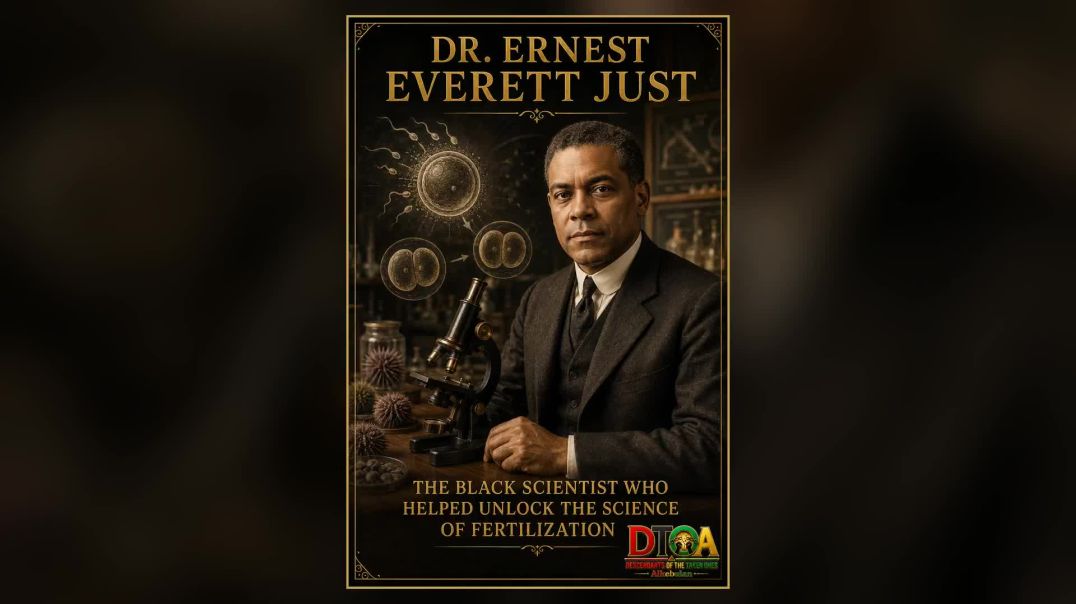
Dr. Ernest Everett Just — The Black Scientist Who Helped Unlock the Science of Fertilization

Dr. Ernest Everett Just — The Black Scientist Who Helped Unlock the Science of Fertilization
Before modern fertility treatments enabled human life to begin in a laboratory, Dr. Ernest Everett Just was uncovering fundamental biological processes that make fertilization and embryonic development possible. Born on August 14, 1883, in Charleston, South Carolina, Ernest Everett Just grew up during an era when segregation sought to restrict every opportunity available to Black Americans. His father died when Ernest was young, leaving his mother, Mary Matthews Just, to support the family through teaching and seasonal work.
Despite poverty, illness, and racial discrimination, Ernest became an exceptional student. In 1907, he graduated magna cum laude from Dartmouth College, earning honors in zoology and several other subjects. He was the only Black student in his graduating class. Yet his brilliance could not shield him from American racism. White universities largely refused to hire Black scholars, regardless of their qualifications. He then joined the faculty of Howard University, initially teaching English before becoming a biology professor and eventually leading its Department of Zoology.
In 1909, Just began conducting research at the Marine Biological Laboratory in Woods Hole, Massachusetts. He became the first African American to study and work at the institution. There, he investigated the eggs and embryos of sea urchins, marine worms, and other organisms. Just discovered that the surface of a living cell was not merely a protective covering. It played an essential role in fertilization, development, and the cell’s response to its environment. His experiments demonstrated that the point where sperm enters an egg helps determine the egg’s first plane of division. He also advanced scientific understanding of how an egg prevents additional sperm from entering after fertilization—an essential process known as the block to polyspermy.
Just identified and documented processes are now described as the fast and slow blocks to polyspermy. These mechanisms help ensure that only one sperm fertilizes an egg, allowing normal embryonic development to begin. He insisted that scientists should study living cells under conditions resembling their natural environments. He believed that removing or breaking apart a cell could destroy the relationships that made it alive. This holistic approach anticipated important principles in modern cell biology and developmental biology.
Dr. Ernest Everett Just was a pioneering founder of modern fertilization and developmental biology whose discoveries helped establish scientific principles relevant to later reproductive research, but he was not the primary developer of human IVF.
In vitro fertilization in humans was developed decades later, primarily through the work of Robert Edwards, Patrick Steptoe, Jean Purdy, and their research team. Their work led to the 1978 birth of Louise Brown, the first baby born through IVF. Just’s research primarily involved marine organisms rather than clinical human fertility treatment. Nevertheless, his investigations helped scientists understand how eggs respond to sperm, how fertilization activates an egg, how cells prevent multiple fertilizations, and how environmental conditions affect developing embryos.
For this reason, Just should not be called the inventor or principal developer of IVF. He should be recognized as one of the pioneering scientists who helped unlock the biological science of fertilization upon which later reproductive research could advance. In 1915, the NAACP awarded Just its first Spingarn Medal for outstanding achievement by an African American. The following year, he earned his doctorate in experimental embryology from the University of Chicago.
Just was also one of the founders of Omega Psi Phi Fraternity, Incorporated. In 1911, he joined Howard University students Edgar Amos Love, Oscar James Cooper, and Frank Coleman to establish the historic Black fraternity. Although internationally respected, Just continued to face discrimination in the United States. Major universities denied him research appointments and laboratory resources routinely offered to white scientists. He increasingly traveled to Europe, conducting research in Italy, Germany, and France, where his scientific abilities generally received greater recognition.
In 1939, he published two important books: Basic Methods for Experiments on Eggs of Marine Animals and The Biology of the Cell Surface. Throughout his career, he authored more than 70 scientific papers on fertilization, cellular behavior, and embryonic development. When Nazi Germany invaded France in 1940, Just was briefly detained. He eventually returned to the United States in declining health and died of pancreatic cancer on October 27, 1941. He was 58 years old.
Dr. Ernest Everett Just did more than study cells. He challenged a scientific establishment that often dismissed both his discoveries and his humanity. His work showed that life cannot always be understood by examining isolated parts—the living organism must also be recognized as an interconnected whole.
Descendants of the Taken Ones honors Dr. Ernest Everett Just—the Black scientist who helped unlock the science of fertilization and expanded humanity’s understanding of how life begins.
To support the channel, please click the like button and subscribe to receive new videos

















1 Comments
cliprize
14 days ago