
297 Views· 09/25/26· Black History
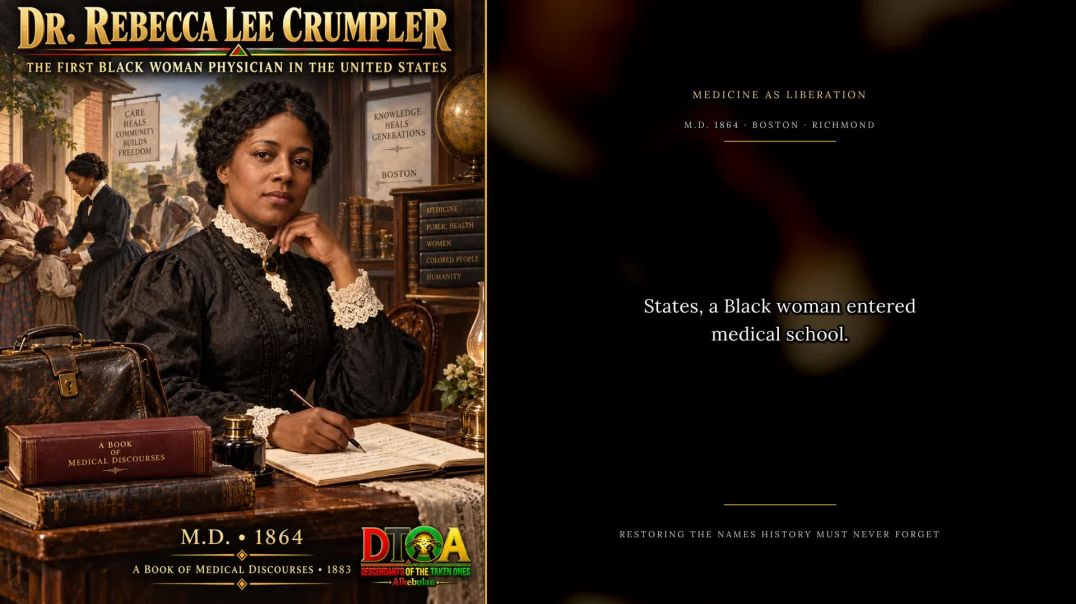
Dr. Rebecca Lee Crumpler — Medicine as Liberation

Dr. Rebecca Lee Crumpler — Medicine as Liberation
Before the Civil War ended, before slavery was abolished throughout the United States, a Black woman entered medical school.
Her name was Rebecca Lee Crumpler.
Born Rebecca Davis in Delaware in 1831, she was raised in Pennsylvania by an aunt who cared for sick neighbors. Observing her aunt provide comfort and treatment awakened Crumpler’s calling to medicine. She later moved to Massachusetts, where she worked as a nurse for about eight years. At the time, nursing generally required no formal education, but Crumpler’s skill impressed the physicians with whom she worked. Their recommendations helped her gain admission to the New England Female Medical College in 1860. Her presence challenged two powerful barriers simultaneously.
Medical education was overwhelmingly controlled by white men. Women were often declared intellectually or physically incapable of becoming physicians—and Black women faced the combined weight of racism and sexism. Crumpler continued. On March 1, 1864, she received her medical degree, becoming the first known Black woman in the United States to earn an M.D. and practice as a formally trained physician. She was the only known African American graduate of the New England Female Medical College. The National Library of Medicine documents her groundbreaking medical career.
But Dr. Crumpler did not pursue medicine merely for recognition.
After the Civil War, she went to Richmond, Virginia, where thousands of newly freed Black people urgently needed medical care. Formerly enslaved families faced disease, poverty, inadequate housing, and widespread discrimination from white physicians and medical institutions. Working alongside missionary and relief organizations associated with the Freedmen’s Bureau, Crumpler treated women and children whom many other medical professionals neglected. She faced intense hostility. Some physicians refused to respect her medical judgment. Pharmacists reportedly refused to fill her prescriptions, while others tried to ridicule the medical degree after her name.
But Dr. Crumpler continued treating her patients. She eventually returned to Boston, where she practiced medicine—particularly for women and children—regardless of patients' ability to pay. In 1883, she published A Book of Medical Discourses in Two Parts. Drawing on years of clinical experience, the book addressed maternal health, childhood illnesses, nutrition, prevention, and the care of women and children.
It is recognized as one of the earliest medical publications written by an African American—and the first known medical book published by a Black American woman. The surviving volume can be viewed through the National Library of Medicine’s historical collection.
Dr. Rebecca Lee Crumpler understood something revolutionary:
Freedom required more than the removal of chains.
It required healthy children.
It required educated mothers.
It required medical knowledge within the community.
It required Black people to receive care from someone who recognized their humanity.
She entered medicine when neither the profession nor the country was prepared to welcome a Black woman physician. Then she carried her knowledge directly to people rebuilding their lives after slavery.
Dr. Rebecca Lee Crumpler did not merely break a medical barrier. She transformed medicine into an instrument of healing, dignity, and liberation.
We are the Descendants of the Taken Ones. We remember the healers who cared for our people when America refused to recognize their humanity. Dr. Rebecca Lee Crumpler was not only the first Black woman doctor in America. She was a healer of the wounded, a pioneer in public health, and proof that Black women belonged in medicine from the beginning. Thank you for your time. To support the channel. Please like, share, and subscribe, and pass this along to your family and friends. Remember: information kept to yourself is lost over time, but shared information becomes enduring knowledge. People who lose control of their history can be led to believe they never contributed anything.





![Plies - Medicine [feat. Keri Hilson] (Official Music Video)](https://theblacktube.com/upload/photos/2024/03/d70c99c0a43c468c4f9c90a4dd6b10dfb694621dlnOUPtWs7JJz9g685AcY.video_thumb_6322_166.4.jpeg)



2 Comments
cliprize
16 days agoJOSEPH ELISHA
23 days ago