
218 Views· 09/09/26· Black History
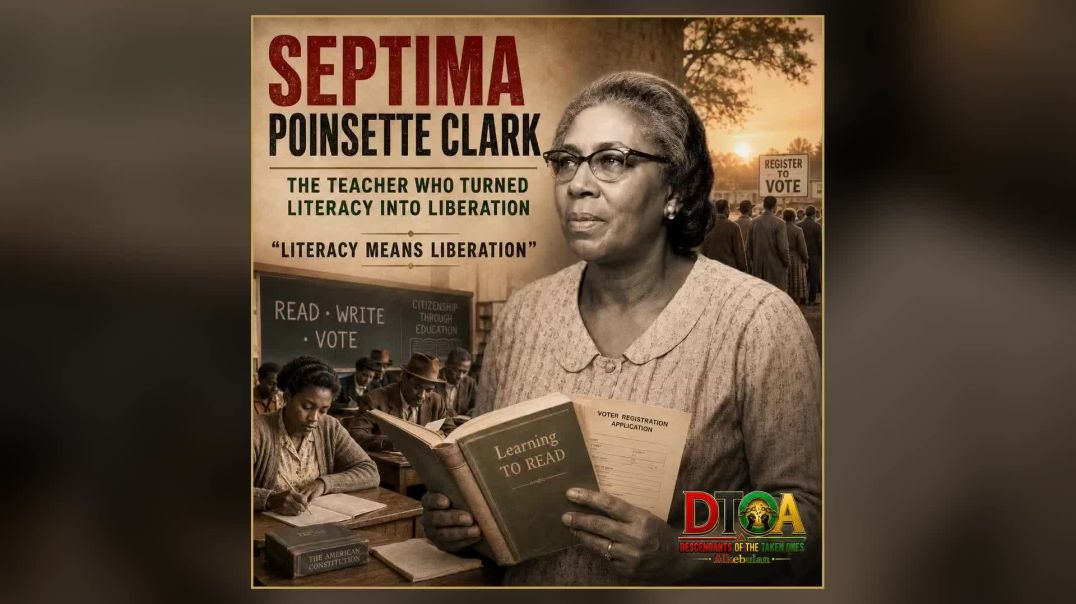
SEPTIMA POINSETTE CLARK The Teacher Who Turned Literacy Into Liberation
SEPTIMA POINSETTE CLARK
The Teacher Who Turned Literacy Into Liberation
Descendants of the Taken Ones
Before the marches filled America’s streets and before the Voting Rights Act became law, Septima Poinsette Clark was building a quieter revolution. She taught Black adults to read and write, complete voter-registration forms, understand government, and claim the political power segregation had tried to deny them. Her classrooms helped build the Civil Rights Movement from the ground up. Born Into the Shadow of Slavery. Septima Poinsette was born on May 3, 1898, in Charleston, South Carolina. Her father, Peter Poinsette, had been born enslaved. Her mother, Victoria Warren Anderson Poinsette, was raised in Haiti and worked as a laundress after returning to Charleston. Clark graduated from the Avery Normal Institute in 1916 and qualified to become a teacher. However, Charleston prohibited Black educators from teaching in its public schools. At 18, she began teaching on Johns Island, one of South Carolina’s Sea Islands. There, Clark encountered a school system deliberately structured to keep Black children poor and politically powerless.
Her overcrowded school had few resources, while nearby white schools received more funding, better facilities, and higher-paid teachers. Clark understood that unequal education was not accidental. It was a foundation of Jim Crow. Fighting for Black Teachers After returning to Charleston, Clark joined a campaign demanding that the city allow Black teachers to work in Black public schools. The movement gathered thousands of signatures, and Charleston began employing Black teachers in 1920. Clark later joined the NAACP and helped fight for equal salaries for Black and white teachers. She believed educators could not separate classroom instruction from the struggle for justice. In 1956, South Carolina passed a law prohibiting public employees from belonging to civil-rights organizations. Clark refused to surrender her NAACP membership.
After approximately 40 years as an educator, Charleston officials fired her and denied her retirement benefits. At nearly 60, Septima Clark lost her career because she refused to abandon the struggle for Black freedom. But the action intended to silence her instead expanded her influence across the South. Clark began working full-time at Tennessee’s Highlander Folk School, an interracial training center for labor and civil-rights organizers. Working with activists including Esau Jenkins and her cousin Bernice Robinson, Clark helped develop and expand the Citizenship School model. The first school opened at the Progressive Club on Johns Island.
These schools did far more than teach adults to pronounce words from textbooks. Students learned from materials tied to their daily lives—voter-registration forms, newspapers, applications, checks, tax information, constitutional rights, and local government. The purpose was not merely literacy. It was liberation. Southern states used literacy tests and other discriminatory barriers to keep Black citizens from registering to vote. Citizenship Schools helped adults build the skills and confidence to challenge those barriers. The program also rejected the traditional notion that only formally trained educators could teach. Trusted community members were prepared to become instructors, enabling the schools to spread through churches, homes, beauty salons, meeting halls, and other community spaces.
Building the Movement From Below In 1961, the Southern Christian Leadership Conference acquired the Citizenship Education Program. Clark became its director of education and worked alongside Dr. Martin Luther King Jr., Andrew Young, Dorothy Cotton, and other movement leaders. Under the SCLC, Citizenship Schools expanded throughout the South. Thousands of Black adults learned to read, register to vote, understand public institutions, and organize their communities. Clark did not teach people simply to follow famous leaders. She trained ordinary people to become leaders themselves. Domestic workers, farmers, laborers, church members, and parents learned that their experiences mattered and that they possessed the ability to change their communities.
Septima Clark called this teaching people to do their “own talking.”
A Woman Overlooked by the Movement
Clark’s work was sometimes minimized within a movement in which the most visible leadership positions were dominated by men. She challenged sexism as directly as she challenged racism. Clark understood that Black women did much of the organizing, teaching, fundraising, and community work that sustained the movement, even though men received greater public recognition. Dr. King reportedly called her the “Mother of the Movement.” The title recognized something history too often overlooks: protests could mobilize people for a moment, but education prepared them to exercise power for generations.
Her Enduring Legacy
Septima Clark retired from the SCLC in 1970. She later won the restoration of the pension South Carolina had taken from her and served on the Charleston County School Board. She died on December 15, 1987, at age 89. Clark’s legacy lives wherever education is used to confront oppression. She demonstrated that literacy is more than the ability to read words on a page. It is the ability to understand the systems that govern your life—and to organize with others to change them. Septima Clark did not stand at the front of every march. She prepared the people who marched, registered, organized, taught, voted, and transformed the South.
She turned classrooms into organizing centers, students into citizens, and literacy into liberation. We are the Descendants of the Taken Ones, and we honor Septima Poinsette Clark—the teacher who helped a disenfranchised people find their political voice.
Sources
• National Park Service — Septima Poinsette Clark
• SNCC Digital Gateway — Septima Clark
• Martin Luther King Jr. Research and Education Institute — Septima Poinsette Clark
• South Carolina State Museum — Septima Poinsette Clark
• Southern Cultures — “I Train the People to Do Their Own Talking” To support the







![Tinashe - Nasty [2025 Dick Clark's New Year's Rockin Eve]](https://theblacktube.com/upload/photos/2025/02/mT7GFS15LFX794xshebq_09_91ad51e27bab88265484949640a23077_image.jpeg)

2 Comments
cliprize
17 days agoJOSEPH ELISHA
1 month agoTobe Sweeney Jr.
1 month ago