

134 Views· 10/04/26· Film & Animation
Dr. William M. Watts The Physician Who Built Oakland’s First Black Hospital

Dr. William M. Watts The Physician Who Built Oakland’s First Black Hospital
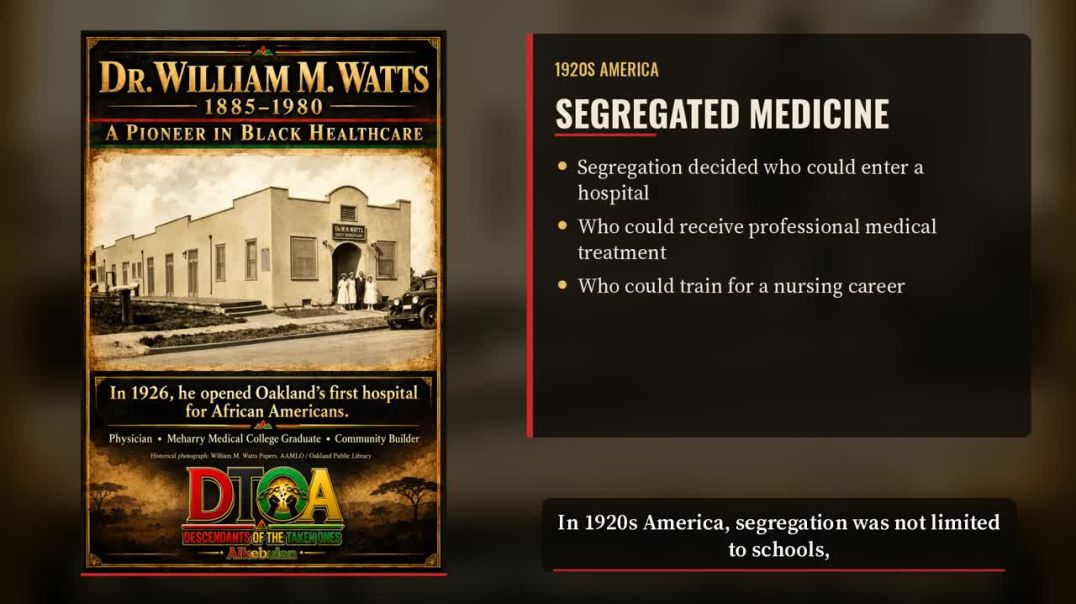
In 1920s America, segregation was not limited to schools, restaurants, and public transportation. It also determined who could enter a hospital, receive professional medical treatment, or train for a nursing career.
Dr. William M. Watts refused to accept that injustice.
William M. Watts was born on February 15, 1885, in Lodi, Texas, to Perry and Jane Watts. Determined to enter medicine during an era when Black physicians faced enormous educational and professional barriers, he attended Meharry Medical College, one of the nation’s leading institutions for training Black medical professionals.
After earning his medical degree in 1915, Dr. Watts practiced in Houston, Texas, and Fresno, California, before relocating to Oakland.
A hospital created because segregation denied care
Black residents of Oakland frequently encountered discrimination within the city’s established medical institutions. Black nurses were also denied access to many professional training programs.
Dr. Watts responded by building an institution of his own.
In 1926, he opened the W. M. Watts Private Hospital at 3437 Harlan Street in North Oakland. The modern, fireproof facility contained approximately 22 beds and provided medical and surgical treatment to Black patients who could not depend on receiving equal care elsewhere.
The hospital also created training opportunities for Black nurses, opening a professional pathway that Oakland’s segregated institutions had largely closed to them.
It was reportedly the first hospital established specifically to serve African Americans in Oakland. The surviving papers of Dr. Watts are preserved by the African American Museum and Library at Oakland. Oakland Public Library
Dr. Watts believed that healthcare included education as well as treatment. While practicing in Oakland, he wrote a medical-advice column titled “How to Keep Well” for the Western American, a local Black newspaper. Through that column, he brought practical health information beyond his examination room and directly into the community.
A necessary institution—and a difficult struggle
Although the hospital answered an urgent need, operating an independent Black medical facility during segregation was financially difficult. Black hospitals often lacked access to the wealthy donors, insurance networks, public support, and institutional resources available to white facilities.
The Watts hospital closed in 1927, only a short time after opening. Its brief existence, however, does not diminish its importance. The hospital proved that Black physicians and nurses could establish and operate modern medical institutions even when the larger healthcare system rejected them.
After returning to Texas, Dr. Watts operated the Sheppard-Watts Hospital in Marshall following the death of his brother. He continued practicing medicine until retiring in the late 1960s. His professional papers include photographs, licenses, newspaper articles, and a 600-page patient and financial ledger documenting his work in Houston and Marshall. Online Archive of California
Dr. Watts died in 1980, leaving behind a legacy that reaches far beyond one hospital building.
He was part of a generation of Black medical pioneers who understood a painful truth: when existing institutions refused to serve their people, Black communities had to create institutions of their own.
Dr. William M. Watts did more than treat illness. He confronted medical segregation by building a place where Black patients could receive care and Black nurses could prepare to serve.
His Oakland hospital may have operated briefly, but its message remains permanent:
Black health mattered. Black medical knowledge mattered. Black institutions mattered.
Descendants of the Taken Ones
Restoring the history left behind by builders, healers, and pioneers.Thank you for your time. To support the channel. Please like, share, and subscribe, and pass this along to your family and friends. Remember: information kept to yourself is lost over time, but shared information becomes enduring knowledge. People who lose control of their history can be led to believe they never contributed anything.






2 Comments
cliprize
20 days agonhlanhla666
21 days ago