
271 Views· 10/01/26· Black History
Elizabeth City State University: A Black Legislator’s Vision Became a University

Elizabeth City State University: A Black Legislator’s Vision Became a University
Elizabeth City State University was founded by an African American lawmaker who understood that Black political representation could be used to build permanent institutions.
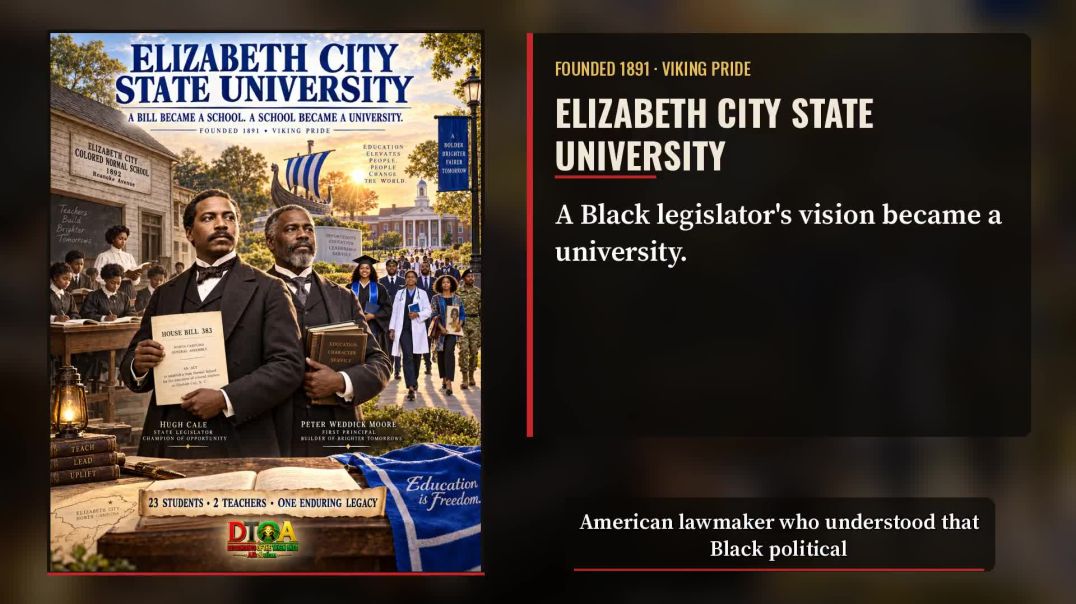
His name was Hugh Cale.
Born in 1835, Cale became an educator, community leader, and representative for Pasquotank County in the North Carolina General Assembly during an era when Reconstruction's achievements were systematically attacked.
On January 26, 1891, Cale introduced legislation to establish a school to train Black teachers for North Carolina’s public schools.
His proposal became House Bill 383.
The bill passed on March 3, 1891, formally establishing what was initially called the Elizabeth City Colored Normal School. Its stated mission was to educate Black teachers to serve children in communities that North Carolina’s segregated system had neglected. (Elizabeth City State University)
The school began operating on January 4, 1892, with:
• 23 students
• Two teachers
• A state appropriation of $900
• Peter Weddick Moore as its first principal
Moore guided the institution for 37 years. Under his leadership, enrollment grew from 23 students to 355, the faculty expanded, and the curriculum developed beyond its original teacher-training program. (Elizabeth City State University)
In 1912, the school moved to its present location. Collegiate courses followed, and in 1939 it became Elizabeth City State Teachers College, awarding its first bachelor’s degrees that same year.
As the institution’s mission expanded, its name changed again:
• Elizabeth City Colored Normal School
• State Normal School
• Elizabeth City State Teachers College
• Elizabeth City State College
• Elizabeth City State University, adopted in 1969
In 1972, ECSU became a constituent institution of the consolidated University of North Carolina system.
The university grew from a small teacher-training school into a center for education, aviation, science, technology, business, the arts, and public service.
Its teachers carried knowledge into Black communities throughout northeastern North Carolina. Its graduates became educators, pilots, scientists, entrepreneurs, public officials, military officers, and community leaders.
But the institution’s existence was never guaranteed.
Black normal schools across North Carolina faced consolidation and closure during the rise of White-supremacist political rule. ECSU survived because educators, students, local residents, and institutional leaders refused to surrender the school that Hugh Cale’s legislation had created.
Elizabeth City State University represents the lasting power of the Black vote when political authority is converted into education and community infrastructure.
Hugh Cale did more than occupy a seat in the legislature.
He used that seat to create generations of opportunity.
A bill became a school.
A school became a college.
A college became a university.
From 23 students and two teachers emerged the enduring legacy of Viking Pride.
DTOA—Descendants of the Taken Ones. We remember the Black leaders who transformed political power into permanent institutions.
Thank you for your time. To support the channel. Please like, share, and subscribe, and pass this along to your family and friends. Remember: information kept to yourself is lost over time, but shared information becomes enduring knowledge. People who lose control of their history can be led to believe they never contributed anything.








1 Comments
cliprize
19 days ago