
46 Views· 10/19/26· Black History
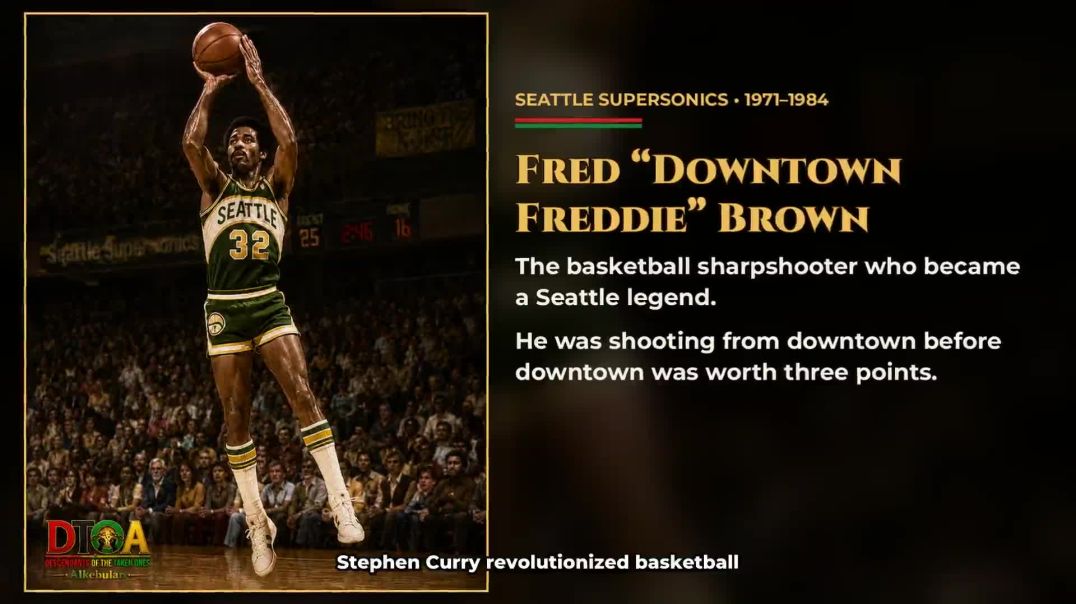
Fred “Downtown Freddie” Brown

Fred “Downtown Freddie” Brown
The Basketball Sharpshooter Who Became a Seattle Legend (1948–Present) Before Stephen Curry revolutionized basketball with the three-point shot and long-range shooting became the centerpiece of the modern NBA, there was a Black basketball legend whose deep shooting accuracy earned him one of the most memorable nicknames in basketball history: “Downtown Freddie” Brown.
He played in an era when a long-distance basket was worth only two points. During most of his career, there were no three-point records to chase, no social-media highlights, and no modern analytics to celebrate his shooting range.
But when Freddie Brown released the basketball, defenders knew they were in trouble. For 13 seasons, he played for the Seattle SuperSonics. He became an NBA All-Star, a league champion, a respected team captain, and one of the most accurate long-range shooters of his generation. His story is one of perseverance, loyalty, extraordinary shooting ability, and a legacy that deserves greater recognition.
1. Early life: From Milwaukee to basketball greatness. Fred Brown was born on August 7, 1948, in Milwaukee, Wisconsin. Growing up during the civil rights movement, Brown honed his basketball skills as opportunities for Black Americans expanded, yet racial discrimination remained widespread. He attended Lincoln High School in Milwaukee, where he became known for his remarkable shooting touch. Brown could score from distances many players rarely attempted. His ability to hit long jumpers earned him the nickname “Downtown Freddie Brown” in high school, a moniker that followed him throughout his professional career. Brown later attended Southeastern Community College in Iowa before transferring to the University of Iowa, where he continued to develop into an outstanding offensive player. His performance drew the attention of professional basketball scouts, who recognized his combination of shooting, ballhandling, and offensive versatility.
Basketball Reference
2. The 1971 NBA Draft: Seattle discovers a future legend
In 1971, the Seattle SuperSonics selected Fred Brown with the sixth overall pick in the NBA Draft. At the time, Seattle was a relatively young NBA franchise, established in 1967. Brown entered professional basketball as a 6-foot-3 guard capable of playing both shooting guard and point guard. His rookie season brought limited playing time, but Brown refused to let his early role define his future. Through preparation and consistent scoring, he earned a larger role in Seattle's offense. What initially seemed an ordinary draft pick would eventually become one of the most important decisions in SuperSonics history. Fred Brown would spend his entire 13-year NBA career in Seattle, from 1971 through 1984. In an era of increasing player movement, his commitment made him a defining figure in the franchise's history.
Basketball Reference
3. The unstoppable jumper: Why they called him Downtown
Brown possessed an exceptional shooting touch. His offense relied on timing, footwork, balance, and the ability to create space for his jump shot. He was especially dangerous from long range. Imagine a player consistently making shots from behind today's three-point line, yet receiving only two points for each successful basket. That was the reality for Brown during the first eight seasons of his NBA career. The NBA did not introduce its three-point line until the 1979–80 season. By then, Brown was already an established long-range specialist. When the three-point shot finally became part of NBA basketball, his abilities were immediately rewarded. During the 1979–80 season, Brown connected on an extraordinary 44.3% of his three-point attempts, leading the NBA in three-point shooting percentage. He had spent years developing the very skill that would eventually transform professional basketball.
NBA
4. The night Freddie Brown scored 58 points. On March 23, 1974, Brown delivered one of the most extraordinary scoring performances in Seattle basketball history. Facing the Golden State Warriors in Oakland, he exploded for 58 points, leading the SuperSonics to a dramatic 139–137 win.
58
Points scored
24
Field goals made
64.9%
Field goal accuracy
Brown accomplished this without a three-point line. Every one of his 24 field goals counted as two points. The performance set a Seattle franchise scoring record at the time and cemented his reputation as one of the NBA's most dangerous shooters. Seattle Post-Intelligencer
5. Becoming an NBA All-Star
Brown's rise continued throughout the 1970s. During the 1974–75 season, he averaged 21.0 points per game. The following season, he improved to a career-high 23.1 points per game. His accomplishments earned him a spot in the 1976 NBA All-Star Game, where he joined some of basketball's greatest players, including Kareem Abdul-Jabbar and Rick Barry, on the Western Conference roster. For a young man from Milwaukee who had built his reputation by shooting from distances others considered unreasonable, the recognition was another major achievement.
NBA
6. The 1979 NBA Championship: Seattle reaches the top
In 1978, the Seattle SuperSonics reached the NBA Finals but lost to the Washington Bullets. The following season, they returned determined to finish what they had started. Under head coach Lenny Wilkens, Seattle assembled a team featuring Dennis Johnson, Gus Williams, Jack Sikma, and Freddie Brown. Brown, now a veteran, accepted a reduced role while continuing to provide leadership and reliable scoring from the bench. The SuperSonics defeated the Washington Bullets four games to one in the 1979 NBA Finals, securing Seattle's first NBA championship.
Brown had achieved what every professional basketball player dreams of. He was an NBA champion. His leadership illustrated something equally important: greatness is not always measured by how many shots a player takes. Sometimes it is measured by how much he is willing to sacrifice for his team's success.
Sonics Forever
7. The career numbers: A remarkable basketball legacy Career points
14,018
NBA games
963
Points per game
14.6
Free-throw percentage
85.8%
Over his NBA career, Brown averaged 3.3 assists and 2.7 rebounds per game while shooting 47.8% from the field. He appeared in 83 playoff games and spent all 13 of his professional seasons with Seattle. Following his retirement in 1984, the SuperSonics honored him by retiring his No. 32 jersey in 1986. No future Seattle SuperSonics player would wear his No. 32.
Basketball Reference
8. The Descendants of the Taken Ones' perspective: Before the three-point revolution, there was Freddie Brown. Fred Brown belongs in conversations about the evolution of long-range basketball shooting. Today, fans celebrate players who regularly shoot from 25 or 30 feet away. But Brown spent much of his career proving that great shooters could extend their range well beyond the conventional boundaries of his era. His legacy reminds us that modern athletic achievements are often built on techniques perfected by earlier generations. He did not have the advantage of the three-point line during his prime, nor did he have the enormous national media exposure available to today's professional athletes. Nevertheless, he became a champion, an All-Star, a franchise legend, and a respected figure in Seattle basketball history.
His loyalty also teaches an important lesson. Over 13 NBA seasons, Fred Brown never wore another franchise's uniform. His number 32 became a symbol of Seattle basketball, and his contributions continued to be celebrated long after his retirement.
Descendants of the Taken Ones | Alkebulan remembers Fred “Downtown Freddie” Brown, who helped demonstrate what long-distance shooting could become before the NBA fully recognized its strategic value. He shot from downtown before downtown shots were worth three points. He helped build a championship before Seattle became synonymous with basketball greatness. And he proved that a player's influence on the game can extend far beyond his final statistics. Fred Brown was not simply ahead of his time. He was among the players who helped prepare basketball for its future. Thank you for your time. To support the channel. Please like, share, and subscribe, and pass this along to your family and friends. Remember: information kept to yourself is lost over time, but shared information becomes enduring knowledge. People who lose control of their history can be led to believe they never contributed anything.




0 Comments