
106 Views· 10/15/26· Black History
Jesse Leroy Brown (1926–1950): The Black Naval Aviator Who Broke America's Color Barrier and Di

Jesse Leroy Brown (1926–1950): The Black Naval Aviator Who Broke America's Color Barrier and Died Fighting for His Country
historyhit.com
He grew up in segregated Mississippi, where Black Americans were told which schools they could attend, where they could sit, and what opportunities they could pursue. But one young Black boy looked toward the sky and decided that no racial barrier would determine how high he could fly.
His name was Jesse Leroy Brown.
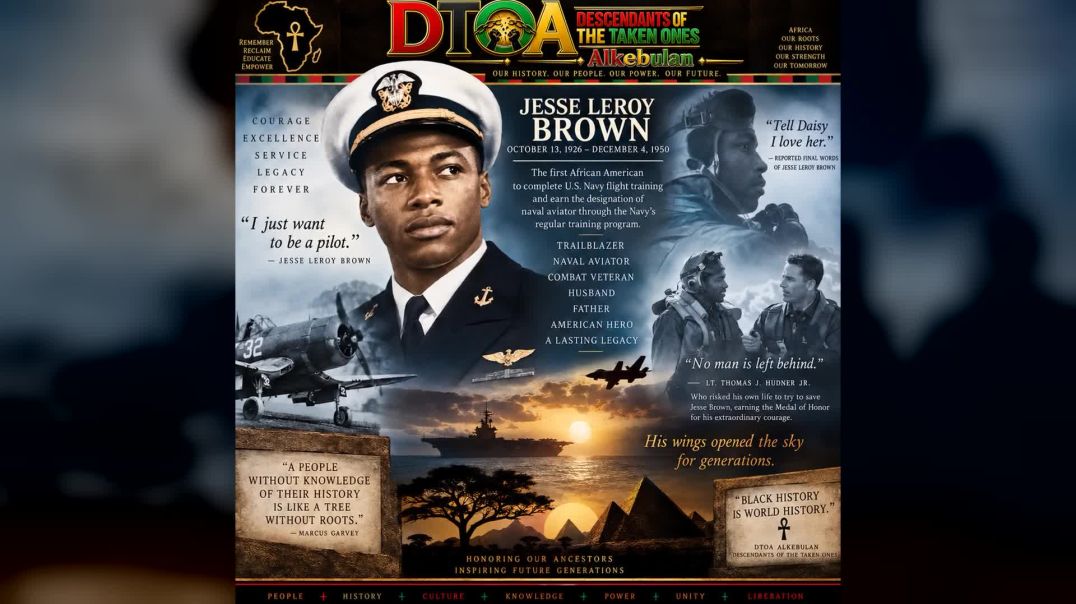
He became the first African American to complete U.S. Navy flight training and earn the designation of naval aviator through the Navy's regular training program.
He would also become the first Black U.S. Navy aviator killed in combat.
His life ended at just 24 years old, in the frozen mountains of North Korea.
And the extraordinary attempt by a white fellow pilot to save him would become one of the most recognized stories of loyalty and sacrifice in American military history.
1. Childhood: A Dream Born in Segregated Mississippi
Jesse Leroy Brown was born October 13, 1926, in Hattiesburg, Mississippi.
He was one of six children in a working-class Black family. His father worked multiple jobs, including sharecropping and factory labor.
Growing up in the Jim Crow South, Brown experienced the racial restrictions that defined everyday life for millions of African Americans.
But he had a fascination with airplanes.
After attending an air show with his father, he developed a dream of becoming a pilot.
It was an extraordinary ambition for a Black child in Mississippi during the 1930s.
Black Americans faced systematic exclusion from many aviation training opportunities, and the U.S. military had long maintained racially segregated institutions.
Brown refused to let those limitations determine his future.
National Air and Space Museum
2. Education: The Young Man Who Would Not Give Up
Brown was a gifted student, particularly in mathematics.
He attended segregated schools in Mississippi and graduated near the top of his high school class.
His academic ambitions eventually carried him to Ohio State University, where he enrolled in 1944 to study architectural engineering.
But attending college was financially difficult.
Brown worked demanding jobs to support himself, including unloading railroad boxcars.
He also faced racial prejudice at a university where very few Black students had access to the opportunities available to white students.
Yet he persisted.
He recognized that military aviation might offer a route toward his childhood dream.
In 1946, he joined the Naval Reserve and entered the pathway toward flight training.
National Air and Space Museum
3. October 21, 1948: Breaking the Naval Aviation Color Barrier
For years, naval aviation had been overwhelmingly reserved for white men.
Brown entered flight training knowing that his every accomplishment would be scrutinized.
He encountered racial discrimination, including instructors who questioned his place in the program.
He had to demonstrate the technical knowledge, discipline, physical ability, and flying skills required of every naval aviator while facing additional prejudice.
On October 21, 1948, he achieved his dream.
Jesse Leroy Brown earned his Navy wings of gold.
He became the first African American to complete the Navy's standard pilot training program and receive the naval aviator designation.
Historical research indicates an earlier Black naval aviator, Oscar Holmes, may have qualified through a different route, but Brown's breakthrough in the regular Navy flight training program remains firmly established.
In April 1949, Brown received his commission as an ensign.
He had accomplished what segregation had once made seem impossible.
Naval History and Heritage Command
4. A Husband, Father, and Fighter Pilot
Beyond the military uniform, Brown was a husband and father.
He married his sweetheart, Daisy Pearl Nix, in 1947 while undergoing flight training.
Because aviation cadets were prohibited from marrying during training, they initially kept their marriage secret.
Their daughter, Pamela Elise, was born in December 1948.
For Brown, his achievements carried a personal responsibility.
He was building a future for his family while opening doors for other Black Americans.
He joined Fighter Squadron 32, flying the powerful Vought F4U Corsair fighter aircraft.
Then, in June 1950, war erupted on the Korean Peninsula.
Naval History and Heritage Command
5. The Korean War: The First Black Naval Aviator in Combat
navytimes.com
Brown served aboard the aircraft carrier USS Leyte (CV-32).
In October 1950, he flew his first combat mission over North Korea.
He participated in dangerous missions supporting United Nations forces, attacking enemy targets and providing assistance to American troops.
The Corsair was a formidable aircraft, but flying it into combat over hostile territory meant risking antiaircraft fire, mechanical failures, and capture.
Brown completed 20 combat missions during the Korean War.
His service was particularly important because it came just two years after President Harry Truman issued Executive Order 9981, directing equality of treatment and opportunity in the armed forces.
Brown was helping demonstrate what Black military personnel could accomplish when given the opportunity to serve.
Naval History and Heritage Command
6. December 4, 1950: The Final Flight
On December 4, 1950, Brown participated in a mission near the Chosin Reservoir in North Korea.
American Marines were engaged in desperate fighting against Chinese forces in mountainous terrain during an exceptionally harsh winter.
Temperatures were dangerously below freezing.
Brown and his fellow pilots flew missions in support of the troops below.
During the flight, Brown's Corsair suffered damage, apparently from enemy ground fire.
His aircraft began losing power.
He attempted an emergency landing on a snow-covered mountainside behind enemy lines.
Brown survived the crash.
But he was trapped inside the wreckage.
His leg had been crushed beneath the damaged aircraft.
He could not escape.
And the freezing temperature threatened to kill him before help could arrive.
Naval History and Heritage Command
7. Thomas Hudner: The White Pilot Who Refused to Abandon His Black Wingman
aarp.org
Flying nearby was Lieutenant Junior Grade Thomas J. Hudner Jr., a white naval aviator from Massachusetts.
Hudner could see Brown's damaged aircraft on the mountainside.
He realized that Brown was alive but unable to escape.
At that moment, Hudner faced an extraordinary decision.
He could remain airborne and hope rescue personnel reached Brown in time.
Or he could risk his own life by deliberately crash-landing his Corsair near the wreckage.
Hudner chose to land.
He intentionally brought his aircraft down on the frozen mountainside, then struggled through deep snow to reach Brown.
He found his fellow pilot badly injured and pinned inside the cockpit.
Hudner tried desperately to free him.
A rescue helicopter eventually arrived, bringing additional help.
But the men could not release Brown from the wreckage.
The cold intensified.
Daylight was disappearing.
And enemy forces remained nearby.
Despite their efforts, rescuers were forced to leave.
Brown died from his injuries.
He was only 24 years old.
Naval History and Heritage Command
8. The Final Words of Jesse Leroy Brown
Accounts of Brown's final moments describe him asking Hudner to convey his love to his wife, Daisy.
One widely repeated version of his last message is:
"Tell Daisy I love her."
The precise wording varies among retellings, but the message captures the tragedy of the moment.
A young husband and father who had overcome extraordinary barriers to become a military pilot would never return home to his family.
His remains could not be recovered from the remote crash site.
Decades later, Hudner continued seeking a way to bring his friend home.
9. Recognition: Two Men, Two Different Honors
Following his death, Brown was awarded the Distinguished Flying Cross, the Air Medal, and the Purple Heart.
His military service was recognized for courage, achievement, and sacrifice.
Hudner received the Medal of Honor for deliberately risking his life in an attempt to rescue Brown.
On April 13, 1951, President Harry Truman presented Hudner with the Medal of Honor at the White House.
Brown was not awarded the Medal of Honor. His service and sacrifice were recognized through his own posthumous decorations.
Their story became an extraordinary example of military fellowship across the racial boundaries that had shaped American society.
Hudner's actions did not erase the racism Black military personnel encountered.
But they demonstrated that personal courage and loyalty could transcend those divisions.
Naval History and Heritage Command
10. The Navy Ship That Carried His Name
In 1972, the Navy launched the USS Jesse L. Brown (DE-1089), a destroyer escort later reclassified as a frigate.
His widow, Daisy, served as the ship's sponsor.
The naming of a United States warship in his honor represented an enduring tribute to his contribution to naval aviation.
In 2013, at age 88, Hudner returned to North Korea in an unsuccessful attempt to locate Brown's remains.
Hudner died in 2017.
Their friendship, military service, and sacrifice inspired Adam Makos's book Devotion: An Epic Story of Heroism, Friendship, and Sacrifice and the 2022 film Devotion.
The film introduced many viewers to a man whose story had remained unfamiliar outside military history circles.
Naval History and Heritage Command
11. Descendants of the Taken Ones. Perspective: Remember the Man, Not Just the Rescue
Jesse Leroy Brown's history is sometimes told primarily through the actions of Thomas Hudner.
Hudner's bravery deserves recognition.
But Brown's accomplishments began long before his final flight.
Before Hudner became a Medal of Honor recipient, Brown had already challenged segregation in naval aviation.
Before the Korean War, Brown had already endured discriminatory barriers in education and military training.
Before the story of the rescue became famous, Brown had already made American military history.
He was not simply a man another pilot tried to save.
He was a trailblazer, an accomplished aviator, a husband, a father, and a combat veteran who earned his place in American history through his own determination.
That is the story that must never be overlooked.
12. Descendants of the Taken Ones. Closing Message
Jesse Leroy Brown was born into an America that restricted Black opportunity.
Yet he refused to surrender his ambitions.
He studied when education was difficult to afford.
He trained when racial prejudice threatened to end his aviation career.
He earned his wings when very few Black Americans were permitted to become military pilots.
And when his country went to war, he served.
His final mission ended in tragedy, but his legacy did not die on that frozen mountainside.
Every Black naval aviator who followed helped extend the path he opened.
Every generation that learns his story discovers another example of Black courage, technical ability, professional excellence, and military sacrifice.
Jesse Leroy Brown did not ask history for permission to fly. He earned his wings and changed history.
Remember his name.
Remember his family.
Remember his sacrifice.
And remember that the story of Black Americans in the United States military is not simply a story of exclusion.
It is also a history of achievement, service, leadership, and extraordinary courage.
Jesse Leroy Brown — October 13, 1926 – December 4, 1950.
Descendants of the Taken Ones.
Our history deserves to be remembered. Our ancestors deserve to be honored. Our achievements deserve to be told.
Historical sources: U.S. Naval History and Heritage Command, Smithsonian National Air and Space Museum, American Battle Monuments Commission, and Mississippi Department of Archives and History. Naval History and Heritage Command Thank you for your time. To support the channel. Please like, share, and subscribe, and pass this along to your family and friends. Remember: information kept to yourself is lost over time, but shared information becomes enduring knowledge. People who lose control of their history can be led to believe they never contributed anything.
Hashtags: #jesseleroybrown #dtoaalkebulan #descendantsofthetakenones #blackhistory #blackhistory365 #blackexcellence #blackmilitaryhistory #usnavy #navalaviation #koreanwar #thomashudner #chosinreservoir #forgottenheroes #blackveterans #militaryheroes #africanamericanhistory #devotion #HonorOurHeroes


















0 Comments