
201 Views· 09/25/26· Black History
How black farms and land are legally stolen: educate your family.

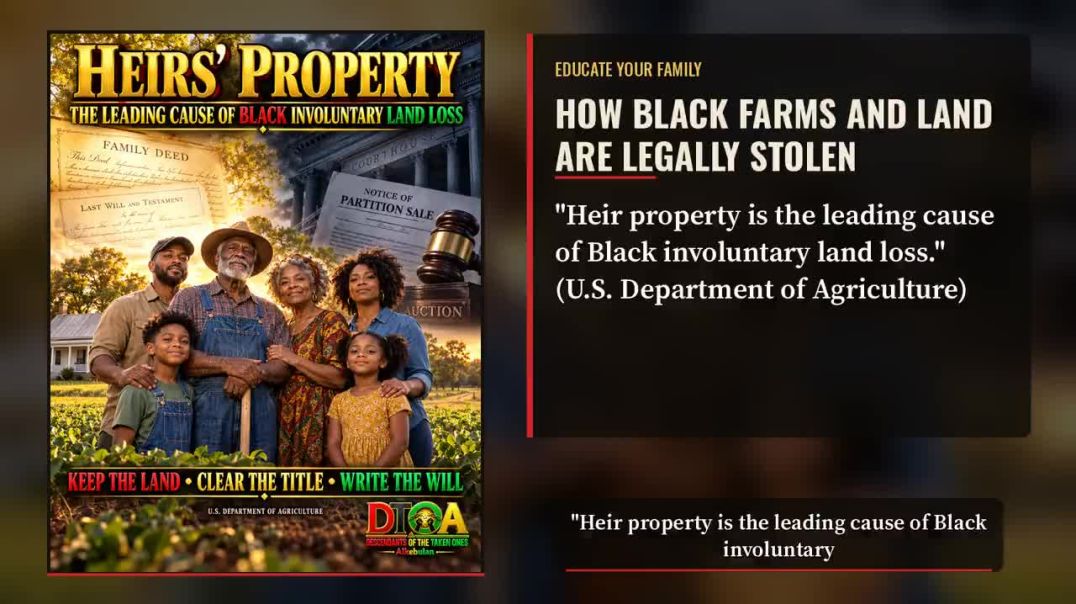
The U.S. Department of Agriculture explicitly states: “Heir property is the leading cause of Black involuntary land loss.” (fsa.usda.gov)
Heirs’ Property: How Black Families Lost Land Without Selling It
At the beginning of the 20th century, Black Americans owned millions of acres of farmland. That land represented more than property. It represented freedom from plantation labor, food security, political independence, family identity and wealth that could be passed to future generations. But much of that land was lost—not because families willingly sold it, but because the legal system made inherited Black land dangerously vulnerable.
The USDA now identifies heirs’ property as the leading cause of involuntary land loss among Black communities. (fsa.usda.gov)
What Is Heirs’ Property? Heirs’ property is land inherited by multiple family members when an owner dies without a legally enforceable will or estate plan. Instead of the property passing to one named beneficiary, ownership is divided among the deceased owner’s legal heirs. Initially, that may mean several children. After another generation, their shares pass to grandchildren. Over time, dozens—or even hundreds—of relatives may acquire fractional interests in the same property.
The family may continue living on, farming or paying taxes on the land, but the title remains clouded because ownership was never formally resolved through probate. Some heirs may not know one another. Others may have moved away decades earlier. A few may not even know they own an interest.
How the Land Becomes Vulnerable
Under traditional partition laws, a person who purchases or inherits even a small ownership interest may ask a court to divide the property. If the land cannot be physically divided conveniently, the court may order a partition sale. That means the entire family property can be sold—sometimes at an auction price far below its actual market value—even when most family members want to keep it. Speculators have exploited this weakness by locating a distant heir, purchasing that person’s small share and then petitioning the court to force the sale of the entire property.
The family members who lived on the land, maintained it and paid its taxes could lose everything. They received only their fractional portion of the sale proceeds. The purchaser obtained the land. Why Black Families Were Especially Vulnerable
After emancipation, Black families faced violence, discriminatory courts, limited access to attorneys and deep distrust of local legal systems. Many landowners never prepared wills. Some could not afford legal assistance. Others believed that simply telling their children how the land should be divided would be sufficient. In many Southern communities, Black families continued occupying and farming inherited property for generations without obtaining clear title.
That arrangement might function within the family—but it created serious legal and financial risks. Heirs’ property generally could not be used easily as collateral for a business or construction loan. Families encountered problems obtaining disaster assistance, participating in agricultural programs, managing timber or securing grants for property improvements.
USDA researchers have identified uncertain ownership, limited investment and the inability to use the property effectively as collateral as connections between heirs’ property and persistent poverty in the Black Belt South. (research.fs.usda.gov)
Land Lost Means Wealth Lost
When Black land disappeared, families lost more than acreage. They lost homes. They lost farms and timber. They lost the ability to borrow against property. They lost income that could have financed education or businesses. They lost something that could have been inherited by their children. Land that might now be worth hundreds of thousands—or millions—of dollars passed out of families through tax sales, partition proceedings, fraud, intimidation and legal technicalities.
The USDA reports that heirs’ property affects other communities as well, including Appalachian, Hispanic and Native American landowners. But its effects have been especially destructive in Black communities because it compounded an existing history of discrimination, violence and unequal access to legal protection. (research.fs.usda.gov)
Protecting the Family Land
Families can reduce the risk by:
• Preparing legally valid wills
• Creating family trusts or other appropriate ownership structures
• Opening probate after an owner’s death
• Identifying every legal heir
• Creating written agreements for taxes and property expenses
• Maintaining complete tax and ownership records
• Clearing or consolidating the title
• Obtaining independent legal advice before signing deeds or selling an ownership share
• Learning whether the state has adopted the Uniform Partition of Heirs Property Act
USDA programs now recognize heirs’ property issues and may help qualifying agricultural landowners establish eligibility using alternative documents. Its Heirs’ Property Relending Program was created to help families resolve ownership and succession problems, although assistance depends on program requirements and available lenders. (fsa.usda.gov)
The lesson is urgent:
Owning land is not enough.
The ownership must be legally protected.
A verbal promise is not an estate plan.
A tax receipt is not always clear title.
And family land without a will, probate proceeding or succession plan can become an opportunity for someone outside the family to take advantage of division within it. Black ancestors struggled to acquire land because they understood that land created independence. Protecting that land is how their descendants preserve the sacrifice.
Keep the land.
Clear the title.
Write the will.
Protect the inheritance.
Descendants of the Taken Ones
What our ancestors fought to acquire, we must be prepared to defend.
Case study What Happened in Macon County, Alabama?
Macon County contains one of the clearest documented examples of how Black families could acquire farmland, build successful communities—and then watch ownership become increasingly vulnerable through heirs’ property.
The community was called Prairie Farms.
The Government Created a Black Farming Community
During the Great Depression, the federal Resettlement Administration purchased approximately 5,770 acres in Macon County. The land was divided into family farms for Black tenant farmers and sharecroppers. Out of approximately 300 applicants, 34 Black families were initially selected.
Each family received:
• A newly constructed four-room house
• A barn, smokehouse, well and sanitary facilities
• Approximately 40 to 90 acres
• A mule team, livestock and farming equipment
• A long-term lease with an eventual opportunity to purchase the farm
The program remained segregated: white families were settled at the nearby Hillside community, while Black families were assigned to Prairie Farms.
Prairie Farms Became Successful
The families established a school, community store, cooperative association and health clinic. They raised crops, livestock and poultry and sold milk through a cooperative creamery. Prairie Farms became one of the more successful federal resettlement communities. Families began paying for their farms ahead of schedule.
By 1944, ownership of the individual farms had been transferred to the residents. The community had paid the federal government approximately $76,280 in principal and interest—about $1.3 million when adjusted to the study’s 2019 value.
These families were not given free land.
They purchased it.
The Problem Began After the Original Owners Died
Many of the original landowners died without wills.
Under Alabama inheritance law, their interests passed collectively to their children. When those children died, their shares passed to grandchildren and later generations. One farm that originally belonged to a single couple could eventually have dozens of owners.
The USDA Forest Service study examined 15 Prairie Farms families:
• Most had retained between 35 and 103 acres
• Some properties had remained in the families for three generations
• One family’s property had been divided into approximately 80 separate ownership shares
Many heirs had moved to cities such as Detroit, Cleveland and New York. Some did not know the relatives with whom they shared ownership. Others did not know they owned part of the property at all.
Ownership Became Too Divided to Manage
Because no single heir held clear title, families faced serious problems:
• No individual could easily obtain a conventional mortgage
• The land could not readily be used as collateral
• Families could be excluded from USDA agricultural programs
• Repairs and improvements became difficult to finance
• Heirs disagreed about taxes, timber harvesting and land use
• One heir could sell an interest to an outsider
• A co-owner or outside purchaser could seek a partition sale
Tax payments also became a source of conflict. Some relatives believed that paying taxes gave them exclusive ownership, but the USDA study explains that paying taxes alone generally did not extinguish the legal interests of the other heirs.
The Community Began to Decline
The decline of farming, disappearance of local agricultural markets and migration of younger generations weakened Prairie Farms.
Families stopped farming much of the land. Houses deteriorated. Some land became overgrown or was used informally for dumping. Properties located near valuable roads or commercial development became especially vulnerable to outside buyers.
A related examination of Macon County partition cases documented forced property sales between 2001 and 2005, showing that heirs’ property was not merely a theoretical risk.
However, Prairie Farms was not wiped out by a single mass seizure. The documented story is more complicated: some land was lost or sold, some became difficult to use, and some remained in the founding families' hands despite fractured titles.
Some Families Protected Their Land
The study identified Prairie Farms families that successfully retained their property by:
• Preparing wills
• Creating trusts
• Consolidating ownership
• Requiring relatives to offer shares to the family before selling outside it
• Holding regular family meetings
• Assigning responsibility for taxes and maintenance
• Working cooperatively rather than claiming individual control
One family transferred its land into a trust specifically to protect it from outside purchase. Another developed a written agreement requiring any heir wishing to sell to offer the interest to relatives first.
The Lesson of Prairie Farms
Prairie Farms proves that Black land loss cannot always be explained by families “failing” to work or pay for their property.
These families:
• Farmed the land successfully
• Created cooperatives and community institutions
• Repaid the federal government
• Received legal ownership
• Passed the property to their descendants
The danger emerged because inheritance without effective estate planning fragmented ownership across generations.
The USDA study concluded that heirs’ property had become one of the principal threats to Prairie Farms’ survival. Residents later organized a symposium to educate families about wills, trusts, cooperatives and other tools for keeping the land intact.
Prairie Farms was built by Black farmers.
It was paid for by Black farmers.
The challenge now is ensuring that the land those farmers purchased remains with their descendants.
Keep the land. Clear the title. Write the will.
Thank you for your time. To support the channel. Please like, share, and subscribe, and pass this along to your family and friends. Remember: information kept to yourself is lost over time, but shared information becomes enduring knowledge. People who lose control of their history can be led to believe they never contributed anything.



















2 Comments
cliprize
13 days agoJOSEPH ELISHA
20 days ago