
272 Views· 09/29/26· Black History
Howard University: The Mecca of Black Excellence
Howard University: The Mecca of Black Excellence
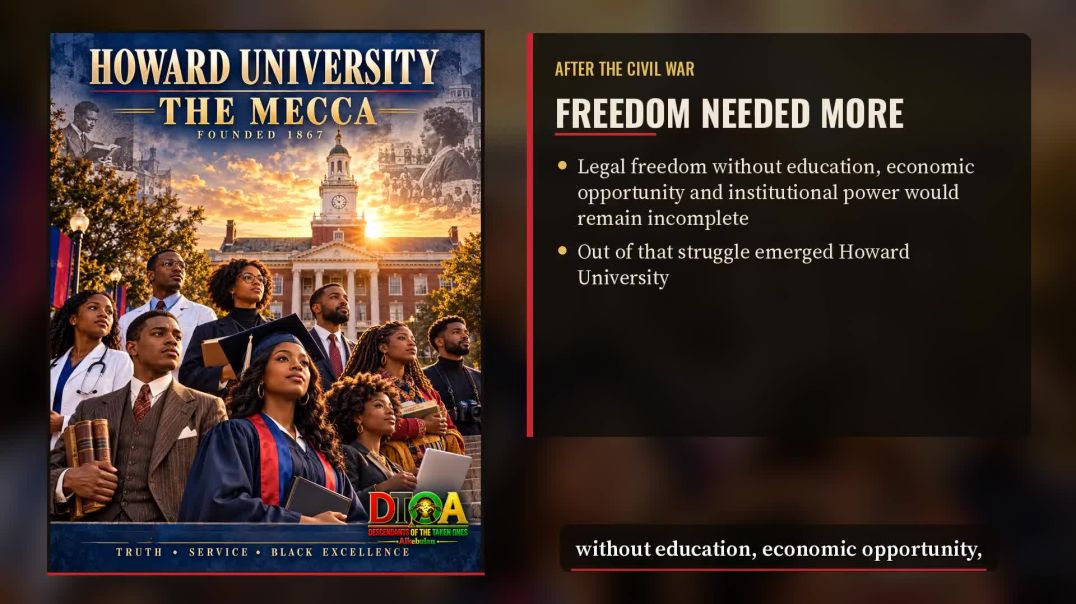
In the aftermath of the Civil War, formerly enslaved people understood that legal freedom without education, economic opportunity, and institutional power would remain incomplete. Out of that struggle emerged Howard University. On March 2, 1867, President Andrew Johnson signed the congressional charter establishing Howard University in Washington, D.C. The university was named for General Oliver Otis Howard, a Civil War officer who served as commissioner of the Freedmen’s Bureau and became one of the institution’s founders. (medicine.howard.edu) Howard was established as a coeducational institution with departments devoted to preparatory education, college studies, theology, medicine, law, and agriculture. At a time when most American universities either excluded Black students or treated them as intellectually inferior, Howard opened a pathway into the professions. It trained Black doctors when Black patients were routinely denied proper medical treatment. It trained attorneys when the American legal system enforced segregation. It trained educators when teaching Black people had recently been punishable in parts of the country. It prepared ministers, scientists, artists, engineers, diplomats, and political leaders for a nation that was not prepared to recognize their full humanity. The University That Trained the Legal Army Howard University’s School of Law became one of the most important institutions in the campaign to dismantle Jim Crow. In 1929, Charles Hamilton Houston became vice dean of the law school. He transformed it from a part-time evening program into a rigorous, accredited institution dedicated to producing lawyers capable of challenging racial injustice. Houston believed that a lawyer must be a social engineer—trained to use the law to improve the conditions of oppressed communities.
One of his students was Thurgood Marshall, who graduated first in his class. Houston, Marshall, and other Howard-trained attorneys developed a legal strategy that challenged segregation case by case. Their work helped produce the Supreme Court’s landmark 1954 decision in Brown v. Board of Education, which declared state-mandated segregation in public schools unconstitutional (nps.gov). Before the marches captured national attention, Howard lawyers were studying discriminatory laws, documenting inequality, and building the legal foundation for the modern Civil Rights Movement. Howard was not simply teaching the law. Howard was training the people who would change it. Howard became known as “The Mecca” because generations of Black scholars, artists, activists, and professionals traveled there from across America and throughout the African diaspora. Its classrooms and campus brought together students whose families came from the rural South, northern cities, the Caribbean, and nations throughout Africa. At Howard, Black history was not treated as a footnote. Black intelligence was not considered unusual. It was expected. Howard’s legacy includes figures such as Thurgood Marshall, Toni Morrison, Zora Neale Hurston, Dr. Charles Drew, Dr. Mordecai Wyatt Johnson, Paul Laurence Dunbar, Debbie Allen, Phylicia Rashad, Chadwick Boseman, and Kamala Harris. Their achievements spanned law, medicine, literature, theater, government, education, and the arts. Howard’s motto is Veritas et Utilitas—Truth and Service.
Those words capture the institution’s broader purpose. Howard University was founded to educate people, but education was never meant to end with personal advancement. Knowledge was meant to become service. Professional achievement was meant to strengthen the community. Leadership was meant to confront injustice. Since 1867, Howard has awarded more than 100,000 degrees and grown into a major private, historically Black research university. (howard.edu) Its historic buildings—including Founders Library, Frederick Douglass Memorial Hall and Andrew Rankin Memorial Chapel—stand as monuments to the generations who studied, organized and prepared for service within their walls. But Howard’s greatest monument is not built of brick or stone. It is the living legacy of the people Howard sent into courtrooms, hospitals, laboratories, classrooms, newsrooms, boardrooms, theaters and public office. Howard University demonstrates what Black people create when given the opportunity to develop their own intellectual power. It did not merely produce graduates.
It produced generations of leaders prepared to challenge and transform America and to serve the world.
Howard University—The Mecca. Founded in 1867. Built upon truth. Committed to service. A monument to Black intelligence and possibility. Descendants of the Taken Ones Honoring the institutions that transformed education into liberation. Thank you for your time. To support the channel. Please like, share, and subscribe, and pass this along to your family and friends. Remember: information kept to yourself is lost over time, but shared information becomes enduring knowledge. People who lose control of their history can be led to believe they never contributed anything.



1 Comments
cliprize
17 days ago