

78 Views· 09/22/26· Black History
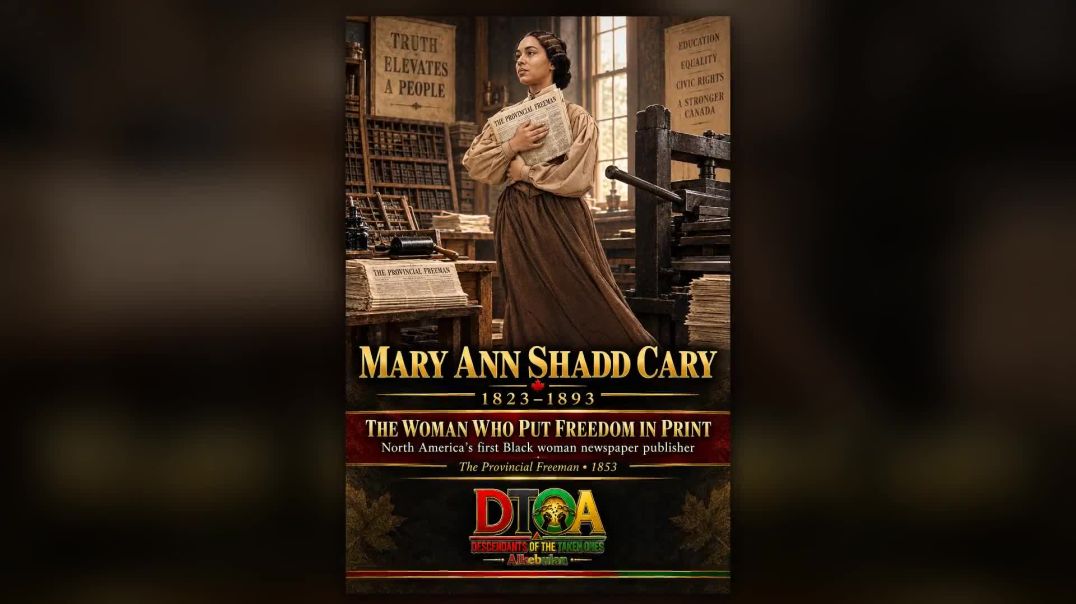
MARY ANN SHADD CARY — THE BLACK WOMAN WHO PUT FREEDOM IN PRINT

MARY ANN SHADD CARY — THE BLACK WOMAN WHO PUT FREEDOM IN PRINT
DTOA — Descendants of the Taken Ones
Before radio, television, or social media, newspapers shaped what people knew—and whose voices they heard. Mary Ann Shadd Cary wielded that power to challenge slavery, defend Black independence, and demand equality.
Born October 9, 1823, in Wilmington, Delaware, she grew up in a free Black family committed to abolition. Her parents helped people escapeMARY ANN SHADD CARY — THE BLACK WOMAN WHO PUT FREEDOM IN PRINT
DTOA — Descendants of the Taken Ones
Before radio, television, or social media, newspapers helped shape what people knew—and whose voices they heard.
Mary Ann Shadd Cary used that power to challenge slavery, defend Black independence, and demand equality.
Born October 9, 1823, in Wilmington, Delaware, she grew up in a free Black family committed to abolition. Her parents helped people escaping slavery through the Underground Railroad. Freedom was a responsibility practiced inside her family’s home. The Canadian Encyclopedia
After the United States passed the Fugitive Slave Act of 1850, the danger intensified for freedom seekers and those assisting them. Shadd moved to Canada in 1851, joining Black Americans seeking greater security beyond the reach of American slavery.
In Windsor, in present-day Ontario, she opened a racially integrated school. Education was central to her work: children needed the knowledge and skills to build independent lives. Government of Canada
Then she took her message to the printing press.
In 1853, Shadd helped establish The Provincial Freeman, becoming the first Black woman in North America to publish and edit a newspaper.
Its pages challenged slavery and racial discrimination while promoting education, self-reliance, and opportunities for Black communities in Canada. She encouraged readers to consider what freedom required beyond escape: livelihoods, schooling, civic participation, and the ability to speak for themselves. The Canadian Encyclopedia
A Black woman was helping shape public debate in an era when both racism and sexism restricted who could speak with authority.
Her work crossed borders. During the American Civil War, she returned to the United States and helped recruit Black soldiers for the Union Army. Afterward, she taught in Washington, D.C., studied law at Howard University, and continued writing and organizing.
She also advocated women’s voting rights. Her vision of citizenship included Black women, whose voices were frequently marginalized even within reform movements. National Park Service
Mary Ann Shadd Cary died on June 5, 1893. She left a legacy spanning classrooms, newspapers, abolitionist organizing, and the struggle for political equality.
Her story belongs to both Black American and Black Canadian history. It reminds us that the fight for freedom travelled wherever people carried their convictions.
For DTOA, her example has particular meaning: publishing our history is a responsibility. The words we share can challenge falsehoods, preserve overlooked lives, and help another generation understand its possibilities.
Mary Ann Shadd Cary put freedom in print—and gave her community a stronger voice.
We are DTOA—Descendants of the Taken Ones. We recover overlooked stories and honor the people who made them.









1 Comments
cliprize
10 days ago