
30 Views· 10/11/26· Black History
Mary Ellen Pleasant: The Black Businesswoman Who Used Her Wealth to Fight for Freedom

Mary Ellen Pleasant: The Black Businesswoman Who Used Her Wealth to Fight for Freedom
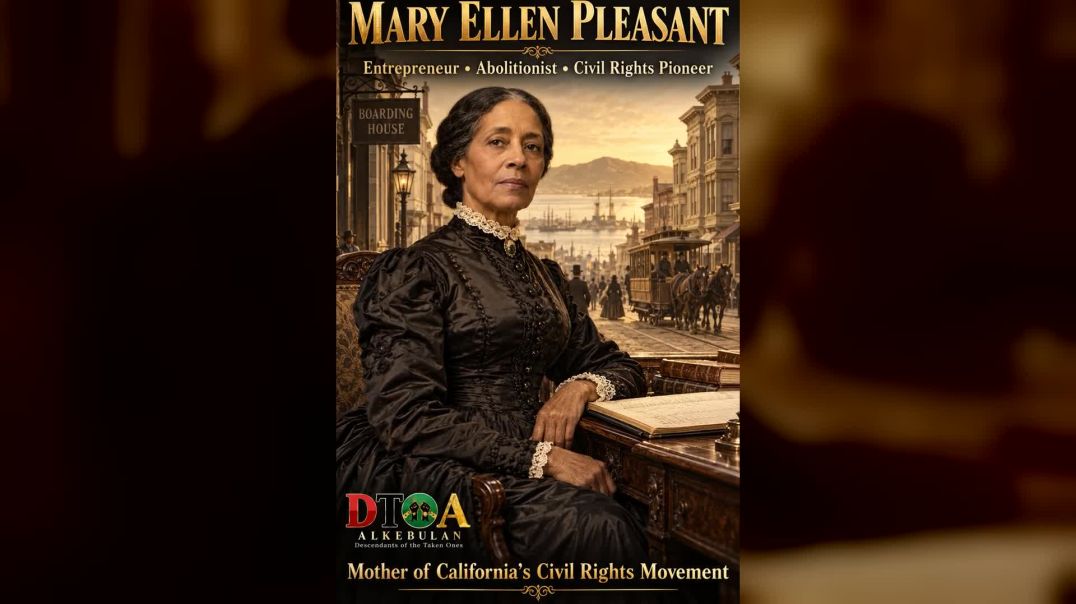
Mary Ellen Pleasant understood that money could do more than purchase comfort. It could provide shelter for someone escaping slavery, create a job for someone denied opportunity, and support a challenge to discrimination.
She became one of the most influential Black women in nineteenth-century San Francisco—a businesswoman whose financial success was intertwined with her determination to help others gain freedom. Today, she is widely remembered as the Mother of California’s Civil Rights Movement.
Her life began amid uncertainties that historians still have not fully resolved. Pleasant gave her birth date as August 19, 1814, and maintained that she was born free in Philadelphia. Other accounts place her birth in slavery in the South. These conflicting accounts make it difficult to state her birthplace, parentage, or earliest circumstances with certainty. What emerges more clearly is that she spent part of her youth in New England, including time working in a shop on Nantucket, Massachusetts. There, she gained experience with customers, commerce, and the daily operations of a business.
She later married an abolitionist named Smith, though historical accounts differ on his full name and background. Their life together connected her to the anti-slavery movement. When he died, he left her a substantial inheritance, providing the financial resources to support both her investments and her activism. She remarried in 1848, adopting the surname Pleasant. According to the National Park Service, she sailed for San Francisco in 1852, possibly to avoid retaliation for her abolitionist activities.
California’s Gold Rush offered extraordinary opportunities, but Pleasant recognized that wealth could be made by serving those searching for gold. Miners, merchants, and newcomers needed food, lodging, and clean clothing. She developed businesses to meet those needs, including boardinghouses, restaurants, and laundries, and invested in property and mining ventures.
Her work as a cook and domestic employee also placed her close to wealthy men discussing business. Accounts describe her listening carefully to their conversations and using what she learned to guide investments. People who underestimated her because she was a Black woman working in service failed to recognize the financial intelligence behind her quiet attention. She was studying opportunities and building connections in a city where access to information could determine who prospered.
Pleasant developed a long business association with Thomas Bell, a wealthy white financier. Saint Mary’s College reports that many investments were held in Bell’s name and that their combined fortune has been estimated at approximately $30 million. That figure requires care: it describes an estimated joint fortune, not a securely documented personal net worth of $30 million belonging to Pleasant before slavery ended. Her reputation as an exceptionally successful entrepreneur does not depend on treating every estimate as a verified balance sheet.
As her resources grew, so did her ability to help others. Her businesses provided employment, including opportunities for Black workers. She supported community institutions, the Black press, and a library and meeting place in San Francisco’s Athenaeum Building. Her influence extended beyond private profit to the development of a community that faced persistent exclusion.
Her abolitionist work was especially consequential because freedom on paper did not always translate into safety in practice. Accounts describe her helping people escaping slavery find protection and employment. The ACLU of Northern California identifies her as having sheltered Archy Lee, an enslaved man whose struggle to remain free became an important California legal battle. For someone in danger of being returned to bondage, assistance of that kind could change the course of an entire life.
One of the most famous stories about Pleasant concerns John Brown. Near the end of her life, she said she had helped finance his 1859 raid on the federal arsenal at Harpers Ferry, an attempt to spark an uprising against slavery.
The often-repeated claim that she gave Brown exactly $30,000 remains disputed. Her account is part of her historical legacy, but the surviving evidence does not establish every detail, and historians have questioned the donation story. The responsible way to tell it is to say that Pleasant supported Brown’s undertaking financially, while acknowledging uncertainty about the amount and circumstances.
Her battle against discrimination also took place in public, through the courts.
In 1866, a San Francisco streetcar conductor refused her passage because she was Black. Despite having built wealth and influence, she still faced racial humiliation on a routine journey. She challenged the refusal in court. Her case reached the California Supreme Court and helped establish that streetcar companies could not exclude passengers on racial grounds, although the court reversed the monetary damages awarded to her below.
That fight deserves a place in the broader history of American civil rights. Pleasant used litigation to challenge segregation decades before the twentieth-century campaigns most Americans learn about. Her case illustrates that Black Americans repeatedly demanded equal treatment long before the country was willing to provide it.
Her philanthropy reached beyond abolition and transportation. In 1892, she contributed to Saint Mary’s College as it relocated from San Francisco to Oakland and developed a new campus. She had neither attended nor worked at the college. Her donation nevertheless helped sustain an educational institution during an important transition.
Her later years were painful. After Thomas Bell died in 1892, disputes with his widow over money, property, and Pleasant’s role in the household led to the loss of much of her fortune. Her reputation was also burdened by sensational accusations. Saint Mary’s College’s account describes baseless allegations involving voodoo and murder—stories that helped turn a formidable businesswoman into a figure of scandal. Such claims warrant scrutiny, especially when repeated accounts have allowed rumor to overshadow documented achievement.
Pleasant eventually faced insolvency. She died in San Francisco on January 11, 1904, and was buried in Napa, California. The woman who had once wielded considerable financial influence ended her life with far fewer resources than she had at her peak.
At her request, her grave identified her as “a friend of John Brown.” That brief description captures the cause she wanted her memory associated with: the struggle against slavery.
For Descendants of the Taken Ones, Mary Ellen Pleasant’s story offers a powerful lesson about the uses of success. She built businesses, developed influence, and used her position to widen opportunities for others. Her life also shows how easily the achievements of a Black woman can become obscured by sensational stories, uncertain numbers, and the prejudices of those who recorded her history.
Remembering her fully means honoring the entrepreneur, the abolitionist, the philanthropist, and the woman who challenged racial exclusion in court.
Mary Ellen Pleasant understood that prosperity could carry a responsibility: to help make freedom possible for someone else. Thank you for your time. To support the channel. Please like, share, and subscribe, and pass this along to your family and friends. Remember: information kept to yourself is lost over time, but shared information becomes enduring knowledge. People who lose control of their history can be led to believe they never contributed anything.




















0 Comments