
267 Views· 09/04/26· Black History
The family lineage focused on Abram Petrovich Hannibal, his descendants, and Alexander Pushkin.
The family lineage focused on Abram Petrovich Hannibal, his descendants, and Alexander Pushkin.
Abram Petrovich Hannibal — The Bloodline That Carried into Literature
Abram Petrovich Hannibal, also spelled Gannibal, was an African-born military engineer, general, and nobleman in Imperial Russia. Taken from Africa as a child and brought into the world of Peter the Great, Hannibal rose through education, discipline, and technical skill to become one of the most remarkable African figures in European history.
But his legacy did not end with his own military career. It continued through his family line.
Abram Hannibal and his wife Christina Regina Siöberg had several children who entered Russian noble society. One of their sons, Osip Abramovich Gannibal, became the key link between Hannibal and Russia’s greatest poet. Osip had a daughter named Nadezhda Osipovna Gannibal. She later married Sergei Lvovich Pushkin. Their son was Alexander Sergeyevich Pushkin, the legendary Russian poet, novelist, and playwright. (Wikipedia)
So the direct family line is:
Abram Petrovich Hannibal
↓
Osip Abramovich Gannibal — his son
↓
Nadezhda Osipovna Gannibal Pushkina — his granddaughter
↓
Alexander Sergeyevich Pushkin — his great-grandson
Pushkin was proud of his African ancestry. He drew on Hannibal’s life in his unfinished historical novel, commonly known in English as The Moor of Peter the Great. Through Pushkin, Hannibal’s African bloodline entered the heart of Russian literature. (Wikipedia)
Poster Text Block
ABRAM PETROVICH HANNIBAL
From African Captive to Russian Noble Bloodline
Abram Petrovich Hannibal was taken from Africa as a child and brought to Russia, where Peter the Great became his godfather. Through education, military science, engineering, and discipline, Hannibal rose to become a respected general, engineer, and nobleman in Imperial Russia.
His legacy continued through his descendants. His son Osip Abramovich Gannibal became the father of Nadezhda Osipovna Gannibal, who married into the Pushkin family. Her son, Alexander Pushkin, became Russia’s greatest poet and one of the most influential writers in world literature.
Family Line:
Abram Petrovich Hannibal
→ Osip Abramovich Gannibal
→ Nadezhda Osipovna Gannibal Pushkina
→ Alexander Sergeyevich Pushkin
Abram Hannibal’s story moved from Africa to Russia, from captivity to nobility, from military engineering to literary greatness. Through his granddaughter Nadezhda and his great-grandson Alexander Pushkin, his bloodline helped shape Russian literature.
In Closing
Taken from Africa, raised in an empire, remembered through genius — Hannibal’s legacy lived on through Pushkin’s pen.
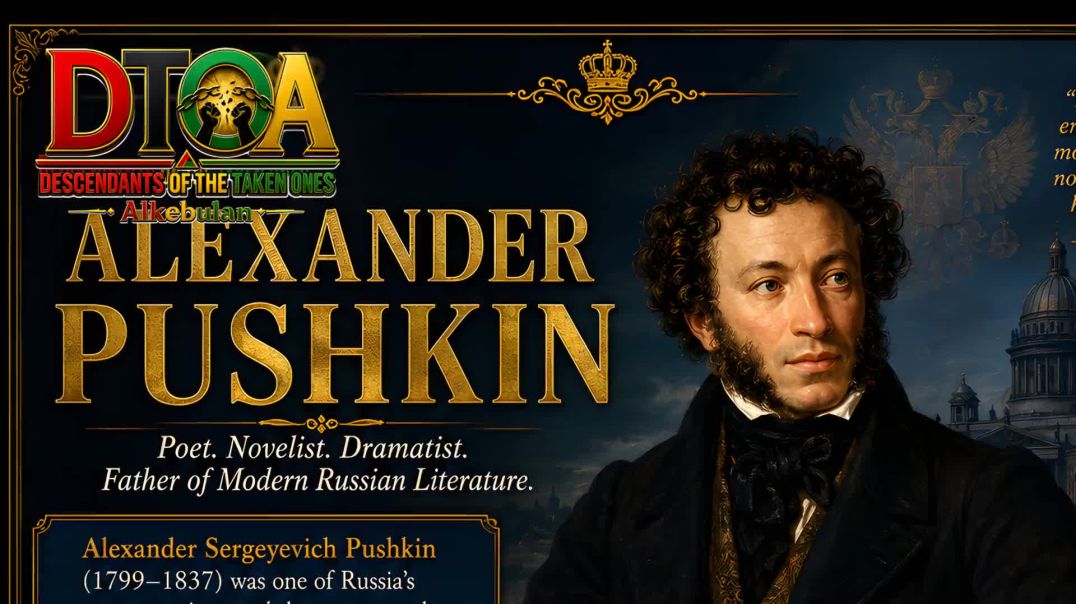
Alexander Pushkin — From African Lineage to Literary Immortality
Alexander Sergeyevich Pushkin was one of the greatest writers in Russian history and is often called the father of modern Russian literature. Born in Moscow in 1799, Pushkin came from a noble Russian family, but his bloodline carried a powerful African legacy through his great-grandfather, Abram Petrovich Hannibal.
Abram Hannibal was an African-born man taken from his homeland as a child and brought into the world of Peter the Great. Through education, military skill, and engineering genius, Hannibal rose in Imperial Russia to become a nobleman, general, and respected military engineer. That legacy passed through his son Osip Gannibal, then through his granddaughter Nadezhda Osipovna Gannibal, who became Alexander Pushkin’s mother.
Pushkin understood that his family history was not ordinary. He was proud of his African ancestry and carried that heritage into his imagination. In his unfinished work, The Moor of Peter the Great, Pushkin drew directly from the life of Abram Hannibal, turning family memory into literature.
But Pushkin’s greatness was not only in his ancestry. It was in his pen. He transformed the Russian language, bringing poetry, drama, history, romance, satire, and national identity into a new literary form. His works, including Eugene Onegin, Boris Godunov, Ruslan and Lyudmila, and The Bronze Horseman, helped shape how Russia saw itself and how the world would read Russian literature.
Pushkin lived with brilliance, passion, and conflict. He challenged authority, wrote with courage, and became a voice of artistic freedom. His life ended young, after a fatal duel in 1837, but his influence never died.
His story matters because it connects Africa, Russia, empire, memory, and literature. Through Pushkin, the African bloodline of Abram Hannibal entered the foundation of Russian literary culture. The descendant of an African-born engineer became the writer whose words helped define a nation.
Alexander Pushkin, great-grandson of Abram Petrovich Hannibal, transformed family memory, African lineage, and Russian identity into literature. Through poetry, drama, and fiction, he became the father of modern Russian literature and one of the world’s enduring literary voices.
In Closing Line
Alexander Sergeyevich Pushkin
Poet • Novelist • Dramatist, Great-Grandson of Abram Petrovich Hannibal, From African lineage to Russian literature, Pushkin turned heritage into immortality.















2 Comments
cliprize
10 days agoJOSEPH ELISHA
1 month ago