
222 Views· 10/14/26· Black History
Descendants of the Taken Ones THE TRAGIC FATE OF ELDERLY ENSLAVED WORKERS

Descendants of the Taken Ones THE TRAGIC FATE OF ELDERLY ENSLAVED WORKERS
They Stole Their Youth, Exploited Their Strength, and Abandoned Them in Old Age. Descendants of the Taken Ones | The History They Didn't Want You to Know They want you to believe that plantation owners cared for elderly enslaved Black people out of kindness, loyalty, and Christian compassion. They want you to imagine aging Black men resting peacefully on plantation porches, elderly Black women being cared for by grateful families, and enslavers lovingly providing for those who had spent their lives working the land.
But historical court petitions, plantation records, firsthand testimony, and federal government documents expose a much darker reality. Some enslavers abandoned elderly and disabled Black people when they could no longer extract profitable labor from their bodies. Others continued forcing them to work until their final years. And the evidence is so disturbing that laws were enacted to prevent enslavers from escaping responsibility for people whose labor they had exploited. This is the story of what happened when the bodies that built plantation wealth became too old to produce it.
1. When a Human Being Became an Unprofitable Investment
Under American chattel slavery, Black men, women, and children were legally treated as property. Their bodies were bought, sold, inherited, mortgaged, and used as collateral. A young, physically strong enslaved person represented decades of potential labor and financial returns. But what happened when that person reached 50, 60, or 70 years old? What happened when arthritis made it impossible to bend over cotton plants? When failing eyesight prevented them from performing assigned tasks? When injuries from years of field labor, punishment, and inadequate medical care made them unable to continue? Plantation accounting systems sometimes classified these human beings as unprofitable or useless. Research into actual plantation records shows that even people assigned these labels continued working as cooks, nurses, midwives, gardeners, and caretakers. Historian Dea H. Boster documented how enslavers categorized aging and disabled people according to their usefulness, despite continuing to extract labor from them. (RDS Journal) Think about that. A Black woman could spend her youth raising a slaveholder's children, her middle years cooking for the household, and her old age caring for another generation. And after all those decades, the plantation ledger could still classify her as useless. Her humanity was never the measure of her worth. Her ability to produce wealth for someone else was.
2. The Laws That Exposed Plantation Abandonment
Here is a part of slavery's history that deserves far more attention. American lawmakers recognized that some slaveholders tried to free, transfer, or abandon elderly and disabled enslaved people to avoid paying for their care. The legal response was not simply humanitarian. Authorities also sought to prevent impoverished formerly enslaved people from becoming dependent on public assistance.
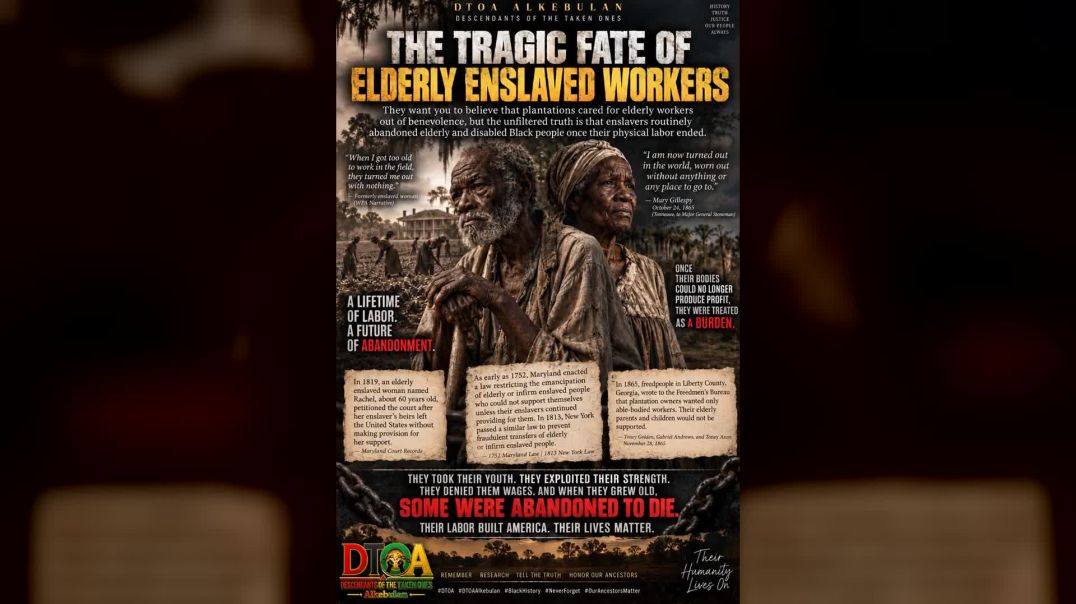
As early as 1752, Maryland enacted a law that restricted the emancipation of elderly or infirm enslaved people who could not support themselves unless their enslavers continued to provide for them. In New York, the April 9, 1813, law concerning slaves and servants prohibited fraudulent transfers of elderly or infirm enslaved people to individuals unable to support them. Violators could face a $50 penalty under the statute. These laws are strong evidence that abandonment was a recognized problem. They do not establish how frequently it occurred in every state or on every plantation. (Maryland State Archives) Ask yourself a question.
If plantation owners universally cared for elderly enslaved people out of love, why did lawmakers need to address the practice of disposing of them? The law recognized a problem that plantation mythology often concealed.
3. Rachel: An Elderly Black Woman Abandoned by the People Who Enslaved Her
In 1819, an elderly Black woman named Rachel in Maryland brought her circumstances before the courts. She had been enslaved by Daniel Dulany. After his death, his heirs left the United States for England without making adequate provision for her support. Rachel was approximately 60 years old. She had attempted to earn her living through her own labor, but advancing age left her unable to continue. Her petition described her as destitute and dependent on others for survival. She had spent years living under a system that deprived her of the financial independence needed to support herself in old age. When she needed assistance, those who inherited the benefits of her enslavement were gone. Her documented case appears in historian David S. Doddington's research on the exploitation of elderly enslaved people (Oxford Academic). Rachel's story exposes a devastating contradiction.
The slaveholding system claimed ownership of a person's labor during the most productive years of life. But when that person grew old, the supposed obligation to provide care could disappear. They claimed ownership of her labor but sought to escape responsibility for her survival.
4. Mary Gillespy: Enslaved Her Entire Life, Then Cast Out at Freedom
One of the most heartbreaking pieces of evidence dates to October 24, 1865. A formerly enslaved woman named Mary Gillespy wrote to Union Major General George Stoneman in Tennessee, desperately asking for help. She explained: "I am now turned out in the world, worn out without anything or any place to go to." Mary had spent her life enslaved by C. M. Gillespy. Now elderly, ill, and unable to work, she had been turned away without food, shelter, or the resources to survive.
She wrote that she had exhausted herself in service to her former enslaver. Her letter was forwarded to the Freedmen's Bureau, but the surviving record does not establish whether she ultimately received assistance. Freedmen and Southern Society Project
Consider the injustice. Mary's labor had benefited another household for decades. Yet when she finally became free, she had no retirement savings, no pension from her enslaver, no property accumulated over a lifetime of work, and no guaranteed place to live. Her emancipation brought legal freedom, but not economic security. Slavery had taken the years she might have used to build an independent future. Freedom arrived when her body could no longer support her.
5. In Georgia, Former Enslavers Wanted Only the Strong Workers
On November 28, 1865, a group of freedpeople from Liberty County, Georgia, wrote to the Freedmen's Bureau for assistance. The group included delegates Toney Golden, Gabriel Andrews, and Toney Axon. They explained that plantation owners wanted to hire only able-bodied workers, leaving their elderly parents and children without support. The freedpeople understood the impossible position this created. How could they return to work for former enslavers knowing that their aging mothers, fathers, and children might be left without basic necessities? They insisted they were willing to work for fair compensation but rejected arrangements that resembled the slavery they had just escaped. Freedmen and Southern Society Project
This document is especially significant because it exposes how the transition from slavery to freedom could become another economic trap. The plantation owners still wanted Black labor. They still needed Black hands to cultivate the land. But many did not want the responsibility of supporting the families who had sustained their wealth.
The strong were wanted. The elderly were treated as burdens. The children were left vulnerable. The plantation economy wanted labor without lifelong responsibility.
6. The WPA Narratives: Memories Plantation Mythology Could Not Erase
During the 1930s, the Federal Writers' Project interviewed thousands of formerly enslaved people. These testimonies, commonly called the WPA slave narratives, preserve memories of enslavement, family separation, punishment, labor, and survival. But historians also warn that the interviews must be read critically. Many formerly enslaved people were interviewed by white researchers in the Jim Crow South. Some feared retaliation for describing slavery truthfully. The Mississippi Department of Archives and History recounts the words of a formerly enslaved man, Martin Johnson, who explained that many elderly survivors were cautious about discussing their experiences openly. Another survivor, Liza McGhee, feared that white people might enslave her again. Some particularly critical Mississippi narratives were not forwarded to the Library of Congress at the time and were rediscovered decades later. 2005-02
That makes these accounts both invaluable and complex historical evidence. They do not prove that every enslaver abandoned elderly people, but they show why cheerful stories about supposedly benevolent plantation households cannot be accepted without scrutiny. The people who experienced slavery did not all remember it the way its defenders described it.
7. Even Old Age Did Not Guarantee Rest
Not every elderly enslaved person was physically expelled from a plantation. For many, old age meant a different kind of forced labor. They were reassigned to cooking, gardening, sewing, nursing infants, tending livestock, cleaning, and other tasks. Plantation records from South Carolina show elderly workers classified as less productive while still performing necessary duties. One enslaved woman, Old Betty, worked as a nurse and midwife. Old Minda was described as an accomplished midwife and nurse. Others with disabilities continued working despite being labeled unproductive. A person's inability to perform strenuous field labor did not necessarily result in retirement. (RDS Journal)
Imagine being forced to labor for 50 years, only to discover that old age offered no guarantee of peace. Imagine raising generations of children who legally belonged to someone else. Imagine cooking thousands of meals, harvesting countless crops, and watching the wealth your labor created accumulate in another family's name. And imagine being told that you were now a burden. The tragedy was not only that some elderly enslaved people were abandoned. It was that they had been denied ownership of the fruits of their labor throughout their lives.
8. Freedom Without Compensation: The Final Economic Injustice
When slavery was abolished in 1865, approximately four million enslaved people gained freedom. But emancipation did not include a universal distribution of land, wages for previously stolen labor, or retirement benefits for those who had spent their entire lives in bondage. The Freedmen's Bureau was established in March 1865 to provide assistance, including food, clothing, medical care, and support for the transition to freedom. Yet its resources and authority were limited. Land redistribution efforts were reversed in significant part under President Andrew Johnson, leaving many freedpeople economically dependent on landowners. (The Bureau ultimately closed in 1872.) National Archives. For an elderly person who had lived through decades of slavery, the consequences were particularly devastating.
Young freedpeople sometimes had opportunities to pursue education, earn wages, relocate, or establish independent households, though they faced severe discrimination and violence. Elderly freedpeople frequently had far fewer options. They had already given their prime years to people who had claimed ownership of them. They entered freedom with no compensation for that stolen labor. And many were expected to survive in an economy built on their exploitation.
9. The Myth of the Benevolent Slaveholder
Defenders of slavery often portrayed slaveholders as paternal figures. They claimed that enslaved people received lifelong protection in exchange for forced labor. Some enslavers did retain and provide for older people, and some aging enslaved people received assistance from family members and their communities. But these facts cannot erase documented cases of abandonment, neglect, continued exploitation, and forced dependence. In a study published in the Journal of Social History, historian David S. Doddington examined how slaveholders' economic self-interest encouraged the sale or abandonment of older enslaved people. His research shows that the treatment of elderly enslaved people often reflected economic calculation rather than the paternalistic promises used to defend slavery (Oxford Academic). The system offered no universal guarantee of a dignified retirement. Even where laws attempted to prohibit abandonment, they could not restore the stolen years or undo the physical damage caused by enslavement. That exposes the central deception. Providing food and shelter to someone whose freedom you have stolen is not evidence that the system is benevolent.
10. DESCENDANTS OF THE TAKEN ONES Remember the Elders Whose Labor Built America
These elderly Black men and women were not useless. They were farmers, builders, mothers, fathers, craftsmen, cooks, caregivers, and community elders. They cultivated crops that enriched generations of plantation owners. They raised families under conditions designed to deny them control over their children. They endured forced labor, violence, displacement, and economic exploitation. Yet many survived long enough to witness emancipation. Their stories remind us that slavery's injustice did not end when someone became too old to work. For some, their most vulnerable years brought abandonment. For others, freedom arrived without the resources needed to sustain it. For still others, old age meant continuing to work for people who had already taken decades of their lives. The consequences of that stolen labor extended beyond emancipation. Without land, savings, inherited wealth, or compensation, formerly enslaved families faced enormous barriers to building financial security across generations. That is why the stories of Rachel, Mary Gillespy, and the freedpeople of Liberty County deserve to be remembered.
They reveal the human cost behind plantation profits. They challenge the mythology that slavery provided lifelong security. And they remind us that human beings cannot be measured by their financial usefulness.
DTOA FINAL MESSAGE
They took their childhoods.
They exploited their youth.
They profited from their strength.
They denied them wages.
They denied them property.
They denied them the freedom to build their own futures.
When their bodies could no longer produce the profits they once did, some were abandoned by the very people who had benefited from their labor. But these elders were never worthless. Their stolen labor helped build fortunes, plantations, businesses, and generations of inherited wealth. Their names may not appear on the buildings their labor supported, and their families may never have received the fortunes their work helped create. But their lives mattered. Their sacrifices mattered. And their history deserves more than a romantic story about kind plantation owners. They were not born to be property. They were human beings whose freedom was stolen. This is why we remember. This is why we research. This is why we tell the stories others neglected.
DESCENDANTS OF THE TAKEN ONES
Our ancestors were more than their suffering. Their humanity, labor, resistance, and legacy will never be forgotten. Historical sources The narrative draws on the 1865 Mary Gillespy letter, 1865 Liberty County petition, David S. Doddington's historical research, and the Mississippi WPA slave narratives. The documented abandonment cases are real, but the sources do not establish that abandonment was universal or quantify how common roadside abandonment was. Thank you for your time. To support the channel. Please like, share, and subscribe, and pass this along to your family and friends. Remember: information kept to yourself is lost over time, but shared information becomes enduring knowledge. People who lose control of their history can be led to believe they never contributed anything.














1 Comments
JOSEPH ELISHA
1 day ago